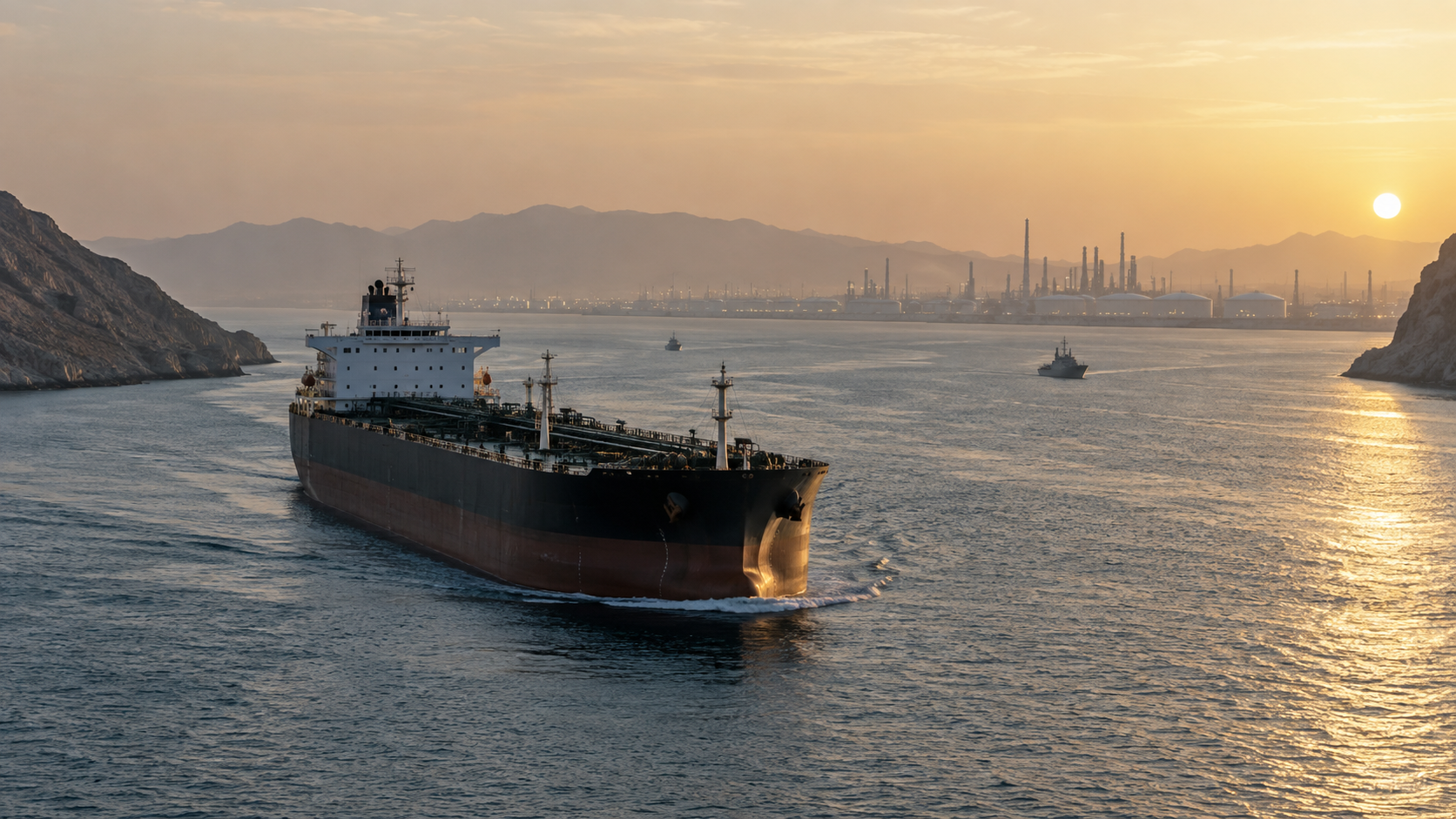
Global investors began the week confronting a familiar but increasingly serious risk: disruption to one of the world’s most important energy corridors.
Brent crude futures rose $1.03, or 1.1%, on 7 September to settle at $97.31 a barrel. The international benchmark touched $98.06 during the session, its highest level since 24 July.
US West Texas Intermediate crude was trading 1.3% higher at $92.65 in early afternoon New York trading, after reaching $93.29. WTI did not record its usual settlement because US markets were operating on a Labor Day schedule.
The move extended a substantial rally. Brent gained approximately 8% during the preceding week, while WTI rose nearly 10%, according to Reuters’ market report.
This was more than a conventional geopolitical risk premium. The latest escalation directly involved energy transportation assets and the military forces operating around the Strait of Hormuz.
Why the latest escalation matters
The United States said it struck three Iranian oil tankers after ballistic missiles were launched towards US warships. Iran subsequently intensified its warnings, including plans for a maritime exclusion zone affecting vessels attempting to transit near the strait.
The White House rejected Iran’s claim to control the route and said US forces had cleared mines from the waterway. However, the competing claims underline the uncertainty facing tanker operators, insurers and commodity traders. Associated Press reporting said the US military had redirected 94 commercial vessels and disabled three as of Monday.
Data cited by Reuters indicated that an average of only 10 commodity ships per day had crossed the Strait of Hormuz over the previous 10 days, the lowest level since May.
Individual vessel counts should be interpreted carefully because ships can operate with tracking systems switched off. Nevertheless, the direction is important: commercial traffic remains far below normal, and tanker owners face unusually difficult security and insurance calculations.
The strait carried roughly one-fifth of global oil supply before the current conflict. Disruption therefore affects much more than Iranian exports. It can obstruct or delay shipments from several Gulf producers and influence liquefied natural gas, refined products and fertiliser markets.
OPEC+ offers no immediate supply response
The supply outlook was further complicated by the latest OPEC+ decision.
Saudi Arabia, Russia, Iraq, Kuwait, Kazakhstan, Algeria and Oman met on 6 September and agreed to maintain their September production requirements during October. The countries also reiterated their commitment to comply with the wider Declaration of Cooperation.
The group will meet again on 4 October, according to the official OPEC statement.
Holding production steady does not necessarily indicate an intention to keep prices elevated. OPEC+ must balance uncertain demand, member compliance and the practical difficulty of delivering additional barrels when regional shipping routes are impaired.
It does mean, however, that investors should not assume an immediate production increase will neutralise the current risk premium.
The market implications extend beyond energy
For investors, the first-order effect is positive pricing power for producers whose output can reach customers reliably. Integrated energy companies, certain independent producers and businesses connected to alternative export routes may benefit from higher realised prices.
The second-order consequences are less favourable.
Higher crude prices increase costs for airlines, shipping groups, chemicals manufacturers and other energy-intensive industries. Refining constraints and low product inventories can also cause consumer fuel prices to rise faster than crude alone would suggest.
The macroeconomic transmission is equally important. Persistent energy inflation can slow progress on headline inflation, squeeze household purchasing power and make central-bank decisions more difficult. Policymakers may face weaker real growth at the same time as fuel costs keep inflation measures elevated.
Bond yields and rate expectations could therefore become as important to watch as energy equities. A temporary spike would have limited policy significance; a sustained disruption could alter inflation forecasts, corporate earnings assumptions and the timing of future interest-rate moves.
Import-dependent economies in Europe and Asia are especially exposed to higher delivered energy costs. The precise impact will vary with currency movements, strategic reserves, refining capacity and the availability of alternative suppliers.
Why oil eclipsed SpaceX
SpaceX remains one of the market’s most closely followed growth companies following its June public listing. But the SpaceX discussion on Monday largely revisited valuation, its post-IPO share performance and previously released quarterly results.
There was no new SpaceX catalyst with the same immediate cross-asset reach as the oil shock. Oil prices can feed rapidly into inflation expectations, sovereign bonds, currencies, transport costs and earnings forecasts across multiple sectors. That breadth made Hormuz the more consequential global finance story.
The contrast is also instructive. SpaceX represents investor appetite for long-duration technological growth. Oil represents an immediate constraint on the physical economy. When energy-security risks intensify, the latter can quickly dictate discount rates and risk appetite for the former.
What investors should watch next
The most useful indicators are operational rather than rhetorical.
First, monitor actual tanker traffic through Hormuz. A sustained reduction would provide stronger evidence of physical disruption than political statements alone.
Second, watch freight rates, marine insurance costs and regional crude-price differentials. These can reveal stress before it becomes fully visible in headline benchmark prices.
Third, follow inventory data, particularly for refined products. Reuters reported that US gasoline and distillate inventories were substantially below both year-earlier levels and five-year seasonal averages, increasing sensitivity to further disruption.
Fourth, assess whether attacks remain focused on vessels or spread more widely to export terminals, refineries and pipelines. Reports that Saudi Aramco’s Jazan refinery had been attacked were still being assessed on Monday, so the scale of any damage remained uncertain.
Finally, watch the diplomatic position of Gulf exporters and whether alternative routes can materially increase capacity.
Practical takeaway
Oil’s rise towards $100 is best understood as the price of constrained logistics and heightened uncertainty, not simply a reaction to political headlines.
Investors should distinguish between a short-lived risk premium and a persistent loss of supply. The clearest evidence will come from shipping flows, inventories, insurance markets and infrastructure availability.
The central question is no longer whether geopolitical tension can move oil. It is whether enough physical supply can reach the market to prevent the energy shock from spreading into inflation, monetary policy and global growth.