No spam - just the latest insights!
Join over 30,000 industry professionals who subscribe for free

Subscribe for free!
We'll never share your information or send you spam

Andreas Warner is member of the EY-Parthenon Leadership for Europe West and responsible for Turnaround & Restructuring Strategy. He supports companies in special situations ranging from performance improvement to restructuring. Andreas is also member of the EY Global Restructuring Leadership.
Andreas has two decades of experience in strategic operations and restructuring businesses. Combining that with his engineering background and mindset for solving the most complex of challenges, he takes pride in finding the best solutions for clients’ biggest challenges.
His career prior to EY-Parthenon includes leading operations in mid-cap firms, and once in consulting, heading up restructuring services in Germany and Central Europe. He has also led value creation services across EMEIA, deploying private equity and operational restructuring techniques to identify and deliver performance improvement with a sharp focus on delivery of cash and earnings before interest, taxes, depreciation, and amortization (EBITDA) benefits.
Andreas holds a Diploma in Engineering and a Master’s degree in Science (production management) from the Chalmers University of Technology, Sweden.

Korbinian Gennies is a Partner at EY-Parthenon’s Turnaround and Restructuring division. With more than 15 years professional experience, he is a proven expert in advising clients in challenging business environments in a wide variety of projects and across various industries. His areas of expertise include planning and executing large scale transformation programs, restructuring concepts and target operating models as well as optimizing SG&A costs.
Before joining EY-Parthenon in 2020, he held various interim management roles after starting his career in a restructuring consulting boutique in 2008.
Having worked both in consulting and management roles, Korbinian developed a pragmatic, solution-oriented and empathic approach, highly valued by his clients. Korbinian takes responsibility for EY-Parthenon’s restructuring business in Frankfurt am Main and the greater Stuttgart area, focusing mainly on automotive, retail, machinery equipment industry and real estate sector.
Korbinian holds a Diploma in International Economics and Business Administration from the University of Innsbruck, Austria.

Marius Herminghaus is a Senior Manager in the Turnaround and Restructuring practice at EY-Parthenon. With more than 8 years of professional experience, he provides clients with trusted leadership in urgent, complex and business-critical situations. He has expertise in planning and implementing complex transformation programs and new business models, as well as performance improvement and restructuring projects.
He is currently the EY Global Development Leader for Reshaping Results and Turnaround and Restructuring Strategy. In this role, he supports EY’s global leadership in shaping and executing strategic priorities on a global scale. His responsibilities include driving initiatives across multiple geographies and industries, providing strategic guidance, facilitating organizational change, and monitoring performance metrics.
Prior to joining EY, Marius gained extensive experience in restructuring and transformation at a leading global management consulting firm. He holds a Master of Science in Business Administration from the University of Muenster in Germany.

In today’s rapidly evolving business environment, business leaders are faced with the imperative of adopting transformative strategies to maintain their competitive edge. However, financing these ambitious initiatives has proven to be a formidable challenge. Once considered a reliable option, external financing has lost its luster, forcing companies to explore alternative funding options.
Moreover, the global economy is displaying signs of deceleration, which are raising concerns among both businesses and investors. According to projections by EY economists, global GDP grew by just 2.7% in 2023 – the slowest pace since 2001, excluding the global financial crisis and pandemic. The outlook for 2024 is only slightly higher at 2.9%. Most advanced economies are bracing for below-trend growth, with Europe facing localised recessions, the U.S. and Japan experiencing stagnant growth, and emerging markets on a path of moderate dynamism. Within this complex economic landscape, China faces notable downside risks, with weakening manufacturing and consumer activity taking a toll.11. Global economic outlook: finding balance in 2024 | EY – US
In this context, the prevailing sentiment among central banks in advanced economies is to maintain a “higher for longer” stance. Central bankers are closely monitoring inflation risks and leaning toward overtightening to mitigate potential inflation persistence.
In the midst of this fast-paced and dynamic business landscape, business leaders are facing a crucial stage – the need to transform their business models to stay competitive, relevant and retain the ability to secure
financing. However, traditional financing methods for these transformations, such as loans, have become increasingly costly and challenging to secure due to rising interest rates and market uncertainties. In addition, for businesses seeking to secure financing, lenders want to see ongoing transformational efforts that focus on profitability for the provision.
To surmount these financial obstacles, business leaders must shift their focus inward and explore internal performance improvement strategies to fund their business transformation, growth, and risk mitigation strategies (e.g., increasing cybersecurity threads). By aligning their financial resources, business leaders can adeptly navigate the complexities of the current economic landscape and achieve transformative growth. Strategic approaches, such as optimising working capital and reassessing capital expenditures, provide viable pathways to success. Embracing these internal financing measures empowers businesses to not only thrive amidst economic challenges but also pave the way towards a prosperous and innovative future. In this quest for financial resilience, resourcefulness and adaptability become indispensable virtues. Escalating external financing costs require a thoughtful exploration of innovative solutions. By strategically leveraging internal resources, optimising financial processes, and forging collaborative partnerships, businesses can overcome challenges and seize growth opportunities, even in the middle of a challenging economic landscape.
As part of EY CEO Outlook Pulse survey, EY teams asked approximately 1,200 executives to identify the biggest risks to their business growth.2CEO Outlook January 2024 on transformation strategy ; EY – Global; Majority of CEOs fear recession could be worse than the financial crisis | EY – Global 3. Therein, CEOs are driving business transformation in a challenging low-growth environment. Despite obstacles such as persistent inflation and higher interest rates, CEOs remain optimistic about their outlook. The main focus is on transforming the business portfolio, with 95% of CEOs planning to maintain or accelerate transformation in 2024. However, there are internal and external risks associated with this ambitious stance. Activist shareholder pressure has reached historic highs in 2023, prompting CEOs to more clearly articulate transformation plans. CEOs are proactively using internal levers, reallocating capital, and emphasizing core capabilities, with 48% seeking internal financing. Furthermore, 25% of CEOs are considering external financing, specifically through debt. Despite a positive outlook on debt market funding, CEOs remain cautious about the continued higher cost of money.
In addition to the need for transformation, executives are also realising the shift in the financing landscape. Fears of higher input prices, inflation, and prolonged high interest rates have tightened the credit market, making external financing for transformation initiatives more challenging. Corporate refinancing and highly leveraged transactions, once readily funded, now encounter difficulties, evident in the decline of loan volumes in the U.S. over the last twelve months.3Q2 US Volume Wrap: Leveraged loan issuance weak again; refinancings remain in play – PitchBook Also, the hopes of a short-term return to zero interest rate policies have been forlorn as interest rates are expected to stay higher for longer than for pre-rate-hike levels that started in March 2022.4nterest Rate Statistics | U.S. Department of the Treasury
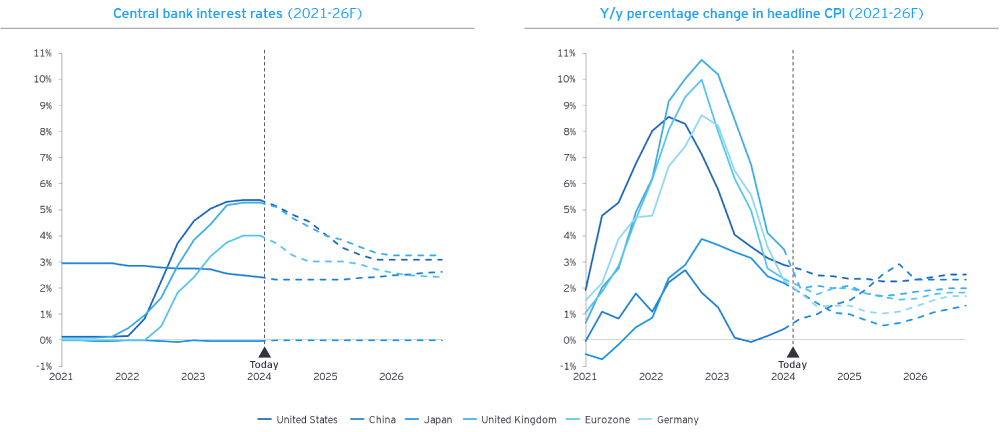
Figure 1: Interest rate and inflation projections5Oxford economics; EZB; Federal Reserve; Eurostat; EY analysis
In addition to higher interest rates, external financing continues to come under pressure6Global Financial Stability Report, April 2023: Safeguarding Financial Stability amid High Inflation and Geopolitical Risks (imf.org):
As a result, businesses should refrain from postponing transformative actions to “wait out the storm” and instead focus on finding alternative financing solutions to propel their business transformation forward. By doing so, they can mitigate the potential impact of weaker macro trends on corporate earnings and balance sheets. In fact, the results from the latest EY CEO Outlook Pulse survey reveal a striking shift in executives’ approaches, with only 5% (-32%pts. vs. Q1/2023) planning to pause or reduce transformational change, while the majority (95%) are either maintaining or accelerating their transformational efforts. Among this bold cohort, performance improvement emerges as the primary source of funding for their transformation initiatives.7CEO Outlook January 2024 on transformation strategy | EY – Global ; Majority of CEOs fear recession could be worse than the financial crisis | EY – Global
This shift in mindset reflects the evolving economic environment over the past 18 months. Previously, the focus was on growth at any cost, driven by the availability of extremely cheap money and elevated liquidity. However, the current paradigm places a premium on sustainable growth, where a clear path to profitability or value creation must be evident from the outset. Businesses are now realising the importance of securing funding through continuous performance improvement and internal resources, paving the way for a transformation built on a solid financial foundation.
As we usher in this new economic phase, it brings a unique set of challenges. Only businesses that can sustainably and efficiently operate while perpetually adjusting to future challenges will prosper. This scenario aptly illustrates the concept of “survival of the fittest.” It’s not necessarily the largest organizations that will prevail, but the most adaptable ones, those best suited to evolve and embrace change effectively, that will succeed. This requires business leaders to put the topic of continuous performance improvement as a priority on their agenda. Depending on their business model and industry sector, leaders have a variety of performance improvement levers at their disposal to navigate external financing challenges and internally finance their transformation. Approaching continuous performance improvement comprehensively and consistently, beyond merely optimising existing setups, allows businesses to effectively identify, detail, implement, and communicate the levers within their organization. This empowers them to leverage their strengths and respond appropriately to market conditions. By utilizing the right levers, financial resources are freed, enabling the redirection of capital towards high-priority strategic goals. Depending on the industry, these levers can include:
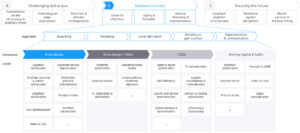
Figure 2: Continuous performance improvement levers to improve to invest8How cost take out can enable a performance mindset | EY – Global
Businesses need to conduct comprehensive cost assessments and identify areas for optimisation. Implementing cost reduction measures involves cutting the cost of goods sold, fostering workforce flexibility (e.g., through short-term work arrangements, and implementing hiring freezes or terminating fixed-term contracts) but also production efficiency. By optimising labor costs and reducing temporary workers, business leaders can redirect resources towards their transformation initiatives, improving overall performance and margins. This step is essential in improving profitability and releasing capital for reinvestment into critical areas of business operation and transformation. Herein, strategic sourcing and vendor optimisation can significantly reduce the cost of raw materials and services procured – in the case of the automotive industry this can also secure and optimise the supply chain. It involves consolidating the vendor database, leveraging volume discounts, and improving vendor relations to ensure better terms and lower costs. Portfolio optimisation helps identify low-margin or non-core products for discontinuation, thereby lowering complexity and associated direct costs. Make-or-buy decisions
allow businesses to assess if producing goods or services internally is cost-effective or if they should be sourced from external suppliers. This can lead to operational improvements, manufacturing cost reductions, and enhanced focus on core competencies. Lastly, footprint optimisation can help to achieve increased efficiency, shorter lead times, reduced costs, lower environmental impact, and a more competitive position in the market. All these levers can help improve gross margins, enabling leaders to allocate more resources toward strategic transformation. For example, the implementation of AI and automation technologies can dramatically increase production efficiencies, while optimisations of sales (pricing, claims, etc.) and salesforce productivity can offer additional potential.
Streamlining structural costs, and notably Selling, General and Administrative (SG&A) costs, is a critical step for businesses when financing their transformation. This process can improve efficiency, bolster profitability, and free up capital for growth and reinvestment in crucial aspects of operation. For example, operating model reviews can shed light on potential inefficiencies and overlapping roles, helping organizations identify areas for structural cost reduction. The implementation of AI and automation technologies can dramatically reduce manual administrative tasks, allowing leaders to reallocate resources towards innovation and strategic decision-making. Furthermore, standardization and harmonization of processes not only reduces expenses but also improves consistency and efficiency, fostering better collaboration and transparency. Lastly, business leaders should also focus on optimising cash and cash-equivalents by evaluating the possibility of tax optimisations and implementing prudent cost-saving measures such as travel bans and spend freezes. Redirecting funds towards essential items ensures business continuity and creates a cash buffer for transformation efforts. Through these levers, businesses can make significant strides in their transformation journey, financed by cost savings derived from a streamlined SG&A function.
Efficient working capital management is crucial for internal financing. Businesses can generate cash through the reduction of inventory, which can be achieved by optimising supply chain strategies, logistics and sourcing models. In addition, selling slow-moving inventory can free up valuable capital. Finally, reducing outstanding invoices by implementing robust receivables collection processes enhances cash flow and provides the necessary funds for transformation initiatives. In addition, to maximize internal
resources for financing transformation, businesses should evaluate existing projects and identify non-core low-priority investments and assets. By allocation of CapEx or disposal of non-core assets, businesses can make efficient use of their resources and free up additional cash for business transformation. Exploring alternative investment models, equipment sharing, or outsourcing certain functions, can also provide cost savings and flexibility, reducing the need for significant upfront capital expenditures.
“ Based on the project experience, it has been seen that executives are recognizing the urgency to implement continuous holistic performance improvement programs, citing overall cost reductions, as well as optimising working capital and capital expenditures as key priorities for their businesses.”
Achieving sustainable and transformative growth requires a customised and ongoing strategy for performance improvement that is tailored to each industry. By concentrating on enhancing gross margins and optimising SG&A, businesses can effectively manage complexity and operational overlap to unlock synergies. Figure 3 (overleaf) provides a practical example of this approach, highlighting the key performance improvement drivers across different industry sectors.
To implement these performance improvement levers, it is necessary to address operational, compliance, and capital investment challenges. Operational hurdles, such as lead times and inventory, require significant time and financial investments. The next set of obstacles are compliance and quality considerations, including testing and qualification, which ensure adherence to standards and regulations. The third category, capital investment, involves securing contracts, upskilling employees, and investing in technology for cost reduction.
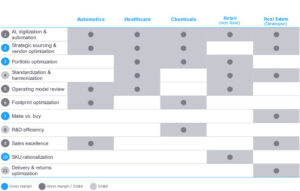
Figure 3: Exemplary key performance improvement levers of improve to invest concepts by industry sector
Considering these barriers, companies are recognizing the central role of operating model design in financing transformation initiatives. By strategically structuring and optimising operating models, companies can achieve cost savings, revenue growth, and improved financial performance. This, in turn, strengthens their ability to finance transformation projects. In addition to operational streamlining, redesigning the business model promotes a culture of innovation and adaptability that is crucial for managing the complexity of today’s business landscape.
“Operating model redesign is not merely a blueprint but serves as the financial guide to transformation. Each strategic adjustment becomes a means of exchange, unlocking resources to fuel the journey towards financing the future.”
It requires careful planning, a commitment to change, and strategic resource investment. Key strategies include transparent communication, collaborative data sharing, evidence-based decision-making, and coordinated incentives among stakeholders. These efforts align objectives, provide uniform data access, and foster successful and continuous performance improvement. By prioritizing these factors, business leaders can enhance their potential for sustainable, long-term cost reductions.
In conclusion, with high interest rates posing challenges in external financing, business leaders face the imperative of implementing improve to invest concepts containing a holistic package of continuous performance improvement measures tailored to the business situation. With these internal performance improvement levers, leaders can execute strategic cost reductions, efficient working capital management, and optimised cash resources to unlock growth potential and foster resilience in the global economy. Success lies in effectively managing complexity and adopting a holistic internal transformation strategy, securing a competitive edge in the market both now and in the future.