No spam - just the latest insights!
Join over 30,000 industry professionals who subscribe for free

Subscribe for free!
We'll never share your information or send you spam

Pierfrancesco Anglani is an assurance Partner in the banking and capital markets practice at PwC Milan. Pierfrancesco is chartered accountant, member of the
Financial Services Technical Commission of Assirevi (the Italian audit firms association) and member of various national and international banking working groups.
Pierfrancesco has been with the firm since 1994 and has an extensive experience in providing audit services to primary national and international banks and financial
institutions.
Pierfrancesco Anglani is also involved in a number of nonaudit assurance engagements including due diligences, credit risk management, control assurance engagements and regulatory services.

Gabriele is partner in PwC Italy Financial Services. He is the reference point for regulatory strategy topics and is expert in structuring, transactions, strategic evolutions and sustainable finance.
Prior to becoming part of PwC, Gabriele worked for the Bank of Italy Supervisory Division, where he was involved in on-site and off-site supervisory activities. He has been a university professor in economics and has a previous experience in a major consulting company.
In PwC Gabriele is mainly focused on regulatory and strategic evolutions and on the structural changes of the banking sector. Moreover, he has followed many
transactions as advisor with particular focus on structuring and regulatory strategy.

Pier Paolo Masenza is PwC Italy Financial Services Strategy & Value Creation leader and EMEA Value Creation Leader. He has more than 30 years experience and has been a partner with PwC since 2003. He has an extensive knowledge in M&A, due diligence, and restructuring Services where he has served a wide
range of Italian and International Corporates, Banks and Investors, both on the buy and sell side, and as financial and industrial advisor.
Pier Paolo has a consolidated experience in Banks, NPL, Corporate Investment Banking, Asset Management and Real Estate. Recently he played an active role in the NPL debate and the implementation of the ECB guidelines in the NPL framework.
Author of numerous studies and publications in the banking and financial field (Sole 24 Ore and Milano Finanza) and chief editor of PwC periodic publication on NPL, as well as active participations, as a speaker, in technical conferences organized by leading associations and study centers (ABI, AREL, etc.).
He holds a bachelor degree summa cum laude in a Business Administration from the University “La Sapienza” in and is a fellow of the Italian Chartered Association of Certified Accountants and a registered auditor

Over the past ten years, the nature and structure of the Italian banking sector have undergone significant changes and developments. These transformations have been driven by a combination of regulatory reforms, economic challenges (including the COVID 19 pandemic) and advancements in technology.
Starting from 2014, supervision of Italian banks shifted from the Bank of Italy to the European Central Bank (ECB), with drastic changes in the supervisory approach. Firstly, the ECB pushed for a significant reduction in non-performing loans: from 2008 to 2015, banks’ non-performing loans grew from €85 billion to €341 billion (of which €200 billion were bad loans). Following a deep deleveraging process, aided by state instruments such as GACS (the Italian acronym of Guarantee on Securitisation of Bad Loans) and systemic operations, gross bad loans now amount to approximately €21 billion, while the total of non-performing loans stands at €56 billion. Consequently, the Gross NPE Ratio of significant banks plummeted from 17.0% in 2014 to 2.4% in June 2023 [dedicated focus below].
Simultaneously, Italian banks underwent a substantial capital strengthening. From 2014 to June 2023, significant banks improved their CET1 ratio from 11.1% to 15.8%. In 2023, capitalisation is poised to see further enhancement with the introduction of the Italian Windfall Tax for Banks (Law Decree n°104). In accordance with the law mechanism, the majority of banks have chosen to sidestep the government’s newly imposed windfall tax on additional profits by electing to allocate 2.5 times the amount of the tax due to a non-distributable reserve. Furthermore, capital profitability has risen to levels not seen since before the global financial crisis, driven by interest income and a decrease in credit provisions (Return of Equity of significant banks up to 13.9% in 1H 2023).

Over the last ten years mergers and aggregations, in some cases necessary to avoid failures, led to a significant simplification or rationalisation of the sector.
This process was also determined by some reforms and legislative proceedings which intervened in reforming the market structure. The Legislative Decree No. 3 of 2015 mandated the transformation into joint-stock companies for cooperative banks with assets exceeding 8 billion euros. The Legislative Decree of February 14, 2016, No. 18 reformed cooperative credit banks, (totalling 226 banks by the end of 2022), obliging them to choose membership in one of the nationally relevant banking groups (ICCREA and Cassa Centrale Banca) or in the Raiffeisen Südtirol IPS.
This consolidation has also resulted in the creation of larger and more robust banking institutions capable of withstanding economic shocks and better serving their customers.
In the course of this consolidation process, the size gap between the two largest Italian banking groups (Intesa Sanpaolo and UniCredit) and the rest of the market increased. Over the temporal span extending from 2014 to 1H 2023, the total asset ratio between the second and third market operators rose from 3.5x to 4.2x.
Furthermore, there has been a shift in the distribution model, with the number of bank branches dropping below 21,000 (a decrease of 32% compared to 2014).
In the last decade, approximately 10,000 branches have been closed, with approximately more than 50% of these closures occurring in the last 5 years. Similarly, the number of bank employees has decreased to 264,000, marking a 13% reduction from 2014.
Aligned with the evolution of the distribution network, Italian banks’ offerings have progressively embraced digitalisation. In recent years, technological innovation has played a pivotal role in reshaping the global banking system, a transformation that was underway even before the onset of the Covid-19 pandemic. The pandemic underscored the importance of digital transformation, ensuring seamless access to financial services for bank customers.
As per ABI’s 2022 report, the overall use of Internet banking in Italy, whether for informational or transactional purposes, continues to strengthen. Nearly two out of three customers, totalling 20 million bank users, are now actively engaging with digital banking services. Despite this positive trend, international statistics reveal that Italy still lags behind other European countries in terms of both customer adoption of digital financial services and the level of FinTech investments.
Furthermore, the size of banks plays a crucial role in driving these innovations forward. Given the substantial initial investments and the requirement for highly skilled employees, digitalisation and the diffusion of emerging technologies tend to be more pronounced among significant banks compared to their less substantial counterparts.
In 2022, the Italian banking sector recorded extremely positive performance in terms of profitability, which continued to improve in 2023. The interest rate scenario underwent a profound transformation, with the ECB initiating a restrictive monetary policy from July 2022 to curb inflationary pressures. This had positive impacts on the financial results of the Italian banking groups. The widening gap between the average yield on loans and the average cost of funding had particularly positive effects on the banks’ net interest margin. Italian significant banks recorded an average ROE of 13.9% in the first half of 2023, marking an increase of approximately 478 basis points year-on-year.
The surge in profitability primarily resulted from a boost in net interest income. The net interest margin, which increased from 1.2% to 2.0% year-on-year, remains the primary contributor to net interest income, offsetting a slight reduction in financial asset stock year-on-year (-9%).
The increase in market yields favoured banks with traditional operations, whose profitability had been under pressure in previous years due to low-interest margins. On the other hand, the current interest rate scenario slowed down feerelated components of Asset & Wealth Management and Insurance activities, which had previously supported good financial results and now face competition from plain vanilla asset classes.
Despite the challenging macroeconomic environment, the asset quality of banksremains robust. The gross non-performing loan ratio remained at its lowest level (2.4%), while the allocation of Stage 2 loans stood around 11% (-2% yearon-year). The cost of risk was 36 basis points, closely aligned with the levels reported in the last two years. The average cost-to-income ratio dropped from 61.2% to 52.1%, reaching an all-time low, as banks successfully managed to control the inflation of their expenses. The evolution of the cost base continues to be one of the Italian banks’ greatest achievements, especially in the context of continued nearly-double-digit inflationary pressure, implying that, in real terms, operating expenses are decreasing very significantly.
In this context, the average price-to-book ratio of Italian banks increased, influenced by improved profitability. However, it remains below unity, in line with observations for euro area intermediaries.
Market consensus expects Italian bank P&Ls to maintain robust performance next year. This is attributed to resilient net interest income, driven by higher average interest rates compared to 2023 while deposit betas are expected to remain controlled. Additionally, there is an anticipated recovery in asset management fees despite a potential decline in interest rates. Provisions are expected to remain under control, and there is a focus on cost control. However, some potential threats to the sector persist: the repricing of liabilities, ongoing inflationary pressures on operational expenses, the impact of labour contract renewals and subdued growth in loans.
Asset quality continues to be a hot topic in the financial sector, both globally and locally.
In recent years, Italy has made significant progress in managing distressed credit after the peak of NPEs reached in 2015. In 2015 the gross NPE in the balance sheet of Italian banks amounted to €341.1 bn, decreasing to €56 billion as of June 2023 leading to an average NPL ratio well below 3%.
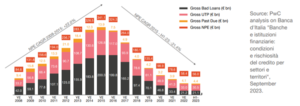
Data show that banks have been working hard in identifying several measures that have proven to be effective solutions, also in response to market and regulatory pressures. Indeed, investors and external stakeholder started paying increasing attention to the NPE and, at the same time, the ECB and Bank of Italy published dedicated guidelines and gave specific targets in terms of NPL ratios.
Therefore, banks implemented both internal and external strategies. Firstly, financial institutions strengthened their internal skills and created dedicated organisation units to adopt proactive strategies for the recovery of impaired loans. Secondly, the external environment played a key role. The ecosystem around banks evolved, with the birth and the development of dedicated players, focused on the management of non-performing exposures, to which banks and investors outsourced servicing activities. Several investors started to consider with interest the Italian market making possible derisking for banking players.
Despite these positive results, the future still presents challenges:
Hopefully, the implementation of stricter controls during the origination phase and of more careful monitoring processes, will help reducing new flows of impaired loans.
In conclusion, credit quality in Italy benefited in recent years from targeted measures and increased control in the origination and management. However, constant monitoring and adaptation to economic dynamics remain imperative. Financial authorities and institutions must continue to work ensure the long-term stability of the Italian financial system.
In the aftermath of significant market and regulatory upheavals over the past decade, tangible structural changes are reshaping the banking and financial landscape. Forces such as technology, evolving customer behaviours and regulatory shifts are propelling a paradigm shift.
Amidst this transformative background, a cohort of new players is leading the change in innovation and providing customers with expanded choices. These include specialised banks and emerging entities with digital business models. Furthermore, players from different industries are entering the fray, forming unexpected alliances and partnerships that are redefining the industry landscape, with the significant disruptive potential of Big Tech on the horizon.
Among these transformative forces, ‘Challenger banks’ stand out as a group of innovative players pursuing distinct strategies compared to traditional high-street banks. Their strategies focus on product/customer specialisation and/or technological innovation. Typically targeting niche segments with attractive risk return profile, Challenger Banks leverage non-traditional distribution channels and rely heavily on digital technology and flexible operating models.
Italy, with over 15 Challenger banks, ranks as the second-largest country in Europe after the UK in terms of their proliferation. Italian Challenger banks predominantly aim to address specific customer groups or products that receive less attention from traditional banks. In contrast to the overall banking system, these banks have experienced consistent portfolio growth in recent years. Their primary focus lies in SME lending and specific products such as government-guaranteed loans and factoring. Another area of emphasis has been NPL purchasing, also given the relevance of NPL market in Italy.
However, Challenger banks do not enjoy the same funding conditions as the traditional banking system, characterised by a high level of resilience in retail funding costs that are not always linked to market dynamics.
Today the management of capital and funding becomes a highly sensitive issue for the entire segment, impacting not only challenger banks but also growing institutions in a macroeconomic and monetary policy environment vastly different from just a few months ago.
In this context, Traditional banking institutions are not shying away from this digital upheaval. They are strategically embracing digitalisation by establishing their own digital banking brands. This strategic move empowers them to compete effectively with digital-only players and simultaneously bolsters the resilience of the banking ecosystem, reducing customer acquisition costs in the process. The recent example of Intesa Sanpaolo’s strategic shift to digital banking with Isybank exemplifies strategic response to digital disruption.
Italian banks are increasingly recognising the need to integrate sustainability into their operating and decision-making processes, thanks to both an evolving regulatory framework and increasing attention to these topics by stakeholder.
In 2020, the ECB published specific guidance on how to integrate climate and environmental risks into the strategy, business model and risk management processes of significant banks, and conducted numerous exercises and supervisory activities on the topic. A similar initiative was taken by the Bank of Italy in April 2022 with reference to less significant Italian banks and financial intermediaries
Supervisory expectations are focused on environmental considerations, and they encourage banks to integrate climate and environmental risk factors into all banking and financial activities.
In 2022, the Bank of Italy also conducted a survey to assess the alignment with expectations. The assessment, extended to both transition and physical risk, revealed, net of some positive exceptions, a low degree of alignment with the expectations, but, at the same time, a widespread and growing awareness of the importance of the theme for the prospective sustainability of the business model.
Specifically, the management of climate and environmental risks is now under the responsibility of many boards of directors, supported by dedicated Committees or internal functions. Moreover, many banks have performed analyses aimed at mapping the regulatory and/or competitive context in order to review their strategies. However, the greatest difficulty concerns the availability of data. Consequently, quantitative approaches in the measurement of climate risks are still rare and not systematic, risk management processes are poorly structured, objectives expressed in terms of quantitative risk indicators and performance are not widely spread.
In order to deal with the poor situation highlighted by the survey, Bank of Italy required to define 3-years action plan to design initiatives in line with supervisory expectations and Italian players are therefore currently working on them, with a constant interaction with the Supervisor.