No spam - just the latest insights!
Join over 30,000 industry professionals who subscribe for free

Subscribe for free!
We'll never share your information or send you spam

Joe is a tax partner and is the Head of Aviation Finance in KPMG who advises a broad range of clients on both domestic and international tax matters. He has extensive experience in tax structuring, international tax planning, complex financing transactions and cross-border acquisitions. He has regularly led multi-country teams in delivering tax advice to his clients on large scale projects. Joe has experience in advising companies in the aviation financing, leasing, insurance and banking sectors. Joe has spoken at numerous international conferences on tax issues impacting the aviation and insurance sectors.

Kieran is a partner in Management Consulting and is the lead advisory partner in the Aviation Finance & Leasing practice. Kieran has 18 years’ experience of providing advisory services to the world’s leading Aviation companies in the areas of performance improvement and optimisation, finance efficiency, post deal integration / separation and setting up leasing platforms. Kieran also provides Financial Management services to our clients across a number of industries leading the transformation of finance functions in reporting, controls and providing management insight.

Geoff is a Director in Aviation Advisory at KPMG. Geoff has 25 years’ experience in aviation, transport and logistics sectors. He specialises in airline transformation, strategy and finance. Previous to joining KMPG, Geoff was Director of Strategy for British Airways with responsibility for strategy, business planning and the transformation across all departments including commercial, engineering and operations. He is a qualified commercial pilot with multi-engine type rating.

Ireland is a major centre for aircraft leasing, with approximately 50 percent of the world’s leased commercial aircraft managed in Ireland and 70% of the top 20 leasing firms operating in the country. This article delves into why Ireland is preferred for leasing and the opportunities that lie ahead.
Though Ireland’s success in leasing can be attributed to several factors, the major ones are:
– favourable tax policies focussed on leasing
– access to EU capital markets
– a strong services industry focussed on the leasing sector
– a skilled workforce and English-speaking country
– a business-friendly regulatory environment
– a strong infrastructure supporting the aviation industry
– geographic proximity to either side of the world.
a.Double tax treaties: Ireland has a wide network of double tax treaties with countries worldwide. As of May 2023, Ireland has signed double tax treaties with over 76 countries (74 of which are in effect), including many of the world’s largest economies. These treaties generally follow the model tax convention developed by the Organisation for Economic Co-operation and Development (“OECD”) and provide for reduced tax rates or exemptions for residents of the treaty partner countries. The treaties also include provisions for the exchange of information between tax authorities to prevent tax evasion.
b.Low tax rate: In particular, from 1 January 2003, the Irish government reduced its general level of corporate tax from 32% to just 12.5%, which has helped to attract a large number of leasing companies to the country. This tax rate is significantly lower than in many other countries, making Ireland an attractive destination for airlines looking to minimise their tax burden. However, the benefit of a lower tax rate extends to a range of industries beyond aircraft leasing firms, thus encouraging many to set-up offices in Ireland. Now, with a range of industries to cater to, a natural opportunity exists for financial firms to fund such ventures within Ireland, leading to a well-developed financial industry giving access to global capital.
It’s a combination of these two ingredients, double tax treaties and lower tax rates, that is encouraging Sale and Leaseback (“SLB”) transactions in Ireland. SLB is a financial transaction in which an airline or other aircraft operator sells one or more of its aircraft to a third-party leasing company, and then immediately leases the same aircraft back from the leasing company, thus allowing it to free up capital while retaining the use of the aircraft for its operation. Ireland promotes tax-efficient planning of SLB transactions by encouraging airlines companies to:
Moreover, many financial institutions such as international banks and investment firms have set-up their base in Ireland for European operations due to Ireland’s favourable business and tax policies making it easier for lessors to access services from such institutions. Membership of the EU also grants Ireland a certain degree of political stability, thus giving leasing companies a sense of protection and security on the assets they hold.
In addition, Ireland is an English-speaking country making it an attractive location for foreign companies looking to set up operations in a country where they can communicate easily with the local workforce and customers. It’s also an incentive for talent to move to Ireland as they don’t need to learn a new language for communication.
Coupling this advantage with friendly immigration laws help candidates willing to move to Ireland. Many companies sponsor visas under the ‘critical skill permit’ route, allowing candidates can get two years of work employment to reside in Ireland.
Aviation Research Institute (“IARI”), the Shannon Aviation Cluster, the International Aviation Services Centre (“IASC”), and Aircraft leasing Ireland (“ALI”). ALI represents the aircraft leasing industry in Ireland and is dedicated to the continued development and success of Ireland’s aircraft leasing industry.
All these institutes are set up to support the aviation industry not only though a commercial lens but also through a sustainability one, especially in areas of sustainable aviation fuels, zero-carbon propulsion systems, and noise mapping. Additionally, there are generous donations from leading Irish Universities to support such innovation allowing both the industry and students to benefit.
The aviation sector is in many respects in good health but there are some key challenges that are facing the industry including the rising cost of ownership, aircraft shortages and higher labour costs.
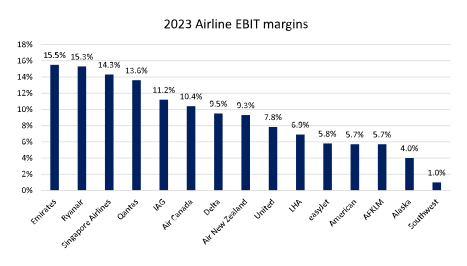
Airlines reporting strong profitability: Most major airline groups in the world returned to respectable levels of operating margin in 2023 as illustrated by the chart below, mainly driven by strong revenue. Strong passenger demand combined with a global shortage of aircraft has limited the supply of seats and kept pricing firm. In 2024 we expect to see a normalisation of passenger yields (against a very strong 2023 base) as capacity constraints ease a little but we continue see a strong revenue environment.
Supply chain issues continue to affect aircraft and engine supply: Airbus recently trimmed its full-year delivery forecast guiding to a figure of 770 aircraft this year, down from 800 previously, and the production target of 75 A320neos monthly has been pushed back from 2026 to 2027. The OEM says it is facing “persistent” and “specific” supply-chain issues, primarily affecting engines, aerostructures and cabin equipment. Boeing has faced production quality issues most notably with its key supplier Spirit AeroSystems which manufacturers the fuselage of the 737 Max. In Boeing’s Q1 results statement, the company stated that “Our first quarter results reflect the immediate actions we’ve taken to slow down 737 production to drive improvements in quality”. Meanwhile the Pratt & Whitney’s Geared Turbofan (GTF) engine issues continue to ground a significant proportion of Airbus A320 neo and Airbus A220 aircraft. Airlines are reporting that worldwide repair capacity is too low leading to many months of engines off wing.
Rising cost of ownership: Rising interest rates mean that the cost of borrowing is clearly much higher than it has been over the last fifteen years when interest rates were held low following the global financial crisis. This combined with the shortage of aircraft means that aircraft lease rates have risen substantially over the past 12 months. New aircraft lease rates for the A320-200N and B737 Max 8 for example were below USD300,000 a month in January 2022 but are now around USD400,000.
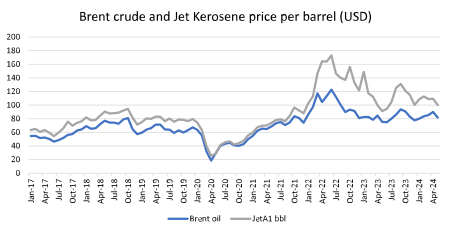
Jet crack spread moderates but labour costs structurally higher: Brent crude has been fairly stable at around US$80/ bbl over the past year which is perhaps surprising given the amount of geopolitical instability. However, the key issue for the industry in recent years has been the unusually high cost of refining with crack spreads averaging USD40/bbl in 2022 compared to historical averages below USD20/bbl. The good news is that the crack spread has returned to around USD20/bbl as illustrated by the chart below.
However, labour costs are structurally higher than historically especially in the US mainly driven by pilot wages. For example in 2013, American, United and Delta all had employee costs of between 20 and 23% of sales. In 2023 they reported employee costs at 28% of sales.
KPMG offers a broad range of professional services in aviation including tax advisory, capital markets and management consultancy covering airline business planning, cost benchmarking, project management and transaction due-diligence.