No spam - just the latest insights!
Join over 30,000 industry professionals who subscribe for free

Subscribe for free!
We'll never share your information or send you spam

Tomotaka leads Data Driven Re-Design Strategy Team, a part of Strategic Impact, which offers solutions to social issues.
Before joining EY, he worked for a government financial institution and a global consulting firm.
He spearheads initiatives for solving various social issues, focusing on formulation of data-driven strategies.
In recent years, along with supporting policymaking for tourism, he has been playing a leading role in offering data utilisation platform services in cooperation with local governments and tourism-related operators throughout Japan. Now he is recognised as one of the leading experts in ecosystem and platform businesses.
Committee Member of the Japan Tourism Agency (Promotion of tourism DX)
Committee Member of the Japan Tourism Agency (Functional enhancement for JNTO certified Foreign Tourist Information Centres)

While the global impacts of the COVID-19 pandemic gave rise to temporary stagnation in the FinTech market, the preventative measures undertaken in response accelerated the adoption of contactless and unattended services and paved the way for continued growth.
Current projections call for the global market to reach an astonishing USD1.5 trillion in magnitude by 2030, a six-fold increase from 2021 levels1QED Investors, “Global FinTech 2023 Reimagining the Future of Finance”, Boston Consulting Group website,www.bcg.com/ja-jp/publications/2023/future-of-fintech-and-banking, accessed 31 October 2023. A notable driver of this growth is the APAC region, which is projected to surpass the North American market by 2030 and become host to the world’s largest FinTech market (at sizes of USD6 trillion and USD5.2 trillion, respectively).
While the Japanese FinTech market was no exception to the global and domestic impacts of COVID-19, a market recovery is underway with projections calling for continued market expansion; banking and investment services boast the highest growth rates forecast in a measure of total Japanese enterprise IT spending, standing at 6.8% in 2023 (c.f. the average of 4.7%) and 6.6% in 2024 (c.f. the average of 4.9%).2Gartner, 日本における2023年のエンタプライズIT支出の成長率を4.7%と予測 [Gartner Forecasts Japanese Enterprise IT Spending To Grow 4.7% in 2023], www.gartner.co.jp/ja/newsroom/ press-releases/pr-20230227, accessed 31 October 2023
The Global Financial Crisis of 2008 — commonly known in Japan as the eponymous “Lehman Shock” — is recognised as the catalyst for global recognition of FinTech, as the former employees of affected financial institutions (primarily in the US and the UK) began to push the limits of technology to gain mainstream status by unbundling offered services into standalone functions capable of providing enhanced convenience and versatility. The rapid gains in service quality brought about by this flurry of activity seemed at one time poised to disrupt the established system of financial institutions.
The global shockwaves generated by the birth of FinTech abroad fell flat in Japan, however, producing only lukewarm reactions in a market saturated with and insulated by forerunner products generated through the domestic industry’s unique and successful focus on the sophistication of such individualised services. At that time, Japan was already enjoying a suite of services at the intersection of finance and technology: the capability for same-day deposit of interbank fund transfers, for instance, was already online at the majority of Japanese financial institutions; and the NTT Docomo mobile phone service Osaifu-Keitai enjoyed a dominant position in Japanese society and served as a precedent for later mobile payment services such as Apple Pay and Google Pay. This social climate effectively laid the foundations for the concurrent adoption of personal finance management, asset management, insurance and cloud-based accounting services.
The development pathways taken by the domestic industry contributed to the birth of a large number of startups in the years since interest in FinTech began to deepen in Japan circa 2015, although the impact of this interest in the financial markets was limited in comparison to the shockwaves that traversed other world markets.
While some expected FinTech to disrupt the established network of financial institutions, very few ventures have actually effected disruptions; in fact, the current state of the market serves only to highlight the possibilities made feasible by collaboration and alignment between financial institutions and FinTech companies. FinTech ventures’ initial struggles to acquire large market shares and win over new clients in Japan can largely be attributed to the high degree of trust placed in traditional financial institutions by the local populace. The difficulties faced by FinTech ventures generated room for successful collaborations aimed at providing the clientèle of traditional financial institutions with more convenient services, as the traditional financial institutions such ventures chose as collaboration partners had themselves long lacked the capacity to speedily develop and commercialise a versatile suite of financial services.
Categorisation of the impact FinTech has had within the context of the industry’s development in Japan gives rise to two major but inexhaustive groupings:
1 Increasing the importance of data utilisation
2 Increased vectors for customer reach
These two categories of impact continue to be of great importance in the present day, as they are at the essence of FinTech services and digital transformation (DX). When Japanese interest in FinTech first began to grow circa 2015, FinTech services were most frequently part of the service lineup offered by financial institutions, and were included under the premise that the benefits obtained therefrom would include the two categories of impact described above. Long-sustained low interest rates and the COVID-19 pandemic spurred financial institutions into rebooting their store location strategies,3世界の銀行店舗、10年で1割減 DX·低金利で削減加速 [Global bank locations decrease 10% in 10 years, DX and low interest rates spur closures], The Nikkei, 4 August 2021, www.nikkei.com/ article/DGXZQOGD19BJO0Z10C21A7000000/ (accessed 31 October 2023) and such activities helped facilitate the burgeoning transition of analog channels for customer interaction into their digital equivalents, and the major challenges this transition posed for financial institutions attempting to design the optimal customer experience.
The emergence of FinTech provided an overnight reduction in the barriers to entry in the financial services industry, and corporations with core non-financial businesses — including the likes of Apple, Google, Tencent and Alibaba — expanded into financial services offerings, with the majority of such initial forays into payments. These corporations leveraged the data they obtained from such services to launch financing and other services, ultimately developing into platform operators that host a seamless suite of financial and non-financial services.
A great number of non-financial corporations in Japan also began their forays into the financial services through payment services, but Japan’s already-saturated mobile payment landscape made success a difficult prospect for any of those ventures. In part due to this business environment, the growing global popularity of embedded finance, wherein businesses refrain from building their own payment service offerings and instead partner with financial institutions to provide financial services, is readying to take root in Japan as well.
SBI Sumishin NetBank is a ready supporter backing the ventures of non-financial corporations with Banking as a Service (BaaS). Current SBI Sumishin NetBank clients for BaaS services include JAL, Yamada Holdings and Culture Convenience Club, and this trend is likely to grow further in popularity, in part due to similar offerings in development at other financial institutions.4銀行の広告参入相次ぐ 住信SBI、CCCと組みポイントも [Banks flood into advertising: SBI Sumishin and CCC collaboration includes point programs], The Nikkei, 20 December 2022
The most alluring benefits financial institutions obtain through collaborations with non-financial corporations are the ability to reach the customers of their collaboration partners, as well as the ability to use the front-facing structuring of the offering, which conceals the brand of the financial institution under the covering of the non-financial corporation’s brand, as a pathway to developing new customers. Such arrangements have the potential to outcompete previous ways of doing business, as they enable financial institutions to act on strategies which fully leverage the front-facing brand of a chosen non-financial corporation to their advantage, without the constraints of the brand established by the financial institution itself.
Non-financial corporations stand to benefit from increased customer retention through higher usage of their apps and services (e.g., point programs) and the ability to increase the value of their brand by building longer-lasting customer relationships tied to their provision of financial services such as home loan financing or asset management.
As described above, the Japanese FinTech industry is similar to its global counterpart in that embedded finance (the incorporation of financial services into the service offerings of non-financial corporations) is the dominant industry trend.
In the US and other countries, interest is growing in a category of post-payment services known as “buy now, pay later” (BNPL) aimed at customers who avoid or do not have credit cards. Similar services offerings were once commonplace, with examples including those made available by Japan’s major household appliance retailers, and the transition into the digital realm has conferred an additional factor of convenience onto such services. Projections are for the domestic market to grow in a similar manner as that seen in international markets, i.e., primarily driven by younger sectors of the population.5E-commerce Payment Service Market in Japan: Key Research Findings 2023, Yano Research Institute Ltd., https://www.yanoresearch.com/en/press-release/show/ press_id/3217 (accessed 31 October 2023)
Services for corporate clients are garnering attention in much the same manner as customer-focused services. Topics trending in Japan, such as operational efficiency and digitalisation, have boosted the adoption of cloud-based solutions for invoicing, accounting and other services. Some providers of such services even undertake the pseudo-securitisation of such invoices as accounts receivable and provide financing, factoring and loan services. A notable feature of such arrangements is that financial institutions are not providing financial service functions per se, but rather aligning to the provision of actual services, including via the acquisition of other corporations.
The majority of Japanese small and medium enterprises (SMEs) are in need of flexible, timely financing, and as services such as those described above provide methods for obtaining such financing, there is a strong likelihood of continued growth in the market for such services.
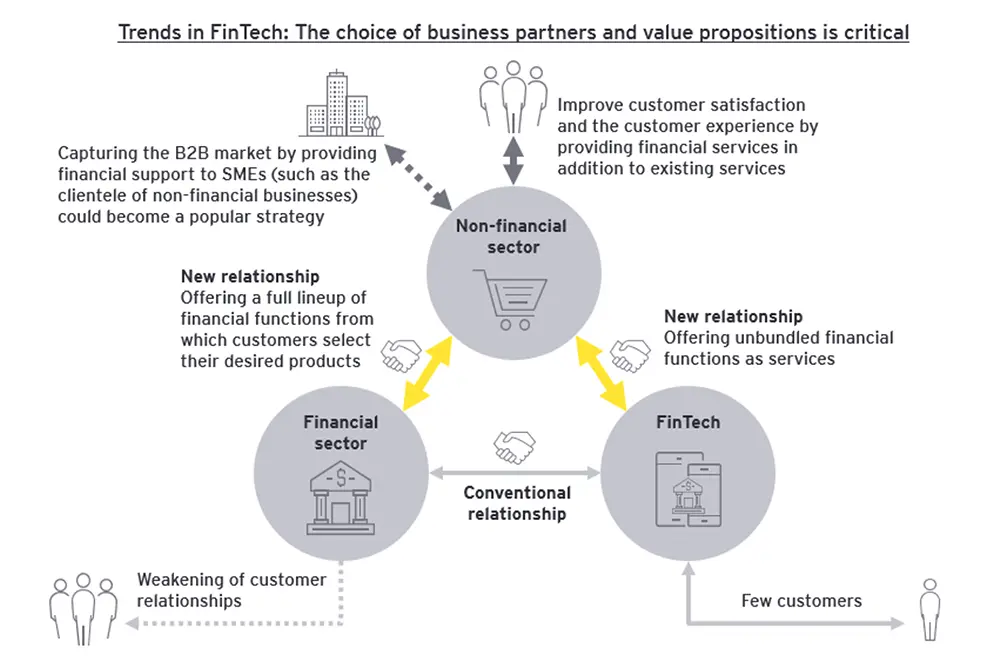
Further growth is also predicted in the market for initiatives aimed at supporting SMEs, including schemes in which the provision of BaaS functions to non-financial corporations is used in indirect support of the clients of the corporation purchasing such functions. While an increase in online tourism reservations is expected to occur in response to the global expansion of the tourism industry, the online travel agents who provide bookings of hotels and other services currently go no further than providing the platforms through which said bookings are made. This transaction data, however, could easily be leveraged to, for example, provide support directly to the hotels and other businesses registered on the platform in the form of loans and other financial services. The alleviation of the historical difficulties constraining financial services providers from easily supporting SMEs, namely the difficulty of obtaining information concerning their ordinary transactions, will likely be realised through the usage of services provided by non-financial corporations.
In April 2023, the Japanese government permitted the payment of wages to digital wallets, smartphone payment apps and other services (below, “digital salary payments”).6Digital salary payments can be received only via the accounts of fund transfer service providers (i.e., operators of cashless payment services) designated by the Minister of Health, Labour and Welfare; and as such digital salary payments are unavailable as at the time of writing (October 2023). Underlying this development promoting cashless payments is a commitment made to reaching the cashless payment prevalence targets set forth by the Japanese government in its Cashless Vision (i.e., 40% of payments in 2025, with an ultimate target of 80% of payments).
Widespread adoption of this policy will effectively mandate an overhaul of financial institutions’ tried and true strategy of utilising direct deposit accounts to entice clients into utilising other financial services. The loss of direct deposit account dominance will erase that category of customer touchpoints and deepen the business challenges facing such enterprises.
FinTech businesses have succeeded in expanding thus far by approaching customer acquisition and development through their collaborations with financial institutions. Increased digitalisation is engendering an outflow of customers from conventional financial institutions, and as a result collaborations with the subset of non-financial corporations who remain within constant reach of their customers is on the rise. Such collaborations are prime examples of embedded finance at its essence.
In the sense that embedded finance is a trend unique to FinTech, FinTech companies specialising in payments, insurance or other fields will enjoy a relatively stronger ability to remain the corporate face of the services they offer. Conventional financial institutions, however, may find service offerings that highlight their own brand are incompatible with the brands of non-financial corporations. Potential avenues for such companies include either rebranding the services they offer or dedicating themselves to providing functionality in the role of a behind-the-scenes financial services platform operator (i.e., the dumb piping of financial institution services).
In the US, Goldman Sachs has committed to transitioning into a technology company and entered the BaaS market. As similar actions are being taken in Japan, largely by online banks operating within its borders, the number of corporations aiming to expand their financial services offerings by providing BaaS functions is increasing.
As trust has been an essential component of finance since its inception, the path to growth was in increasing brand awareness and thereby gaining new customers and service users. These rules are no longer absolute in the current era, as non-financial corporations are increasingly enjoying more prevalence in front-facing roles than financial service providers and are thus becoming the primary touchpoint for customers. While it goes without saying that financial institutions must continue to provide trustworthy services, a key component of business strategy for any such institution is now the twin choices of which corporations to partner with and which services to offer.
The relationship between FinTech companies and financial institutions, who once enjoyed a plethora of possibilities for collaboration and alignment, is starting to be laid bare to competition through the vector of their interactions with non-financial corporations. Financial institutions who find themselves at such junctions will likely be forced to revisit their strategies and choose whether to leverage their established brands for continued customer service offerings or to shift to a role behind the scenes providing a varied and highly trustworthy lineup of services with the high versatility of said services as their primary value proposition.
This publication contains information in summary form and is therefore intended for general guidance only. It is not intended to be a substitute for detailed research or the exercise of professional judgment. Member firms of the global EY organisation cannot accept responsibility for loss to any person relying on this article.