No spam - just the latest insights!
Join over 30,000 industry professionals who subscribe for free

Subscribe for free!
We'll never share your information or send you spam

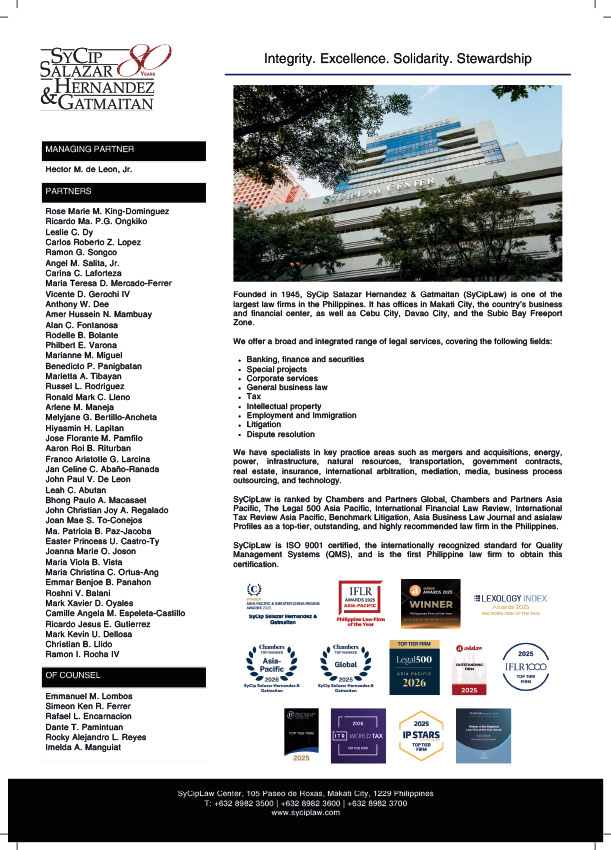
Jan Celine C. Abaño-Ranada is a Partner at SyCipLaw and a member of the Firm’s Special Projects and Banking, Finance and Securities groups. Her areas of practice include project financing, mergers, acquisitions, privatization, energy, and infrastructure.
She has extensive experience in project finance and other financing transactions in a range of industries, including energy, infrastructure, hotels, gaming and real estate development. She is also immersed in M&A work, and has led teams in projects in the banking, public utilities, manufacturing, and retail sectors.
Ms. Abaño-Ranada has advised several banks that have extended financing to companies, including those engaged in the development of power plants and hotels and casinos. She has also participated in various capacities in mergers and acquisitions involving banking institutions, public utilities, manufacturing, communications, and retail companies.
She has been ranked as a “Next Generation Partner” in Banking and Finance by The Legal 500 since 2020.

Camille Angela M. Espeleta-Castillo is a Partner at SyCipLaw and a member of the Firm’s Special Projects, Banking, Finance and Securities, and Taxation groups. She is also a Certified Public Accountant.
Her practice areas include mergers and acquisitions, debt and capital markets, financial technology, public private partnerships, infrastructure, and energy and power.
Ms. Espeleta-Castillo regularly renders advice to clients from various regulated industries (e.g., financial technology, energy and power, lending and money services), particularly on regulatory compliance, corporate structuring and tax matters. She has extensive experience in high-value cross-border acquisitions and divestments, in addition to having acted as counsel to financial investors in private equity transactions and issuers and underwriters in capital markets transactions.

Ricardo Jesus E. Gutierrez is a Partner at SyCipLaw and is a member of the Firm’s Special Projects, Banking, Finance, and Securities, and Intellectual Property groups. His practice areas include banking and finance regulations, project financing, structured finance, mergers and acquisitions, investments, projects and energy, technology, franchising and distribution, and arbitration.
He regularly advises banks and financial institutions for regulatory compliance. He likewise advises clients on the regulatory requirements applicable to derivatives and repurchase transactions.
Mr. Gutierrez also has extensive knowledge of financial technology regulations, such as those relating to online contracts, payments, and banking, and has advised a significant number of financial institutions in this area. Mr. Gutierrez is a Senior Lecturer in the University of the Philippines – College of Law, teaching Property Law and Private International Law. He is also a Teaching Fellow and an Associate Member of the Institute of Corporate Directors (ICD).
The Philippine banking sector continues to play a central role in the country’s financial system. Banks account for approximately 83 percent of the total resources of the domestic financial system,1Inquirer, Philippines’ financial system resources near P37T; banks dominated growth in 2025, accessible via https://business.inquirer.net/574759/ph-financial-system-resources-near-p37t-banks-dominated-growthin- 2025; last accessed on March 25, 2026. underscoring their importance in supporting economic growth, facilitating capital flows, and providing financial services to businesses and consumers. As financial services increasingly migrate to digital platforms, however, financial institutions face growing risks, including cyberattacks, online fraud, identity theft, and sophisticated financial scams. These developments require stronger governance, enhanced technological safeguards, and more robust consumer protection frameworks.
In recent years, Philippine regulators have responded by strengthening the legal and regulatory framework governing financial institutions. These reforms reflect a coordinated effort to enhance the integrity of the financial system, prevent financial crime, and protect financial consumers. Recent high-profile financial crime and corruption controversies have further heightened regulatory scrutiny and accelerated calls for stronger safeguards across the banking sector.
Several legislative and regulatory initiatives illustrate this policy direction.
First, the Financial Products and Services Consumer Protection Act (“FPSCPA”), which took effect on June 3, 2022, introduced a comprehensive framework governing the conduct of financial service providers. The law strengthens the authority of financial regulators, including the Bangko Sentral ng Pilipinas (“BSP”), to oversee market conduct and enforce consumer protection standards. It also imposes obligations relating to product design, disclosure, fair treatment of clients, data protection, and dispute resolution mechanisms.
Second, the Anti-Financial Account Scamming Act (“AFASA”), signed into law on July 20, 2024, represents the Philippines’ first dedicated legislative response to the rapid rise of online financial scams. AFASA requires banks and other BSP-supervised financial institutions (“BSFIs”) to implement fraud management systems capable of detecting and preventing suspicious or fraudulent transactions and authorizes the BSP to conduct inquiries into financial accounts involved in scam-related activities.
In 2025, the BSP issued implementing circulars strengthening information technology risk management, establishing procedures for financial account inquiries and information sharing, and providing rules for the temporary holding of funds involved in disputed transactions.
Third, in September 2025, the BSP introduced additional safeguards governing large cash value transactions, requiring enhanced due diligence and documentation for large withdrawals or payouts to reduce the risk of fraud, money laundering, and other illicit activities.
Fourth, the Philippine Deposit Insurance Corporation (“PDIC”) increased the maximum deposit insurance coverage (“MDIC”) from PhP500,000 to PhP1,000,000 per depositor in March 2025, strengthening depositor protection and reinforcing confidence in the banking system.
These reforms have taken place alongside broader efforts to enhance the Philippines’ compliance with international anti-money laundering and counter-terrorism financing standards. These reforms contributed to the Philippines’ recent removal from the Financial Action Task Force (“FATF”) grey list,2FATF, Philippines, accessible via https://www.fatf-gafi.org/en/countries/detail/Philippines.html#:~:text=Jurisdictions%20under%20Increased%20Monitoring%20%2D%2021,also%20subject%20to%20increased%20monitoring; last accessed on March 25, 2026. although continued vigilance remains necessary as the country prepares for its next evaluation cycle in 2027.
Taken together, these developments signal a clear regulatory policy direction. Philippine financial regulation is increasingly focused on strengthening consumer protection, improving fraud detection capabilities, and ensuring that financial institutions maintain robust safeguards against emerging threats in a digitalized financial environment.
The following sections discuss key regulatory developments shaping this framework, including the implementation of the FPSCPA, the expansion of deposit insurance protection, the regulatory measures introduced under AFASA, the new safeguards governing large cash transactions, and ongoing discussions surrounding bank secrecy and anti-money laundering reforms. These initiatives demonstrate the Philippine government’s continued efforts to build a secure and resilient financial system capable of preventing financial crime while protecting consumers and maintaining public confidence in the banking sector.
The FPSCPA is the central consumer protection statute for financial services. It strengthens regulators’ market conduct powers, including rulemaking, supervision, enforcement, and dispute resolution mechanisms, and imposes baseline duties on financial service providers.
For BSFIs, the most operationally significant points are the law’s expectations on product governance and complaint handling. In particular, the FPSCPA mandates providers to (i) design and distribute products appropriately, (ii) provide clear and meaningful disclosures, (iii) treat consumers fairly, and (iv) protect customer data and privacy. These requirements do not only improve consumer outcomes, they also help mitigate risks of financial fraud by tightening vulnerabilities that bad actors often exploit, such as unclear customer communications, slow dispute handling, and weak identity or channel controls.
From a contract governance standpoint, the FPSCPA also curbs provisions that unreasonably deprive consumers of meaningful remedies. In practice, this pressures institutions to align their terms, disclosures, and operational manuals with a defensible “fair treatment” posture, especially for digital products.
Deposit insurance is a key mechanism for maintaining depositor confidence and promoting financial system stability. In March 2025, the PDIC increased the MDIC to PhP1,000,000 per depositor, strengthening depositor protection and reinforcing trust in the banking system.3Philippine Deposit Insurance Corporation, Deposits are insured by PDIC up to P1 Million per depositor, accessible via https://www.pdic.gov.ph/MDIC; last accessed on March 2, 2026. While this measure is not an anti-scam mechanism in itself, it complements crime prevention objectives by reducing panic dynamics in the event of widely publicized fraud incidents and by encouraging consumers to keep funds within regulated channels.
THE ANTI-FINANCIAL ACCOUNT SCAMMING ACT
The AFASA is the Philippines’ dedicated anti-scam framework for electronic and digital financial services. It addresses common forms of financial account fraud, including social engineering, account takeovers, and unauthorized transfers, and imposes specific obligations on covered institutions to implement fraud risk management systems that are commensurate with their risk profile.
In 2025, the BSP issued implementing measures to operationalize AFASA’s requirements, including rules that strengthen IT risk governance and fraud controls for BSFIs. For example, BSP Circular No. 1213, Series of 2025 updated information technology risk management expectations to implement AFASA-related requirements. BSP Circular No. 1214, Series of 2025 provides procedures for inquiry into financial accounts and information sharing pursuant to AFASA. While BSP Circular No. 1215, Series of 2025 established a framework on the temporary holding of funds that are the subject of disputed transactions and a coordinated verification process.
AFASA-linked supervisory expectations are driving covered financial institutions to adopt real-time, prevention-oriented controls intended to identify and disrupt potentially fraudulent activity before losses are incurred. These controls typically include: (i) velocity and pattern monitoring to detect unusual transfer frequency or transaction bursts indicative of automated attacks; (ii) account-compromise indicators, such as changes in device identifiers, SIM swaps, credential resets, or abrupt modifications to account profile information; and (iii) geolocation and other contextual controls that flag transactions occurring outside a customer’s usual location or established transaction patterns, including atypical cross-border activity. Institutions are also expected to conduct screening against internal and external watchlists and risk lists, including known fraudulent accounts, compromised merchants, and other high-risk endpoints. In addition, behavioral analytics may be deployed to detect anomalous activity that departs materially from a customer’s historical transaction behavior.
These measures are not merely formal compliance requirements. Properly designed and implemented, they are operational loss-mitigation tools that shift fraud risk management upstream in the transaction lifecycle, where prevention is materially more effective and less resource-intensive than post-transaction recovery.
A distinctive feature of AFASA is its strong emphasis on customer-controlled safety tools that serve as a “last mile” safeguard against scams. For digital platforms that facilitate retail fund transfers and other high-risk transactions, the BSP has encouraged the implementation of functionalities that allow customers to directly protect their accounts. These include (i) a self-service account freeze or “kill switch” that enables account holders to immediately block outgoing transactions in the event of suspected fraud; (ii) permission and device access controls that allow customers to revoke access for trusted devices, merchants, or third-party applications; (iii) a “money lock” feature that enables users to secure a portion of their funds so that they cannot be used for online or digital transactions; and (iv) customizable transaction limits, such as daily caps, per-transfer limits, or cross-border restrictions. Collectively, these tools empower customers to respond quickly to suspicious activity and reduce the likelihood that fraudulent transactions will be successfully completed.
These tools are consumer protection measures, but they also materially strengthen crime prevention by shortening the window scammers can exploit and by improving the customer’s ability to interrupt scams midstream.
AFASA’s operational direction increases the pressure on institutions to show that they have adequate controls and complaint processes. Where institutions fail to implement required safeguards, regulators may take the view that the institution bears responsibility for resulting losses, depending on the fact pattern and the institution’s compliance posture. The compliance implication is straightforward: fraud governance must be auditable, and dispute handling must be prompt, consistent, and well-documented.
In September 2025, the BSP issued BSP Circular No. 1218, Series of 2025, which introduced additional safeguards for large cash value transactions, including enhanced due diligence measures and stronger controls to reduce the misuse of the banking system for illicit purposes.
While the detailed mechanics depend on an institution’s product set, the policy objective is consistent with crime prevention: large cash movements increase ML/TF risk and facilitate the rapid dissipation of scam proceeds. Requiring additional scrutiny, documentation, and legitimacy checks raises the cost of abuse and supports investigation and interdiction.
From a consumer protection perspective, these controls also help reduce the likelihood that scam victims can be induced to rapidly cash out or move large sums without meaningful friction or intervention.
The baseline confidentiality regime
Bank secrecy in the Philippines is principally anchored on Republic Act No. 1405 (Secrecy of Bank Deposits) and Republic Act No. 6426 (Foreign Currency Deposit Act). The general rule is confidentiality, subject to defined statutory exceptions, including lawful court orders and specific regulatory or investigatory authorities, such as in Anti- Money Laundering Council-led processes under the Anti-Money Laundering Act framework.
This regime supports depositor confidence, but it can create investigative friction when authorities seek to trace proceeds of crime. As digital fraud and complex financial crimes evolve, the tension between confidentiality and enforcement capacity becomes more pronounced.
AFASA’s narrow exception and controlled information use
AFASA introduces a targeted mechanism that supports scam investigations. As implemented, it enables information sharing and account inquiry processes in a scam-specific context, creating a limited pathway to obtain relevant financial information for defined purposes. This is framed as a narrow exception rather than a broad relaxation of bank secrecy.
The key policy balance is this: allow sufficient access to identify perpetrators and freeze or trace funds, while restricting use to legitimate scam investigations to avoid mission creep and preserve trust.
The case for sustained reform
There is a continuing interest in broader bank secrecy reform to strengthen the State’s capacity to investigate financial crime beyond scam-specific contexts. Any such reform, however, must be calibrated. Excessively broad measures may undermine depositor confidence, while overly narrow reforms may weaken the deterrent effect against modern financial crime and corruption.
Recent Philippine banking regulation reflects an increasingly integrated approach to crime prevention and consumer protection. The FPSCPA provides the market conduct and consumer redress backbone. PDIC reforms reinforce depositor confidence. AFASA and its BSP implementing measures move fraud management toward real-time prevention, strengthen dispute handling, and require customer-controlled safety features. Large cash transaction safeguards reduce exposure to illicit fund flows and scam proceeds dissipation.
The common thread is accountability: institutions must (i) prevent losses through strong controls, (ii) respond quickly and fairly when fraud occurs, and (iii) maintain governance systems that regulators can test and trust. As technology and scam taxonomy continue to evolve, the institutions best positioned to succeed will be those that treat these rules not as compliance checklists, but as operational standards that protect customers, preserve confidence, and strengthen the integrity of the financial system.