No spam - just the latest insights!
Join over 30,000 industry professionals who subscribe for free

Subscribe for free!
We'll never share your information or send you spam

Abhinav is Director and Capital Projects & Infrastructure Leader at PwC Vietnam. He specialises in infrastructure advisory, project finance, public-private partnerships (PPPs), investment strategy and capital raising across the infrastructure sector. He also leads the Government and Public Sector account for PwC Vietnam and is the ESG lead for Energy, Utilities & Resources.
His experience spans energy transition, renewable energy, industrial infrastructure, urban development/smart cities, and utilities supporting both public and private sector stakeholders on complex infrastructure initiatives across Asia.
He is particularly experienced in helping stakeholders navigate evolving regulatory frameworks and unlock investment opportunities in complex infrastructure environments. Abhinav holds a Master’s degree in Infrastructure Planning and a Bachelor’s Degree in Civil Engineering.

Angela is a Partner in PwC Vietnam’s Corporate Finance practice with over 20 years of experience advising clients on mergers and acquisitions, capital raising and strategic investments. She leads the Corporate Finance & Infrastructure Platform in Deals and is also the Markets Leader for the Deals Vietnam business.
She works closely with international investors, financial institutions and corporates across sectors including infrastructure, energy, logistics and financial services. Angela has advised on numerous significant transactions in Vietnam and brings extensive experience in transaction structuring, financial analysis and investment execution.
Combining strong commercial insight with deep knowledge of Vietnam’s investment landscape, she supports clients in identifying opportunities, managing transaction risks and delivering long-term value. Angela holds an MBA from Concordia University, Canada.

Vietnam’s next growth phase depends on financing a substantially larger infrastructure pipeline. Investment in power, transport and logistics has long underpinned its export-led model by connecting production centres, supporting industrialisation and attracting foreign investment. This has required Vietnam to outspend the region: over the past decade, Vietnam has had an average infrastructure spending of 6 to 7 per cent of GDP against a regional norm of 2.3 per cent. The growth link became explicit in 2025, when the Government increased planned infrastructure spending from 6 to 7 per cent of GDP as it raised the annual growth target from 7 to 8 per cent in anticipation that the additional infrastructure spending, equivalent to 1 per cent of GDP, could help deliver roughly the additional percentage point of targeted growth while also supporting productivity and foreign investment.1VinaCapital. 2025. Economist’s Note: https://vof.vinacapital.com/insights/latest-insights/increased-2025-infrastructure-investment-target/
The Government has intensified this policy approach in 2026. The National Assembly has set a GDP growth target of at least 10 per cent, with major infrastructure development and public investment positioned as central drivers of the new growth model. A March 2026 infrastructure assessment estimates that Vietnam would need to invest about 8.2 per cent of GDP annually to meet its infrastructure objectives through 2050, above the historical 6 to 7 per cent level, while the funding gap through 2030 is estimated at USD 150 to 200 billion.2Infrastructure Development in Vietnam: Achievements So Far and Challenges Ahead: https://amro-asia.org/wp-content/uploads/2026/03/For-publication-AN_VN-Infrastructure-Development.pdf
Vietnam’s infrastructure ambition requires projects to move rapidly from pipeline to bankable delivery. The financing system must evolve beyond balance-sheet lending to mobilise private and international capital at scale. Public budgets, concessional funding and domestic savings cannot fund the programme alone. Projects must be prepared and risk-allocated so lenders and investors can rely on predictable cash flows rather than corporate balance sheets or sovereign guarantees. Vietnam must now finance and deliver its infrastructure ambition.
An estimated ~USD 450 billion requirement is expected in infrastructure from a pipeline that is already planned and scheduled. Within a single five year window the country aims to expand coverage to 5,000 km of expressway, 2,286 km of high speed rail and metro lines, 294.5 million annual air passengers, 1,375 million tonnes of port throughput, and 210 GW of installed power capacity.3Vietnam Investors Service, Funding Vietnam’s Era of Growth: Unlocking Infrastructure Bonds for Long-term Capital Mobilization compiled from Ministry of Construction, ACV, VIMC, EVN, Sun Group and VIS Rating estimates
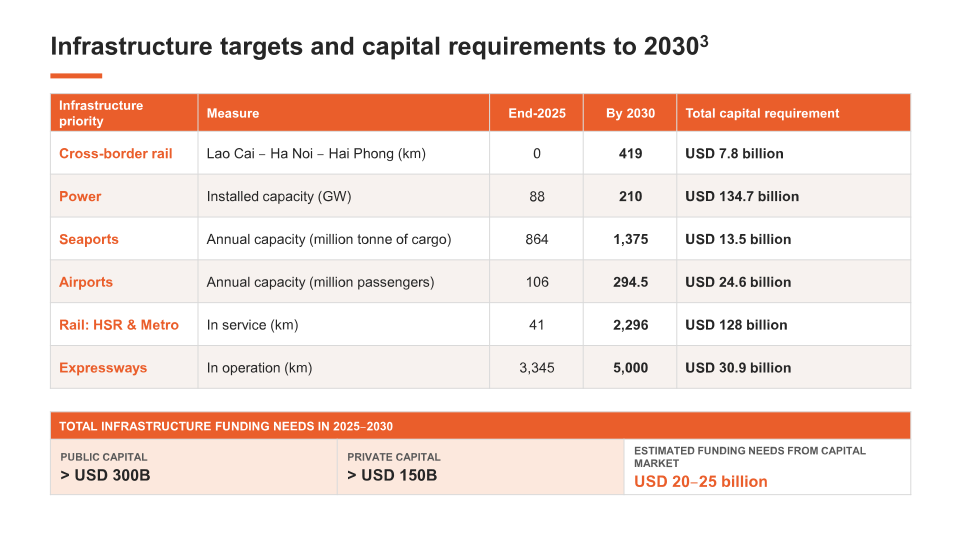
Public investment is being concentrated to maximise its catalytic effect rather than fund the entire infrastructure pipeline. Resolution 27/2026/QH16 sets the 2026-2030 state-budget public investment envelope at nearly USD 314.9 billion4 across all sectors, comprising approximately 46 percent from the central budget and 54 percent from local budgets. It targets public investment at approximately 20-22 per cent of total social investment, indicating that public capital will be deployed selectively across the broader development programme, prioritising nationally significant projects and investments capable of crowding in non-state resources.
Concessional finance can supplement this effort but cannot close the gap: Vietnam aims to mobilise about USD 38.2 billion in ODA and concessional loans during 2026-2030, while only USD 624 million was secured across 10 projects in 20255, and future borrowing must remain aligned with debt-service capacity and increasingly selective terms.
Against an estimated infrastructure funding gap of USD 150-200 billion through 2030, the implication is that roughly USD 150 billion4Vietnam Investors Service, Funding Vietnam’s Era of Growth: Unlocking Infrastructure Bonds for Long-term Capital Mobilization compiled from Ministry of Construction, ACV, VIMC, EVN, Sun Group and VIS Rating estimates will need to be mobilised from private investors, commercial lenders, capital markets, public-private partnerships and other non-state sources. Private capital is therefore not a residual source of funding; it is central to converting Vietnam’s infrastructure pipeline into bankable and deliverable projects.
Vietnam’s financing constraint reflects both a shortage of capital and a mismatch between the required assets and the risks its financial system is structured to hold.
Bank finance remains indispensable, but it cannot carry the infrastructure programme on its own. Vietnamese banks principally underwrite the credit standing of the borrower and its sponsors, not the standalone cash flows of a ring-fenced project. Regulatory concentration limits reinforce that constraint: the 2024 Law on Credit Institutions phases the maximum exposure to a single customer down from 15 per cent to 10 per cent by January 2029. These limits are an important safeguard for financial stability, but they also mean that large projects require syndication, deeper sponsor support or alternative sources of long-term capital.
The expansion of green credit illustrates both the capacity and the limitation of this model. Outstanding green loans rose from about USD 3.8 billion in 2016 to USD 25.0 billion in 2024.5VIS Rating, “Vietnam Credit Outlook 2025”, 6th March 2025 This nine-year increase is significant, but it remains an expansion of bank balance-sheet lending, not a wholesale shift to financing assets on their own contracted revenues.
The second constraint is the tenor. Infrastructure assets commonly require financing over 15 to 20 years, while domestic banks fund themselves predominantly through shorter-term deposits. The State Bank of Vietnam’s prudential framework caps the proportion of short-term funds that may be used for medium and long-term lending; Circular 25/2026/TT-NHNN raised this ceiling from 30 per cent to 40 per cent from July 2026, while explicitly retaining the ratio as a safeguard against maturity mismatch.6Circular No. 25/2026/TT-NHNN; Vietnam Chamber of Commerce and Industry, “Vietnam raises cap on short-term funding for medium- and long-term lending to 40%”, 23 June 2026 The reform expands lending headroom but does not eliminate structural refinancing risk: projects may be economically viable over their operating lives but they remain difficult to finance at matching tenor within the domestic banking system.
The bond market offers a necessary alternative but is not yet deep enough to close the infrastructure gap at scale. Recent reforms have widened the framework for project-related issuance while strengthening investor-protection and disclosure requirements. Under the 2025 amendment to the Enterprise Law (Law No. 76/2025/QH15) and Decree 200/2026/ND-CP, the total liabilities of most private bond issuers including the proposed issuance may not exceed five times equity, subject to specified exemptions; issuance plans must also provide detailed project, risk, timetable and use-of-proceeds information. Yet project companies typically enter the market with high leverage, single-purpose revenue streams, construction exposure and limited operating histories – characteristics that demand stronger disclosure, credit enhancement and contractual protection. Vietnam therefore needs a market architecture capable of producing investable, rated and credit-enhanced project securities for long-duration institutional investors.

Both channels commit capital primarily on borrower or issuer strength. Banks assess sponsor credit; bondholders price leverage, track record and repayment capacity. Neither routinely funds ring-fenced infrastructure assets on contracts and cash flows alone. The financing gap is therefore institutional as much as financial.
Project finance provides the necessary discipline. It shifts attention from sponsor credit to ring-fenced project cash flows, allocates risk and opens access to longer-tenor capital. Vietnam lacks enough projects whose contracts, revenue models and risk allocation make investor interest actionable. The prize is infrastructure assets that can be funded, built and operated at scale.
Vietnam has a relatively narrow project-finance track record, concentrated in a small number of large, contract-backed transactions, predominantly in the power sector. Fully non-recourse financing remains limited, while many recent projects rely on limited-recourse or hybrid corporate-finance structures.
Some examples of project finance structures in Vietnam include the Phu My 2.2 that reached financial close in 2002 with a USD 480 million limited-recourse package backed by a 20-year take-or-pay PPA, government support for state-counterparty obligations and foreign-exchange convertibility, and multilateral political-risk guarantees.7World Bank, “IDA Guarantee supports first competitively bid private power project in Vietnam”, 2003; Asian Development Bank, Phu My 2.2 project data Nghi Son 2 followed in 2018 with approximately USD 1.87 billion of debt from export credit agencies and commercial banks.8Public reporting on the Nghi Son 2 financing close, April 2018 Mong Duong 2 later refinanced project loans through USD 679 million of senior secured notes; its credit strength rests on a take-or-pay PPA to 2040, fuel-cost pass-through and government-guaranteed state-counterparty obligations.9Fitch Ratings, Mong Duong 2 rating actions, 2024 and 2026
These transactions demonstrate that internationally bankable structures can be achieved in Vietnam where bespoke contracts, guarantees and credit support address revenue, currency, termination and counterparty risks. Elsewhere, fully non-recourse finance remains uncommon, and many transactions depend on limited recourse, sponsor guarantees or corporate balance sheets.
The legal building blocks exist, but the market standard does not. Vietnam permits special-purpose project companies and recognises security over project assets, receivables, insurance proceeds and bank accounts. However, the project-finance rules remain dispersed across investment, lending, foreign-exchange, land and sector legislation 10Allens, “Vietnam Project Financing Guide”, 2024. Many renewable and infrastructure financings remain on sponsor balance sheets because project contracts do not give lenders sufficient certainty to rely solely on project cash flows. Most solar and wind capacity built between 2019 and 2022 under the feed-in tariff regime followed this pattern: domestic banks lent to parent companies, leaving curtailment and tariff-revision risks on the parent balance sheet rather than ring-fenced within the project company.
The dominant model remains hybrid: project-level security and covenants combined with sponsor guarantees, parent support or substantial equity. Such structures can finance individual assets but cannot scale national infrastructure pipeline because developer balance sheets are finite. International lenders require ring-fenced risks and clear contractual allocation before providing long-tenor capital without full sponsor recourse.
Recent reforms including the PPP framework and direct power purchase arrangements broaden the routes to private participation, but they do not by themselves make projects financeable. The decisive question is whether the contract protects debt service through construction, operation and stress. Four key elements remain central to this:
Vietnam’s constraint is the repeatability of bankable risk allocation across its infrastructure pipeline. The next phase of market development must convert bespoke protections from exceptional transactions into standard terms for a sustained infrastructure build-out.
The starting point is disciplined asset allocation. Projects where revenues are weak, uncertain or cannot be captured should remain publicly funded or receive explicit viability support. Assets with contractible cash flows including selected toll roads, ports, renewable generation and industrial infrastructure are better candidates for private finance, provided demand, tariff, offtake and termination risks are clearly assigned.
For financeable assets, instruments must match risk. Limited-recourse loans suit contracted revenues; export-credit agency finance can extend tenor and absorb selected political or payment risks where imported equipment or contractors are involved; and blended finance can help strategic projects reach commercial bankability. These tools cannot replace sound contracts and credible project preparation.
Banks can originate the pipeline; capital markets must supply more of its duration. Decision 1413/QD-TTg positions capital markets as a principal source of medium and long-term finance and targets outstanding bonds at around 60 per cent of GDP by 2045. The starting point is materially lower: outstanding bonds were estimated at about 34 per cent of GDP in 2025, against the previous target of at least 47 per cent. Closing that gap requires investment-grade project securities, credible ratings, transparent pricing and a deeper base of long-duration investors.11Decision No. 1413/QD-TTg, 27 July 2026; Vietnam News, 29 July 2026
Credit enhancement is the bridge between project risk and institutional capital. Guarantees can improve credit quality, extend tenor and bring insurers and funds into transactions they could not otherwise hold. But one-off guarantees will not create a market. Scale requires repeatable structures, standardised disclosure and domestic enhancement capacity that can support a pipeline rather than isolated deals.
Vietnam has begun creating that domestic channel. Circular 136/2025/TT-BTC establishes infrastructure bond funds and requires at least 65 per cent of their net asset value to be invested in infrastructure-related bonds and permitted debt instruments. Durable demand, however, requires a steady supply of investable bonds and secondary-market liquidity that enables institutions to manage risk. The sequence is clear: public capital where revenue cannot support debt; project finance where it can; credit enhancement to reach investment grade; and capital-market refinancing to recycle bank and sponsor balance sheets.
From legal reform to market execution: Vietnam must translate its broad legal framework into repeatable, bankable infrastructure transactions. Law No. 57/2024/QH15 amended the Planning, Investment, PPP and Bidding Laws, broadening PPP applicability and introducing new contract types. Bond-market reforms are also moving in the right direction, with proposals to remove the profitability track-record requirement and permit public offerings with immediate listing.
Execution is now the principal constraint. Vietnam must resolve staged issuance and secondary-market liquidity and translate the broader legal framework into projects and securities capable of attracting capital on replicable terms. Sponsors and lenders require predictable rules for tariffs, disbursement, compensation, foreign exchange, termination and enforcement throughout the life of the asset.
Execution must be built on standardisation. Model contracts, transparent risk-allocation matrices, disciplined project preparation and competitive procurement reduce the structuring premium that investors otherwise add to ordinary commercial risk. Development partners increasingly make the same point: Vietnam’s next PPP phase depends on a pipeline of well-prepared, bankable projects, rather than a longer project list.122025 High-Level PPP Dialogue reporting, Ministry of Finance, Asian Development Bank and Vietnam News Agency
Financial closes will provide the decisive measure of progress. Vietnam requires a coherent architecture: public capital where projects cannot sustain commercial debt; project finance where revenues can be contracted; credit enhancement to improve risk allocation; and capital-market refinancing to release bank and sponsor capacity. Progress will be demonstrated through repeat financial closes, longer tenors, broader institutional and international participation, and lower reliance on sovereign and sponsor balance sheets. These outcomes would make project finance a scalable market practice rather than an exception. Vietnam’s infrastructure ambition will be judged by its ability to convert viable projects into investable assets and sustained investment into productive infrastructure. The transition from an “infrastructure programme” to an “infrastructure market” will determine whether the country can finance and deliver its next growth phase.