No spam - just the latest insights!
Join over 30,000 industry professionals who subscribe for free

Subscribe for free!
We'll never share your information or send you spam

Caroline joined NatWest in February 2019 as Managing Director. She works with customers across products and markets, as well as providing ESG rating, regulatory and disclosure insights. In addition to the financing dialogue, Caroline engages with institutional investors globally to understand their responsible investing objectives and develop products to meet their needs.
As of April 2026, Caroline’s role has expanded to include UK corporates – large and small, alongside her previous remit focusing on European customers, as well as Financial Institutions and SSAs in the Capital Markets. This entails NatWest’s full product suite, including corporate lending and asset finance, across corporate, institutional and commercial mid-market customers.
Caroline leads the Commercial & Institutional (C&I) climate change programme across entities, building the underlying tooling and integrating into decision-making processes. She has worked extensively with AFME and the UK’s Transition Finance Council to support industry-wide solutions and shape sustainable finance as it evolves. She is also Chair of the ESG Standing Committee of the Financial Markets Standards Board.
Caroline has 10 years of investment banking experience advising financial institutions across Europe on capital products at international investment banks which included financing M&A-related transactions and balance sheet restructuring. She later spent 10 years working for a London children’s charity providing academic support as Development Director and Board Trustee. She acted on the Governing Board of Colville Primary School as Deputy Chair until 2022. In addition, Caroline was a member of Synchronicity Earth’s advisory council, a UK biodiversity charity.
Bachelor of Science Chemistry, Queen’s University, Canada and MBA, European University, France.

Martyna Moosuddee is a Director in the Sustainable Finance Advisory (SFA) team at NatWest, where she leads the Sovereign, Supranational and Agency (SSA) segment. Together with her team, she provides advisory support across sustainable finance frameworks structuring, impact and allocation reporting, and works closely with issuers and investors. The team also engages actively in thought leadership, supported by specialist insights across the sustainable finance landscape, including ESG ratings, regulatory developments and market standards.
Martyna joined NatWest in 2024 from Sustainable Fitch, where she was part of the commercial team focusing on second-party opinions, ESG ratings and transition assessment services. Prior to this, she spent the majority of her career in financial markets, holding sales roles at two global investment banks, including 10 years at BNP Paribas in London and two years at Standard Chartered in Mauritius.
She is a CFA Charterholder and holds the CFA Institute’s Sustainable Investing Certificate. She is a Master’s Degree holder from the Poznań University of Economics and Business in Poland.

Giorgio Carlucci is a Vice President in the SFA SSA team, with 9 years’ experience in finance. He has 5 years’ experience in sustainability advising corporates and SSAs, having previously worked in sales and strategy roles.
Prior to joining NatWest, he worked at two international law firms in Rome and at the European Central Bank in Frankfurt. He holds an LL.M from Goethe University (Frankfurt) and the CFA Institute’s Sustainable Investing Certificate. He is a CFA Charterholder.

Daisy Smith is an Associate in the Sustainable Finance Advisory team, with 7 years’ experience in sustainability. Prior to joining the SFA team, she held roles in climate delivery programmes at NatWest, focusing on customer transition planning and climate-related disclosures.
Before joining the firm, she worked at PwC New Zealand advising public and private sector clients on climate and sustainability projects. She began her career at Westpac New Zealand in the corporate sustainability team.

The transition finance market is expanding rapidly, driven by the scale of global decarbonisation requirements and a growing pool of capital seeking exposure to credible transition pathways. The Climate Policy Initiative 1Global Landscape of Climate Finance, Climate Policy Initiative, 2025 estimates that annual global transition finance requirements could reach up to $10 trillion per year from 2031 to 2050. In contrast, only around $2 trillion was invested in 2024, leaving a substantial gap between ambition and deployment.
Meanwhile, assets managed by ‘transition funds’, which invest in companies committed to decarbonisation, rose 16% during the first half of 2025 across all asset classes. Research from MSCI 2Olive Is the New Black: The Rise of Transition Funds, MSCI, 2025 suggests that “transition-labelled funds have become the fastest-growing category of climate funds”, and data from Blackstone 3Demand from transition funds for capital is outpacing supply, says Blackstone, Environmental Finance, December 2025 reveals that demand from transition funds for capital is outpacing supply, underlining the level of activity in the space.
For issuers, this creates an opportunity in debt capital markets; however, access to this capital is determined less by product labels or formal definitions of ‘transition’, and more by the credibility of an issuer’s forward-looking decarbonisation pathway.
While the transition finance market and the existence of emerging transition definitions and frameworks rapidly evolve, the mechanisms through which capital is allocated are already well established. Capital is, in essence, available but only to issuers that meet investor expectations on credibility, transparency and execution.
Transition finance reflects a shift away from a focus on more narrowly defined, purely green activities towards financing the process of decarbonisation itself. Rather than targeting assets already aligned with low-carbon outcomes, transition capital is increasingly directed towards issuers that are moving towards alignment over time.
This is reflected in the growth of transition funds, which are typically actively-managed fixed income vehicles investing across investment-grade and high-yield issuers and across the capital structure. What distinguishes these funds is their willingness to allocate capital to issuers that can demonstrate a credible decarbonisation pathway supporting the transition, including companies in hard-to-abate and emission-intensive sectors.
Historically, sustainable finance has been associated with labelled products, including green and sustainability-linked financial instruments, which helped establish market standards and disclosure practices.
As the approach to transition finance evolves, a recurring question is whether transition finance should, too, be accessed through labelled instruments, such as emerging transition loans and bonds, or through general corporate issuance supported by a credible transition strategy.
NatWest’s own research suggests that transition-focused investors often appear relatively agnostic to instrument types. While labelled instruments can support disclosure and signal intent, investor focus tends to be on how capital is deployed at the issuer level. Recent developments such as the ICMA Climate Transition Bond Guidelines are expected to support growth in labelled transition markets over time. However, at present, findings show that instrument labels are generally a secondary consideration, with greater emphasis placed on the credibility of the issuer and their underlying transition strategy and implementation.
Despite the absence of a single definition of ‘transition’, investors broadly agree on the direction of travel but differ on how they assess and apply such a concept. Transition fund managers broadly converge on a set of core expectations when assessing issuers.
These include:
Research conducted by NatWest 4Unlocking transition finance: what investors are looking for, NatWest, 2026 found that these expectations are applied using principles-based approaches, rather than prescriptive rules. While third-party data providers and disclosure frameworks are widely used, they support rather than determine investment decisions, which remain grounded in internal analysis, integrating sector-specific expertise and forward-looking judgement.
Credibility, as highlighted in NatWest’s analysis of transition fund investors, is typically assessed across targets, implementation governance and financial backing, with the emphasis varying by investor and sector.
A credible transition strategy typically includes:
Weight is placed on short and medium-term milestones, which are often viewed as more decision-useful than distant end-state commitments. Investor focus is on the feasibility of the transition pathway and the ability to execute the steps required to deliver.
In practice, this indicates that investors place significant emphasis on evidence of execution, including capital allocation, progress against targets and the integration of transition objectives into business strategy and governance. Capital expenditure plans are a key consideration, particularly where they demonstrate alignment between financial planning and decarbonisation goals.
Governance and accountability remain central; board-level oversight, clear allocation of responsibility for delivery, and links between executive remuneration and transition performance are among the topics to which investors pay close attention. These provide greater confidence that stated ambitions are supported by internal structures to deliver them.
In practice, this remains a forward-looking, judgement-based exercise, particularly in sectors where technology, policy and timelines are still evolving. However, these characteristics are consistent with emerging frameworks such as the UK Transition Finance Council Guidelines, discussed in a section later in the article, which provide a structured approach to assessing credibility across ambition, implementation, accountability and dependencies.
Issuer assessment in the context of transition finance is an ongoing process of review and engagement. Transition funds combine in-depth analysis with direct engagement to monitor how issuers are delivering on their transition plans.
Monitoring engagement is often supported by a structured process, with interactions documented and revisited over time. Investors may apply escalation processes when issuers fall behind on stated commitments, potentially increasing the intensity of engagement or engaging at a more senior level within the organisation. Divestment remains an option (albeit not one often relied upon in fixed income markets) and, more commonly, weaker transition performance can lead to smaller allocations, higher funding costs, or reduced access to capital.
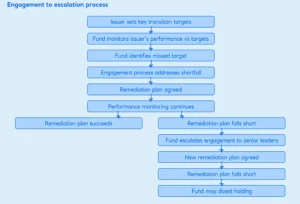
Portfolio construction also reflects this approach. Transition-focused funds often evaluate issuers along a “continuum”, categorising them as leaders, improvers, or laggards, and dynamically adjust portfolio allocations over time in response to these relative positions. Importantly, underperformance on transition metrics does not necessarily result in immediate exclusion. Funds may retain exposure where there is a view that engagement can support improvement, reinforcing the focus on transition pathways rather than end states.
Sector treatment follows a similar logic. While some exclusion policies exist, they are not universal, and investor approaches are evolving. Rather than applying static exclusions, transition funds increasingly focus on the credibility of transition pathways within sectors, including those that are currently carbon-intensive but expected to play a role in the transition.

Building on these market dynamics, there have been a growing number of regulatory and market-led initiatives aimed at providing greater structure and consistency to transition finance, reflecting a progression from instrument-level guidance to broader system-level approaches.
Bond markets: ICMA Climate Transition Bond Guidelines
The ICMA Climate Transition Bond Guidelines, released in November 2025, introduced a structure for transition-labelled bonds intended to finance activities supporting decarbonisation, including some hard-to-abate sectors. A key feature is the requirement to combine use of proceeds with a credible issuer-level transition strategy, as defined in the ICMA Climate Transition Finance Handbook.
Loan markets: LMA Guide to Transition Loans
A similar approach is emerging in the loan market. The LMA Guide to Transition Loans, released in October 2025, emphasises that transition loans should be grounded in a borrower’s overall transition strategy, supported by measurable targets and ongoing monitoring over time. The Guide contains a Transition Loan Principles exposure draft, intended to evolve with market input.
Fund level: SDR and SFDR developments
Recent developments in fund labelling regimes may also support the growth of transition finance. In the UK, the Sustainability Disclosure Requirements (SDR) regime has introduced the “Sustainability Improvers” label, which can lend itself well to investing in transitioning entities. In the EU, proposed reforms to the Sustainable Finance Disclosure Regulation (often referred to as SFDR ‘2.0’) include new “Transition” funds, intended to focus on investment in the transition of undertakings, economic activities or assets. Whilst SFDR 2.0 is currently not expected to come into force before January 2028, both of these regimes may act as additional drivers of capital allocation towards transition by shaping investor behaviour and product design.
Entity level: UK Transition Finance Council Guidelines
The UK Transition Finance Council was established to advance the recommendations of the Transition Finance Market Review and to support the UK’s ambition to become a leader in mobilising transition finance. In March 2026, the Transition Finance Council published the exposure draft of the Transition Finance Guidelines. The draft Guidelines set out minimum expectations for credible transition activity structured around four principles: (i) credible ambition, (ii) action into progress, (iii) transparent accountability and (iv) addressing dependencies. Rather than defining transition finance prescriptively, the Guidelines are designed to support a consistent, principles-based assessment of transition strategies. Supported by a set of assessment factors, including interim targets, implementation, financial viability, governance and engagement, the framework enables capital providers to assess whether an entity’s transition strategy is aligned with relevant pathways and capable of being delivered in practice.
Taken together, these developments reflect a progression from instrument‑level guidance in bond and loan markets, through fund‑level disclosures to entity‑level frameworks assessing transition credibility. While alignment with investor expectations is increasing, frameworks remain voluntary and evolving, with multiple approaches likely to coexist across jurisdictions. They therefore provide useful structure and reference points, but do not fully replace investor judgement in assessing transition strategies.
As the framework and policy landscape evolves, financial institutions are increasingly translating and operationalising transition finance into practical financing approaches.
This is reflected in the evolution of NatWest Group’s approach. Following the achievement of our £100 billion Climate and Sustainable Funding and Financing target, the Group has expanded its ambition to provide £200 billion of Climate and Transition Finance between July 2025 and the end of 2030. This target is underpinned by our Climate and Transition Finance (Lending) Framework, which sets out the definitions, guiding principles and governance used to classify eligible financing and facilitation activities.
In contrast, the Sustainable and Transition Financing Framework, published in May 2026 and superseding the third GSS Financing Framework (2022), underpins NatWest Group’s own labelled issuance. The framework’s scope has been expanded beyond green, social and sustainability financing instruments to include transition financing instruments and Sustainability-Linked Loans Financing Bonds.
At the entity level, NatWest Group’s Climate Decisioning Framework assesses clients’ climate transition progress and seeks to understand how they are managing climate-related risks. It is used to support client engagement, and NatWest has started to integrate CDF outputs as a complementary trigger for enhanced oversight in decision-making processes, reflecting a shift towards more consistent, entity-level evaluation of transition.
These approaches demonstrate how transition finance is being embedded across targets, classification, issuance and client assessment. More broadly, they highlight a shift in the role of financial institutions towards supporting and evaluating transition pathways, integrating climate considerations into capital allocation, risk management and governance.
Transition finance is expected to become an increasingly central feature of capital markets as the necessity and business case for financing the transition continue to strengthen. While frameworks, labels and definitions will evolve, the basis on which capital is allocated is already becoming clearer.
At its core is credibility, defined by a consistent set of characteristics: a clearly articulated pathway aligned with Paris-compatible objectives, quantified and quantifiable interim targets (typically across multiple emissions scopes), and time-bound implementation actions demonstrating how those targets will be achieved.
As the market develops, the ability of issuers to evidence these characteristics, and of financial institutions to assess them effectively, will be critical to unlocking transition capital at scale. In this context, credibility remains the anchor for capital allocation, underpinning the growth of transition finance and its role in enabling reale-conomy decarbonisation.