No spam - just the latest insights!
Join over 30,000 industry professionals who subscribe for free

Subscribe for free!
We'll never share your information or send you spam

Specializes in commercial litigation and legal-business advisory for entities in the maritime economy and yacht industry. His strengths include assessing litigation risks and applying alternative dispute resolution methods (negotiation and mediation). Provides clients with ongoing legal support.
With over 25 years of experience gained both domestically and internationally, he has collaborated with entrepreneurs from the shipbuilding, port, yacht, TSL, construction, and automotive industries. He has personally or with his team handled numerous commercial, civil, and criminal court cases, including high-profile media cases.
He is the author of the blog “About law in the shipyard, at the port and on water “ (patrykzbroja.pl) and the podcast “Polish Offshore Wind” (polishoffshorewind.pl) about the development of offshore wind energy in Poland. He also co-creates a series of podcasts on yachting law titled “Paragraph under sail.”
Actively participates in Szczecin’s maritime economy organizations: the West Pomeranian Maritime Cluster and the Maritime Cluster of Western Pomerania, as well as the Northern Chamber of Commerce and the Association for the Development of Szczecin and Western Pomerania “Business Club,” where he is also a member of the Peer Court.
He is the Chairman of the Peer Court of the West Pomeranian District Sailing Association, a member of the Conciliation Committee at the Polish Chamber of Marine Industry and Water Sports – POLISH YACHTS, and since 2010, a judge at the Disciplinary Court of the Szczecin Bar Association.
Studied at the Faculty of Law and Administration at Adam Mickiewicz University in Poznań. After graduation, he was an intern at Steinbes Transferzentrum Internationale Strategien in Strasbourg. Fluent in English, can also speak in French and German.
In his free time, he enjoys watching movies, reading books, listening to rock music, and meeting old friends. Above all, he is an active sportsman, with a passion for regatta sailing (he is a multiple Polish Champion and medalist in various formulas, in 2024 he and his crew won bronze medals at the European Match Racing Championships). He holds yacht and motorboat skipper licenses.
Additionally, he rides a bike, sometimes runs, and lifts weights at the gym.

Specializes in serving entities in the maritime economy and yacht industry, both domestically and internationally. Advises on the most advantageous yacht sale agreements and analyzes the associated risks. Reviews and negotiates contracts in the shipbuilding industry.
Gained professional experience during her studies, working in law firms. Began her collaboration with Wind & Water Legal Zbroja at the end of 2021.
Author of numerous publications on yachting and co-author of the e-book “Safe Yacht Acquisition”.
Graduate of the Faculty of Law and Administration at the University of Szczecin, and also studied Norwegian philology. Advocate at the Szczecin Bar Association. Fluent in English, Norwegian, and French.
An avid regatta sailor, triathlon enthusiast, and a passionate graphic designer and technology enthusiast, who enjoys walks with her ginger dog in her free time.

He specializes in tax matters, with a particular focus on the yachting industry. Advises clients on how to handle taxes depending on the type of yacht and the country of purchase. He is a European VAT compliance specialist.
Started his career in tax offices and the Tax Chamber in Szczecin. For several years, he advised mainly at the Szczecin branch of Deloitte. He also collaborated with other law firms. Joined Wind & Water Legal Zbroja in 2022.
Authored publications on yachting taxes and co-authored the e-book “Safe Yacht Acquisition”.
Graduate of the Faculty of Law and Administration at the University of Gdańsk and postgraduate studies in taxation and tax advisory at the WSB University in Poznań. Obtained the title of tax advisor in 2011 and became advocate in 2025. Works proficiently in English.
His hobbies include diving. He also holds a sailing license, which he regularly uses in the sailing regattas, representing Wind & Water Legal Zbroja.
Polish ports have entered a stage of development in which growth in handling capacity is strongly linked to investment in access infrastructure. The expansion of terminals alone is not sufficient to build a competitive logistics hub. A port’s attractiveness to shipowners, terminal operators and investors is determined by the ability to transport cargo rapidly inland and on to Central and Eastern Europe. Poland is currently undertaking several projects that will transform the position of its ports on the Baltic Sea.
The integrated port–road–rail–logistics infrastructure system is designed to expand the market for terminal operators, shipowners, infrastructure investors, technology providers and financial institutions. Poland is transforming its ports from domestic transhipment points into Baltic logistics hubs. Road and rail investments are intended to boost the ports’ appeal to global operators.
In the west of the country, the Szczecin Western Bypass is under construction. In 2026, work began on the nearly 50-kilometre route, which includes a 5km tunnel under the Oder river – set to be the longest road tunnel in Poland. Part of the route is due to open in 2029, with the entire route due to open in 2033. The new road network will improve access to the industrial northern part of Szczecin and create a more efficient road infrastructure for the ports in Szczecin and Świnoujście.
Work has now begun on Cape Pomerania, a new deep-water terminal in Świnoujście. Work is currently under way on the construction of a service road, which is essential for the project to proceed. The terminal includes, amongst other, 186 ha of reclaimed land, a deep-water container terminal with handling capacity of up to 2 million TEU per year, and new road and rail infrastructure.
In Gdynia, the planned Red Road is set to link the port directly to the S6 and S7 expressway network.
A comprehensive programme of modernisations works is also planned for the TEN-T Baltic-Adriatic rail corridor, which is intended to enable freight trains to travel at speeds of up to 100 km/h and to increase the route’s capacity.
Investors undertaking port projects and industrial logistics infrastructure projects can benefit from the Polish Investment Zone (PSI), which offers an income tax exemption (CIT/PIT) throughout the country for a period of 10–15 years, subject to a decision granting support. Legislative work is currently underway on reforming the PSI, with the aim of simplifying procedures and creating the ePSI electronic platform.
For larger infrastructure projects, including installation terminals, quays and storage yards, blended finance involving the Polish Development Fund is an option.
Bank Gospodarstwa Krajowego, on the other hand, acting as a development bank, provides loans, guarantees and sureties for projects of significant socio-economic importance, which is useful for the debt financing of large, capital-intensive industrial projects.
The year 2026 marks a turning point for Poland’s offshore wind energy sector. Offshore wind is no longer solely a market for “future” projects. The first operator (Baltic Power) has 76 turbines with a total capacity of 1,2 GW already in place in the Baltic Sea, and the electricity will be fed into the national grid by the end of 2026.
The Polish government plans to expand offshore wind capacity to around 5,9 GW by 2030 and to 18 GW by 2040.
The Act of 17 December 2020 on the promotion of electricity from offshore wind farms established a support scheme, whilst its comprehensive amendment in 2025 clarified the rules governing the market.
From an investor’s perspective, the statutory right to cover a negative balance over a period of 25 years is of particular importance. This mechanism limits the project’s long-term exposure to fluctuations in wholesale energy prices and creates a predictable revenue stream, which can form the basis of the project finance structure.
The amendment has also increased the flexibility of the auction procedure, introduced the possibility of obtaining, in certain situations, a preliminary certificate of admission to the auction, and expanded the mechanisms for dealing with force majeure events and the possibility of extending completion deadlines. From the perspective of banks and financing entities, this means a reduction in some of the regulatory risks that lie beyond the project’s control.
The first competitive auction, held in December 2025, served as a test of the new regulations. Three projects were awarded funding: Baltic East, Baltica 9 and Bałtyk I, with a combined capacity of 3,435 GW.
The offshore installation terminal in Świnoujście, which came into operation in 2025, has already entered the stage of analysing its further development. Similarly, the T5 terminal at the Baltic Hub in Gdańsk is nearing completion.
Further wind farms mean further investment in ports (installation and service ports), installation and service vessels, steel structures, cables, logistics, O&M and the electricity grid.
Poland’s offshore sector is entering its second phase of development. The first turbines have been physically constructed, the support system has been tested, and further gigawatts have been given the economic basis for implementation. For investors, this marks a transition from the risk of creating a new market to participating in a market whose infrastructure and regulations are already functioning in practice.
Alongside the offshore market, efforts are being made to establish a domestic supply chain. Regulations introduced in 2020 required manufacturers to submit a plan for the use of local materials and services and to engage in technical discussions with potential domestic suppliers before joining the support scheme.
In April 2026, the Ministry of State Assets announced the definition of “local content”, namely that the domestic component is the value of goods or services supplied by entities with their registered office, tax domicile and the majority of their workforce in Poland. A measurement methodology, currently being piloted in the energy sector, was also presented.
The significance of “local content” becomes apparent during the tender process: an investor participating in a tender is responsible to the regulator for demonstrating an appropriate level of domestic content. For an entity participating in a tender, this means that Polish tax residence, registered office or employment structure may, alongside price and the implementation schedule, have a real impact on the evaluation and acceptance of the bid.
Entities that are able to demonstrate a sufficiently high level of “local content” will certainly be favoured by investors building supply chains.
The methodology for calculating the domestic component is based on six criteria, each with an assigned weighting:
The current share of Polish companies in offshore projects is estimated at around 20%, but the government’s aim is to increase the “re-Polonization” of supply chains. This is also set to extend to other strategic sectors and reach levels of 45 – 85%, depending on the industry.
Critics of this approach point to the risk of protectionism and a possible rise in prices if Polish companies are unable to compete with foreign suppliers in terms of quality and timeliness.
This issue will also affect those entities which do not themselves take part in tenders but wish to act as subcontractors within the supply chain. For other companies, using local suppliers may, for the time being, remain a matter of corporate image. There is also a noticeable trend towards the formation of international investment partnerships involving Polish companies.
A new package of regulations is soon to come into force in Poland, which could revolutionise the taxation of the maritime sector and boost Poland’s position as a modern and competitive shipping hub in Europe. The aim is clear: to encourage shipowners to relocate their operations to Europe from so-called “flags of convenience”. Poland wants to make it easier for shipowners to return to the Polish flag and to encourage Polish seafarers to pursue their careers in Poland.
New regulations may apply to income generated since 1 January 2027. Just recently the European Commission approved that these measures are in line with EU state aid rules.
The planned reform works in two ways:
This is intended to give shipowners flexibility in managing their fleets and corporate structures, positioning Poland as an attractive location for establishing ship management centres in the Baltic Sea region and across the EU.
For the first time, the new legislation explicitly embraces the rapidly growing offshore sector, amongst other things by:
The new PIT exemptions are closely linked to the ship’s flag (Polish and EU/EEA flags are favoured). However, seafarers generally have no influence over where a ship is registered or over the business structure of the shipowner. Seafarers working under the flags of third countries will still have to rely on double taxation agreements.
Proving where the company managing the ship is actually situated can be difficult in the modern shipping industry, given that the employment agency, the employer, the operator and the shipowner are often based in different countries.
There is still lack of regulations stipulating that a vessel’s technical designation or variable use should not affect its status as “a seagoing vessel” for tax purposes. The absence of precise definitions means that the assessment of specific vessels (particularly in the offshore sector) will continue to be at the discretion of the tax authorities.
Damage to a telecommunications cable, the loss of an AIS or GPS/ GNSS signal, or ransomware blocking a terminal system are no longer purely theoretical scenarios in the Baltic Sea. The growing reliance of shipping and ports on digital systems means that a cyber incident can quickly impact operational continuity, human safety and supply chains. These threats are to be addressed by the amendment to the Act on the National Cybersecurity System (UKSC), which came into force on 3 April 2026 and transposed the EU’s NIS2 Directive into Polish law.
The NIS2 has, above all, changed the way in which regulated entities are identified. The Directive distinguishes between sectors with a high level of criticality and other critical sectors. The Polish model introduces a distinction between “key sectors” and “important sectors”.
In practice, the classification is carried out in two stages:
1) determining whether the type of business activity is listed in one of the annexes to the UKSC,
2) assessing the size of the entity and any specific statutory criteria.
The legislator has included two annexes to the Act, in which entities are classified into specific categories depending on the number of employees and turnover.
Regardless of the category to which they are assigned, entities directly subject to the Act will have a number of obligations.
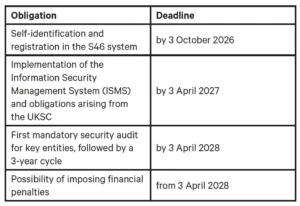
From an operational point of view, significant changes begin the moment an incident occurs. A serious incident is subject to a phased reporting process:
For the transport sector, the Minister for Infrastructure has established CRIST INFRASTRUKTURA, an incident response team for the infrastructure sector. It has formally existed since 30 June 2026 but has not yet achieved operational capability; therefore, serious incidents are reported to the relevant national-level CRIST.
The new UKSC model shifts the focus from mere formal compliance to resilience and operational cooperation. For shipowners, port authorities and maritime infrastructure operators, the first step is to correctly self-identify. The second step is to draw up procedures that will not only enable them to meet the 24/72-hour deadlines, but also to use the notification as a practical channel for obtaining state support. In a sector where a failure of the information system can become an operational and safety issue within minutes, this second function of the UKSC may prove to be just as important as the reporting obligation itself.
From a transactional perspective, the status of a key or significant entity and the state of implementation of the Information Security Management System (ISMS) will increasingly be the subject of due diligence when financing and acquiring maritime assets – such as terminals, fleets or port infrastructure. It is to be expected that banks and investors will begin to take compliance with the UKSC into account as part of their operational risk assessment to an even greater extent than before, and that financing and charter agreements will include clauses referring explicitly to incident reporting obligations.