No spam - just the latest insights!
Join over 30,000 industry professionals who subscribe for free

Subscribe for free!
We'll never share your information or send you spam

Filipa is a partner and head of Restructuring & Insolvency and Litigation & Arbitration at Gómez- Acebo & Pombo. With more than 25 years’ experience in this area of practice, Filipa has a recognised track record in civil, commercial, and corporate litigation, as well as insolvency and restructuring. She has extensive experience in highly complex cases involving multiple jurisdictions, including Switzerland, Luxembourg, and Brazil. Filipa has been involved in some of the most high-profile restructuring and insolvency cases in recent years. Filipa is recognised in the main international legal directories such as Chambers & Partners and Legal500 as a Leading Individual in her field. She has also been recognized by IFLR1000 as Highly Regarded and Women Leader in Restructuring & Insolvency, in 2024.

Rita is a senior associate of Restructuring & Insolvency, Litigation & Arbitration and White-Collar Crime at Gómez-Acebo & Pombo. She specialises in litigation and arbitration (civil, commercial and corporate), white-collar crime, insolvency and criminal compliance. She holds a Law degree from University of Lisbon and a master’s degree in forensic sciences from the Catholic University of Lisbon. Rita holds a post-graduate diploma on Law Enforcement, Compliance and Criminal Law in Banking, Financial and Economic activities from the Institute of Criminal Law and Criminal Sciences – University of Lisbon. She has also recently attended the II Advanced Course on Insolvency and Recovery Legal Instruments by Jurisnova (Association of NOVA School of Law).

Gonçalo is an associate of Restructuring & Insolvency and Litigation & Arbitration at Gómez- Acebo & Pombo. He focuses his work in the areas of civil law, commercial and criminal litigation and arbitration, advising national and international companies on the various stages of dispute resolution (litigation and pre-litigation). He holds a Law degree from the University of Lisbon and a master’s degree in Forensic Law and Arbitration from NOVA School of Law. Gonçalo also holds a postgraduate diploma in Arbitration Law from the Investigation Center for Private Law of Lisbon University. Gonçalo is also recognized in Legal500 as a Key Lawyer in Dispute Resolution. He has participated as coauthor of different specialized publications.

Henrique is an associate of Restructuring & Insolvency and Litigation & Arbitration at Gómez- Acebo & Pombo. His work focuses particularly on civil, corporate and criminal litigation, as well as insolvency and restructuring proceedings. He holds a Law degree from the University of Lisbon and is currently in the dissertation stage of his master’s degree on in Law and Legal Science. He also holds a postgraduate diploma in Insolvency and Restructuring Law from the Investigation Center for Private Law of Lisbon University. He is an author of specialized publications in the above-mentioned areas.

In Portugal, restructuring and insolvency judicial proceedings are governed by the Insolvency and Company Recovery Code1, while extrajudicial recovery proceedings are governed by the Extra-Judicial Regime for Corporate Recovery2.
Alongside these general rules, we can also find special regimes that govern certain types of restructuring and insolvency proceedings, such as the liquidation of credit institutions and financing companies or the recovery of insurance and reinsurance companies3.
For the purpose of this short article, we will focus exclusively on the general rules applicable to insolvency and restructuring proceedings and how these rules were applied in two major and successful insolvency proceedings that took place in Portugal. For such purpose, it makes sense we begin our analysis with a brief, but comprehensive, overview of the rules at hand.
Before beginning an analysis of the procedure per se, it is important to keep in mind a few general concepts that are relevant to understand how the Portuguese insolvency law is applied.
Contrary to some legal systems, Portugal has four categories of claims: secured claims; privileged claims; subordinated claims; and common claims.
Secured and privileged claims are claims that benefit from some sort of security and, as such, are paid before any other claim. Secured and privileged claims are clearly predicted in the law.
Subordinated claims are credits that, because of their nature or because the parties agreed to, are qualified as such and are the last to be paid. Per example, credits that are held by parties in a special relationship with the debtor are qualified as subordinated, e.g., shareholders, board members.
Common claims are all the remaining and are paid after the privileged and secured.
ii.Restructuring procedure
The ever-so-relevant restructuring procedure (the so-called: “Processo Especial de Revitalização”) is a pre-insolvency procedure designed to prevent a company from going bankrupt. The restructuring procedure was introduced in 2012 to ensure wealth production and job maintenance4, allowing a company to negotiate with its creditors to establish a restructuring plan. For a company to resort to a restructuring procedure it must be in a difficult economic situation, meaning that it must be facing difficulties in fulfilling its obligations on due time, namely because it lacks liquidity or is unable to obtain credit5.
The restructuring procedure is only applicable to companies and not to individuals.
Two main types of restructuring procedure exist in Portugal:
i) standard restructuring procedures.
ii) restructuring procedures where the debtor presents an extrajudicial restructuring plan for judicial approval.
a. Standard restructuring procedures
The standard restructuring procedure begins with a motion presented by the company accompanied by a declaration of at least 10 percent of the company’s non-subordinated creditors.
After the motion is received, the Insolvency Judge appoints a provisionary judicial administrator, and the company must immediately communicate to its creditors that the restructuring proceeding has begun.
Once the judicial administrator is appointed and during a period of four months6, the creditors are inhibited from filing any enforcement proceedings against the debtor and all pending enforcement proceedings against the debtor are suspended. Furthermore, during said period, all pending insolvency proceedings requesting the insolvency of the debtor are also suspended.
What follows is a period of negotiation that culminates with a plan presented by the company and voted for by the creditors.
Portuguese law establishes different majorities, but generally speaking the plan is approved by a simple majority of at least 50 percent of the total claims related to voting rights.
If the plan is not approved or if the company believes that no consent can be reached, the administrator issues an opinion regarding on whether the company is insolvent.
If the judicial administrator believes that the company is insolvent and the company does not oppose the insolvency declaration, then the company is declared in insolvent in three business days.
If the opinion is that the company is not in an insolvent state or if the company opposes such declaration, then the proceeding ends.
b.restructuring proceedings where an extrajudicial agreement is reached
The company and creditors, whose claims meet the majority required to approve the plan, can present an extrajudicial agreement for judicial approval. In such a case, the court will also appoint a provisionary judicial administrator, who will contact the known creditors that did not sign the extrajudicial agreement.
If no reason exists for the court to ex officio refuse to approve the plan, the plan is judicially approved and all creditors, even those who did not participate in the negotiations, are subject to its effects.
If the court refuses to approve the plan for any reason, then the proceeding follows the steps enunciated above.
iii. Insolvency proceeding
Under Portuguese law, an entity is considered to be insolvent when it is unable to meet its due obligations; moreover, when the debtor is a company, it will be deemed insolvent when the aggregated value of its liabilities is higher than the value of its assets.
If insolvent a company may be subject to an insolvency proceeding, under which it can either be rescued pursuant to an insolvency plan or liquidated.
In abstract, the insolvency proceeding can be divided into two phases:
i) a declaratory procedure;
ii) a liquidation procedure.
An insolvency proceeding begins with a motion presented by the company or by one of its creditors.
If presented by the company, such a motion must be accompanied by a series of documents concerning the company’s activity, accounts, list of creditors and judicial proceedings pending against the company. In such a case, the court verifies if the company provided all the necessary documentation and, if so, declares the company insolvent.
If presented by a creditor, the company will be summoned to oppose the insolvency declaration. If opposition is lodged by the company, then a hearing will be held, and the court will determine if the company is in an insolvent situation. If no opposition is lodged, then the court, after the 10 days deadline to opposition elapses, will rule on the matter of whether the company is insolvent.
If the company is declared insolvent, an insolvency receiver is appointed, the company’s creditors must lodge their claims, and a meeting of creditors might be scheduled by the Judge.
Once the deadline for lodging claims has expired, the appointed receiver will draw up both a provisional list of recognized and non-recognized creditors and a report regarding the state of the company’s finances, accounts and its ability to maintain activity.
The purpose of the creditors’ meeting is to examine the above-mentioned report drawn up by the insolvency receiver. The creditors will decide if the company maintains its activity and thus should be recovered or if it should be liquidated.
The insolvent company is administrated by the appointed insolvency receiver. Exceptionally, the court may grant the administration of the insolvent estate to the board of the company if the company proposes to present an insolvency plan under which it will continue to operate. Similarly, management may be granted to the board of the company, if it requests as such and is voted on favorably by a simple majority of creditors at the first creditor’s meeting. In the case that management is granted to the company, the insolvency receiver will have a duty to oversee the administration of the insolvent estate.
If the meeting of creditors decides that the company should cease its activity, then the appointed insolvency receiver may present a liquidation plan with an expected timeframe for all assets to be sold; this marks the beginning of the liquidation procedure. The sale of assets is generally carried out by the insolvency receiver. However, one thing to note is that during the sale of assets, secured creditors must be heard and may as well propose that the relevant assets be acquired by themselves or a third party at a higher price than the one set by the receiver.
According to the law the liquidation procedure shall only last one year, counting from the creditors’ meeting, but it may, naturally, and if necessary, be extended (that is most often the case).
After all assets are sold, the product of the sale is apportioned among the creditors according to the classification of their claim and, after which, the insolvency proceeding is closed.
Alternatively, the meeting of creditors may decide that the company is viable and should continue operating. In such situations, an insolvency plan is voted and approved by the creditors.
III. The versatility of Portuguese Insolvency Law: The Insolvency Plan
The rigid nature of legal rules that surround the insolvency proceeding and the insolvency situation as a whole may difficult the satisfaction of the creditors, which is the ultimate goal of any insolvency proceeding.
For this reason, Portuguese insolvency law allows the possibility to deviate from its standard insolvency rules through the approval and judicial homologation of an insolvency plan.
Although especially relevant when the company decides to maintain its activity, an insolvency plan may also establish how the liquidation of the company’s assets should occur, in deterrence of the applicable statutory/ legal regime. In such cases, those insolvency plans are normally called liquidation plans.
If the creditors find it viable to maintain the company’s activities and decide as such, a recovery plan should be drawn up and approved by the necessary creditor majority. The plan may be presented by the insolvency receiver by his own will or mandated by the creditor’s meeting, the company, anyone who is liable for the company’s liabilities and any creditor or group of creditors that represent at least 1/5 of all non-subordinated claims.
The plan must respect the principle of equality of creditors and, therefore, it must not discriminate against creditors who are on equal terms. That being said, the plan may very well establish differences between creditors who are on equal terms if an objective reason exists or if the creditor that is being treated less favorably consents to it.
Among the possibilities of determination arising out of insolvency plans are the possibility of establishing haircuts, the modification of maturity/due dates or of interest rates as well as the creation of new security.
Especially important for companies, the insolvency plan may establish the need to reduce or increase the share capital or to change the company’s by-law, legal structure, management and even its shareholders.
The versatility that Portuguese law attributes to the insolvency plan allows the proceeding to overcome natural shortcomings originating from the establishment of general rules and maximizes the satisfaction of the company’s creditors.
As good examples of restructuring and liquidation plans in recent years, the Portuguese courts have been ground to two large-scale insolvency proceedings: the insolvency of Groundforce (SPdH – Serviços Portugueses de Handling) and the insolvency of Inapa – Investimentos, Participações e Gestão, S.A.. Both these proceedings exacerbate the importance – and maybe necessity – of a well-established insolvency plan, and the needed coordination of the appointed insolvency receiver.
As for the Groundforce proceeding, after the res judicata of the insolvency decision was finally obtained, the insolvency receiver was able to submit a plan that was voted favorably by the creditors and under which the majority of Groundforce’s shares were acquired by Menzies Aviation, one of the largest companies in the sector.
Groundforce acquisition by a foreign investor highlights a key market trend in Portugal: the significant role that foreign investors have in the recovery of a key but insolvent player in the Portuguese economy. Indeed, the lack of liquidity in the Portuguese market, allows the possibility for foreign investors to secure strong and/or significate stakes in Portugal, and by extension, in its economy.
The more recent Inapa’s proceedings is still ongoing and the liquidation plan is still being implemented. That being said, a key point to stand out is the speed at which the creditors have agreed to mandate the insolvency receiver to draw up a plan to monetize the assets seized for the insolvent estate and significantly increased recovery of both companies held by the insolvent and for creditors of the insolvent company.
To give a better perspective of how insolvency and restructuring proceedings have been running in recent years, we have compiled a series of relevant statistics.
While most countries have found a slight to medium surge in insolvency proceedings thanks to COVID-19 pandemic, having now hit pre-pandemic values, Portugal has dropped the number of insolvency declarations in recent years.
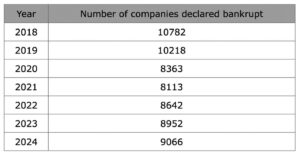
Only 40.2% of insolvency proceedings end with any payment being made.
The credit recovery rate is 10.4%. Although it is already low, this number is slightly misleading, since in most insolvency proceedings only the creditors with any sort of guarantee are able to recover any amount.
The statistics on debt recovery and the graduation of creditors makes it far more likely to recover a debt in a restructuring proceeding than in an insolvency.
Considering the proximity of insolvency proceedings where an insolvency recovery plan has been approved and the restructuring proceedings, although no statistics currently exist on the matter, it is certain that the amount recovered by creditors is by and large magnified.
As for judicial restructuring proceedings, there has been a slight negligible increase in recent years as the effects of the pandemic dissipate.
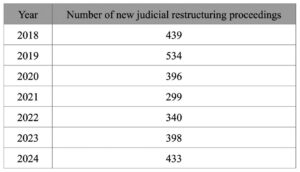
52% of restructuring proceedings end after the creditors and the company reach an agreement.
The Portuguese insolvency law, although far from perfect, allows to a certain degree of freedom desirable to maintain key players active in the Portuguese economy, even if, at a certain moment in time, they are unable to meet their due obligations. This, accompanied by the low odds of recovery of credits in a standard liquidation proceeding, has made the insolvency plan a cornerstone of large and complicated proceedings.
Furthermore, the low liquidity of the Portuguese market, makes Portugal and the insolvency scene a playground for foreign investors that want to own a stake in the Portuguese economy.
Finally, we believe that the current legal framework will be benefited immensely by the prospective European Union Directive that will bring forth the so-called “pre-pack procedure”, but we will write about that topic once the Directive is approved and implemented in Portugal.