No spam - just the latest insights!
Join over 30,000 industry professionals who subscribe for free

Subscribe for free!
We'll never share your information or send you spam

Neeraj Bansal is a Big Four partner with close to three decades of experience in risk consulting. His expertise spans Risk & Controls consulting, including internal controls, enterprise risk management, governance frameworks, process reviews and control transformation programmes. He also has deep expertise in supply chain transformation, having led major engagements across FMCG, ENR, EPC, technology, e-commerce and other sectors. He has served over 500 clients across 15+ countries and leads cross-border strategic initiatives. His advisory spans international trade, regulatory frameworks and global sourcing strategies. Neeraj has contributed to multiple government and industry forums, including the Federation of Indian Chambers of Commerce and Industry, Confederation of Indian Industry and the Central Government Task Force.
A Chartered Accountant, Certified Internal Auditor, Certified Information System Auditor, and Certified Public Accountant, Neeraj has completed executive education at Harvard Business School, Stanford University and the Indian Institute of Management, Ahmedabad. A prolific thought leader, he has authored 100+ articles and 75+ reports, is a frequent speaker at global conferences and a trusted advisor on issues shaping investment, supply chains and emerging market growth. In 2024, he received the Exemplary Business Leadership Award at the Indo-UK Global Business Conclave held at the House of Commons. He has received multiple leadership accolades, including CXO of the Year, Business Leader of the Year and Iconic Leader of Indian Real Estate, reflecting his influence across business and real estate advisory.
As global markets navigate uncertainty, India is emerging as one of the few economies where scale, resilience and policy direction are coming together to create a long runway for growth. With economic growth expected to be upwards of 6 per cent, the country is projected to remain one of the fastest growing major economies, supported by a large domestic market, policy stability and sustained investor confidence.1India remains among the fastest-growing economies even as growth slows amid Middle East conflict; outlook vulnerable to risks and uncertainty, World Bank, 9 April 2026, accessed on 24 June 2026
Now, alongside this economic momentum, India is also experiencing an unprecedented digital transformation. Over the past decade, the country has built a substantially large digital ecosystem, which is powered by internet adoption, digital payments, cloud computing and a growing technology ecosystem. Technology penetration is visible across sectors. From agriculture to logistics, digitisation is impacting every sector, creating new opportunities and smarter ways of working. Today, India is the world’s fifth most digitised economy,2India emerges as world’s 5th most digitalised economy, ranks 4th in Global AI Index: SIDE 2026 Report, Indian Startup Times, 29 May 2026, accessed on 24 June 2026 processing billions of Unified Payments Interface (UPI) transactions every month, while digital commerce, streaming platforms, cloud services and AI-enabled applications continue to expand at scale. India is also the second-largest market worldwide for smartphone users, with an estimated 659 million users.3Top 10 smartphone users by country in 2025: China represents the top spot, HindenTimes, 1 April 2025, accessed on 31 July 2026 As this ecosystem continues to mature, AI is expected to become an increasingly important layer of digital adoption, with India’s AI market projected to grow at a CAGR of more than 28 per cent through 2030.4Unlocking India’s AI potential: Market analysis by The India Watch, 5 October 2024, accessed on 31 July 2026 Every online payment, cloud application, video stream and e-commerce transaction creates data that must be stored, processed and secured somewhere. As a result, the volume of data being created across the economy is growing at an extraordinary pace.
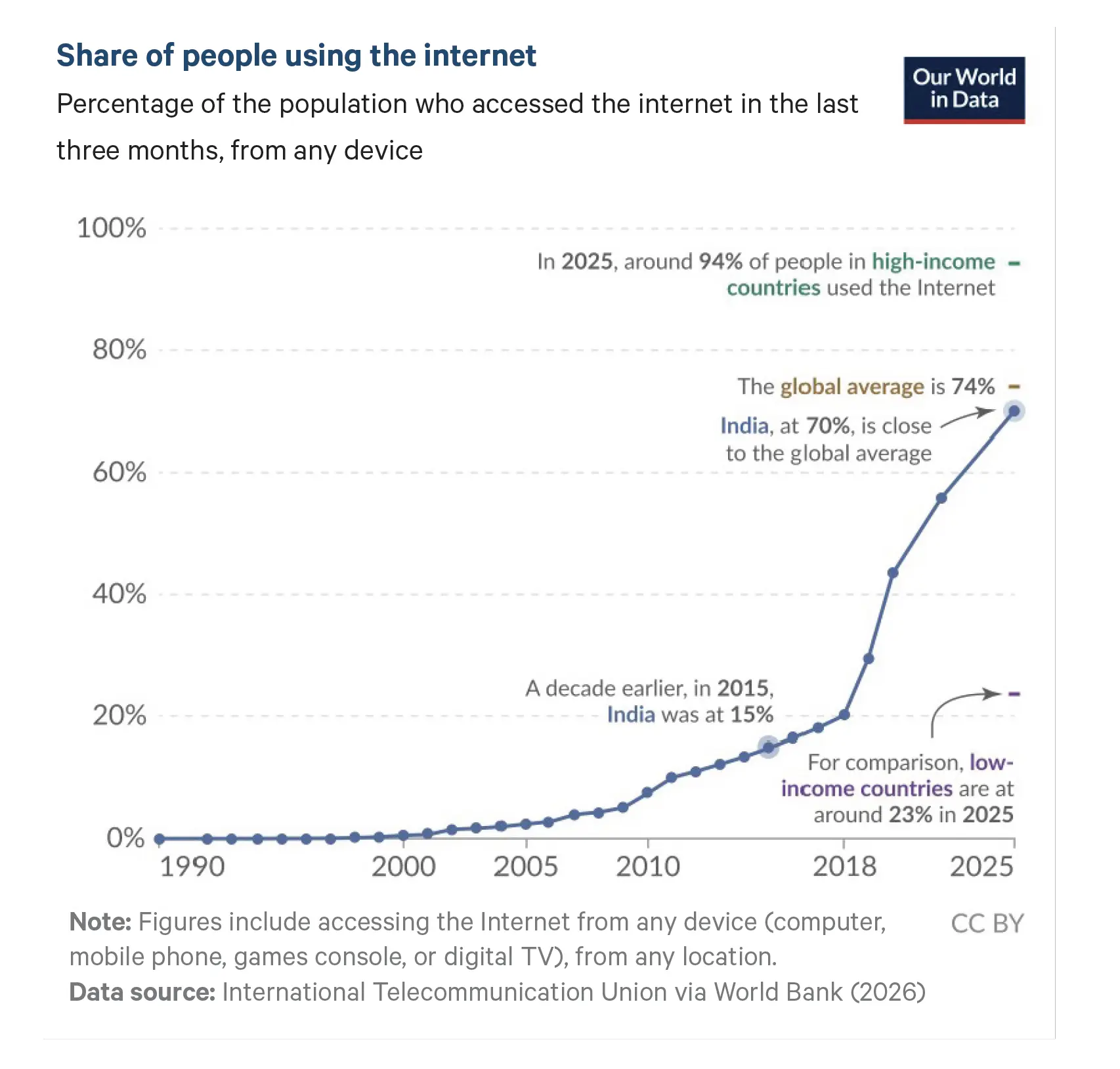
This wave of digitisation is driving a new kind of infrastructure requirement—data centres. They are now central to this shift, emerging as the backbone of the digital economy by enabling data storage and processing at scale. As demand for cloud, AI and digital services rises, India is steadily emerging as a strong global market for data centres—a shift that is also being recognised by global technology leaders. As Microsoft’s Nadella recently said while announcing the company’s latest AI investments, ‘India is emerging as a frontier AI nation.’ If digitisation laid the foundation for the sector’s growth over the past decade, AI could well shape its next chapter.
As this demand expands, so too are investors reassessing the sector. What was once considered a niche real estate segment is rapidly evolving into a mainstream real estate asset class, attracting substantial domestic and international capital. The convergence of digital demand, policy support and infrastructure expansion is creating a unique opportunity for India to establish itself as a major global data centre hub.
The growing importance of data centres highlights a much larger shift taking place across the digital economy. Earlier, growth was driven by traditional digital drivers. Now, next-gen technologies like AI, 5G and data-heavy applications are taking the lead. As organisations increasingly integrate AI into products, services and operations, the need for digital infrastructure is expanding beyond storage and connectivity to large-scale computing capacity. The next generation of factories is likely to be shaped by emerging technologies, with AI increasingly becoming integral to how products are designed, manufactured and delivered. To recall NVIDIA’s Jensen Huang’s words, ‘Every company will have AI factories.’ This captures the direction in which enterprise technology is moving: data centres are fast becoming the core infrastructure that will power the next generation of intelligence-led businesses.
The scale of opportunity becomes more clear when viewed through India’s data generation patterns. According to estimates, despite generating nearly 20 per cent of the world’s incremental data, India currently stores only around 3 per cent domestically.5Real estate highlight: Data center—India edition, Houlihan Lokey, December 2025, accessed on 24 June 2026 This represents a large and unique opportunity within the global digital infrastructure landscape.
Investors are responding accordingly. Industry reports suggest that between 2020 and April 2025, India attracted approximately USD14.7 billion in data centre investments, with foreign institutional investors accounting for nearly 86 per cent of total capital inflows.6Data center investment in India and the execution challenge, DC&T Global, 29 April 2026. accessed on 24 June 2026 Going ahead, the sector is expected to attract an additional 20–25 billion in investments by 2030.7India’s data centre capacity set to surpass 4,500 megawatts (MW) by 2030, backed by INR2,13,550 crore (USD25 billion) investments, IBEF, 29 May 2025, accessed on 24 June 2026
Today, the market is already scaling rapidly. In 2025, India’s operational data centre capacity crossed the 1,700 MW mark, supported by record annual addition of approximately 440 MW.8India’s data centre boom hits new gear: 500 MW of fresh capacity expected in 2026 as investment commitments near USD180 billion, BW Businessworld, 1 April 2026, accessed on 24 June 2026 Now, when we view this against the country’s growing digital appetite and ambitions, AI requirements and expanding localisation needs, this expansion represents only the beginning of a much larger growth cycle.
The scale of demand discussed earlier is beginning to reshape how investors view the sector. As data centres move from supporting digital growth to enabling AI, cloud and localisation requirements on a scale, they are increasingly being recognised as a distinct asset class in their own right. Unlike traditional commercial assets, data centres are supported by long-term contracts and strong occupancy, with added momentum from the expansion of global capability centres (GCCs), policy support and infrastructure status. Demand is also less dependent on economic cycles and more closely linked to long-term digital consumption trends, making the sector particularly attractive to institutional capital.
As a result, data centres are increasingly being viewed as critical digital infrastructure—an asset class that combines the stability of infrastructure with the growth potential of the digital economy. And for a country like India, there is immense scope as getting the ecosystem right for this kind of tech-driven infrastructure will be key as the economy evolves and global trends continue to shift.
The investment case for data centres in India becomes even more strong when viewed in a global context. While we can see that the market has grown rapidly in recent years, it still remains quite unprecedented compared to many of its peers. Today, India has approximately 1 MW of data centre capacity per million internet users. In comparison, China has 4 MW while the US has approximately 51 MW.9Real estate highlight: Data center—India edition, Houlihan Lokey, December 2025, accessed on 24 June 2026 This gap highlights the scale of the opportunity ahead. Despite being one of the world’s largest internet and data-generating economies, India’s data centre infrastructure remains at a relatively early stage of development. For investors, this combination of strong demand and low penetration is particularly attractive. Unlike mature markets where growth is incremental, India offers an opportunity to participate in a market that is still building out its foundational capacity. There is demand in the market—only capacity needs to keep pace with it.
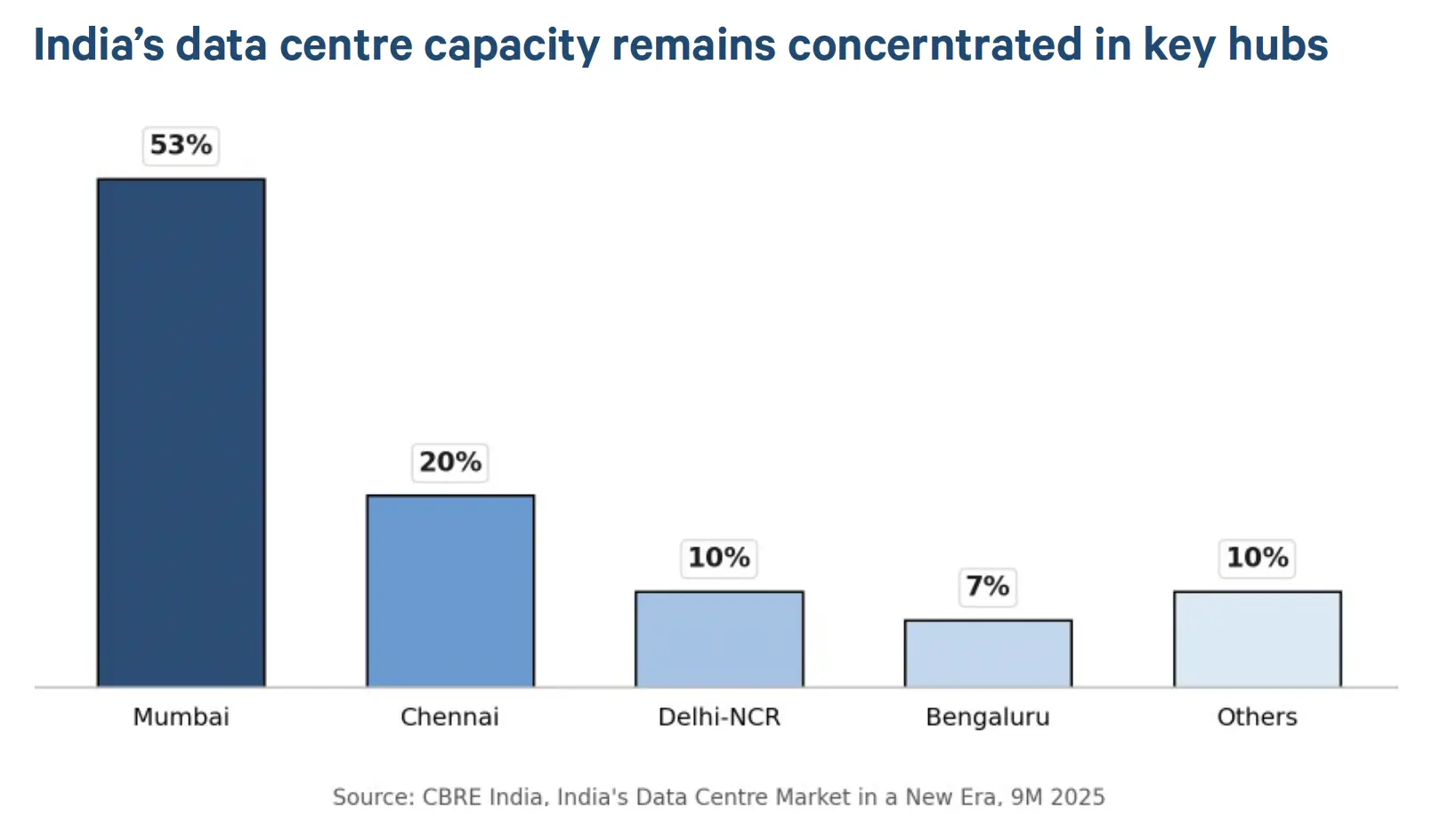
This opportunity is also visible in the way India’s current capacity is distributed. The market remains concentrated in a few established hubs, with Mumbai accounting for 53 per cent of data centre capacity, followed by Chennai at 20 per cent, Delhi-NCR at 10 per cent and Bengaluru at 7 per cent.10Mumbai leads India’s data centre capacity with a 53% share YTD, CBRE India, 12 November 2025, accessed on 14 July 2026 Together, these four markets account for nearly 90 per cent of the country’s total capacity, highlighting both the strength of existing hubs and the scope for wider expansion as AI, cloud and localisation-led demand deepens.11Mumbai leads India’s data centre capacity with a 53% share YTD, CBRE India, 12 November 2025, accessed on 14 July 2026
Now that we have seen how demand is unlocking new opportunities, let’s turn to the competitive advantages India brings to the table. When it comes to costs, the country fares well when compared to other emerging and global markets. Take development costs, for example. In India, these typically range between USD5.5–8.5 million per MW, placing it among the most cost-competitive markets globally, especially when compared to China and Singapore, where cost range is higher.12 India also enjoys an advantage when we consider the broader construction ecosystem. For example, at about USD705 per square metre, India remains one of the lowest-cost construction markets in the world, substantially below China at around USD910 per square metre and Vietnam at approximately USD1,087 per square metre.13
India also has broader ecosystem advantages. For example, the country’s talent base remains one of its strongest differentiators. Global companies can access expert engineering, AI, cloud, machine learning and cyber security talent at operating costs that are often 70–80 per cent lower than those in Western markets, without compromising on quality.14 The scale of this talent is equally significant. India is home to the world’s largest pool of digital and technology professionals, with nearly 2.5 million people employed across GCCs.15 As data centres become increasingly sophisticated and AI-driven, access to skilled talent will become as important as access to capital.
Together, these factors create a strong case for global investors. India offers what only a few markets can simultaneously provide: large-scale demand, room for capacity expansion, competitive development economics and a deep talent ecosystem. As the sector continues to mature, these advantages are likely to further strengthen the country’s position as an attractive data centre investment destination globally.
Now that we have seen how demand is unlocking new opportunities, let’s turn to the competitive advantages India brings to the table. When it comes to costs, the country fares well when compared to other emerging and global markets. Take development costs, for example. In India, these typically range between USD5.5–8.5 million per MW, placing it among the most cost-competitive markets globally, especially when compared to China and Singapore, where cost range is higher.12Real estate highlight: Data center—India edition, Houlihan Lokey, December 2025, accessed on 24 June 2026 India also enjoys an advantage when we consider the broader construction ecosystem. For example, at about USD705 per square metre, India remains one of the lowest-cost construction markets in the world, substantially below China at around USD910 per square metre and Vietnam at approximately USD1,087 per square metre.13Construction Cost Index by country 2026, World Population Review, accessed on 24 June 2026
India also has broader ecosystem advantages. For example, the country’s talent base remains one of its strongest differentiators. Global companies can access expert engineering, AI, cloud, machine learning and cyber security talent at operating costs that are often 70–80 per cent lower than those in Western markets, without compromising on quality.14India’s cost-to-talent advantage attracts global firms, Wisemonk, 3 June 2026, accessed on 24 June 2026 The scale of this talent is equally significant. India is home to the world’s largest pool of digital and technology professionals, with nearly 2.5 million people employed across GCCs.15India’s cost-to-talent advantage attracts global firms, Wisemonk, 3 June 2026, accessed on 24 June 2026 As data centres become increasingly sophisticated and AI-driven, access to skilled talent will become as important as access to capital.
Together, these factors create a strong case for global investors. India offers what only a few markets can simultaneously provide: large-scale demand, room for capacity expansion, competitive development economics and a deep talent ecosystem. As the sector continues to mature, these advantages are likely to further strengthen the country’s position as an attractive data centre investment destination globally.
While strong demand and attractive economics have laid the foundation for growth, policy support is emerging as an equally important catalyst for data centre growth. The government is increasingly recognising data centres as strategic digital infrastructure, resulting in a more supportive regulatory and investment environment. One of the key developments has been the Digital Personal Data Protection (DPDP) Act, 2023. With the act mandating data localisation, there is an increase in demand for data storage and processing within India’s borders. At the same time, the government has introduced initiatives such as the National Data Centre Policy, which aims to simplify clearances and proposes long-term tax benefits to improve project viability, and the Data Centre Incentivization Scheme (DCIS), which seeks to attract investments through fiscal support.
There is growing momentum at the state level too, with states like Karnataka, Gujarat, Maharashtra, West Bengal and Punjab rolling out dedicated policies, offering key incentives like stamp duty waivers, land access and tax breaks to attract data centre investments. Importantly, these measures are helping expand development beyond traditional markets like Mumbai, Chennai and Hyderabad, encouraging the emergence of new data centre clusters in tier-2 and -3 markets. Besides, the infrastructure status for the data centre sector improves access to long-term finance, enables more flexible investment structures and strengthens the sector’s appeal among institutional investors. Taken together, these developments are creating a more favourable investment environment for both domestic and global capital.
As policy support starts to align more closely with market demand, the way data centre projects are financed is also beginning to shift. What was once fairly traditional is now evolving into something more structured—moving towards platform-led, infrastructure-style investment models. Capital is being deployed through large development platforms, joint ventures and strategic partnerships. Take, for instance, the partnerships between Indian infrastructure developers and global hyperscalers, collaborations led by global investment firms with local digital and telecom ecosystems and private equity-backed data centre platforms. All point to how capital is increasingly being deployed through large, scalable models that combine capital, capabilities and long-term demand.
Unlike many traditional real estate segments, data centres are supported by long-term contracts with high-credit tenants such as global cloud providers and government entities. These agreements are creating stable and predictable revenue streams, making the sector particularly attractive to institutional investors seeking long-duration assets. As a result, the investor base is becoming more diverse.
At the same time, financing structures are becoming more sophisticated. Developers are moving beyond conventional bank lending to structured finance and innovative instruments. There is also a growing shift towards ESG-linked financing. Instruments such as green bonds and sustainability-linked loans are becoming more relevant, with financing costs often linked to performance indicators like energy efficiency, renewable energy adoption and carbon reduction. Today, ESG is no longer just a compliance requirement. It is becoming a core investment metric, with lenders and investors increasingly benchmarking projects on sustainability performance and financial returns.
Together, these shifts reflect a broader evolution of the sector. As data centres emerge as a mainstream infrastructure asset class, capital markets are evolving alongside, bringing in larger capital pools, more sophisticated financing structures and longer-term investment horizons to support the next phase of growth.
If the story so far has been one of growing demand, policy support and increasing investor interest, the next chapter will be defined by infrastructure readiness. The priority now is ensuring that power, water and supporting infrastructure can scale alongside the industry’s ambitions.
Power, in particular, will be central to the next phase of growth. Data centres are among the most energy-intensive infrastructure assets. And this intensity is only expected to increase as India’s capacity expands towards an estimated 8–9 GW by 2030.16India data centres: Powering the 9 GW ambition, GRI hub news, 12 December 2025, accessed on 24 June 2026 At that scale, data centres will potentially account for nearly 3 per cent of the country’s total electricity demand.17India’s power-hungry data centre sector at a crossroads, IEEFA, 6 June 2025, accessed on 24 June 2026 To put this into perspective, a single large data centre can consume as much electricity as 100,000 households.18AI surge: Data centres’ energy demand to double by 2030, says IEA report, DownToEarth, 10 April 2025, accessed on 24 June 2026 This raises important questions around grid readiness, reliability and access to continuous, high-quality power.
Addressing this will require a shift towards renewable energy integrated with storage solutions. The growing focus on battery energy storage systems (BESS)—supported by government initiatives such as the Viability Gap Funding scheme offering up to 30 per cent capex support—is already accelerating this transition.19India’s power-hungry data centre sector at a crossroads, IEEFA, 6 June 2025, accessed on 24 June 2026 At the same time, solar, wind and hydropower are becoming increasingly important in helping operators meet both energy requirements and sustainability goals. Going ahead, emerging energy sources such as nuclear, tidal and hydrogen can also play an important role in strengthening long-term energy security for the sector. Dedicated substations, power feeders and specialised data centre corridors will also be critical to ensuring reliable supply across major hubs.
Along with power, water availability is emerging as another important consideration. Data centres rely heavily on cooling systems, making water a critical operational resource. A 1 MW facility can consume nearly 68,500 litres of water per day,20Thirst Trap: Water sustainability issues loom over India’s booming data centre industry, The Economic Times, 14 July 2024, accessed on 24 June 2026 while industry-wide consumption is already estimated to be around 150 billion litres annually and is expected to more than double by 2030, as capacity continues to rise.21How is data centre infrastructure in India shaping power and water use, CEEW, 17 February 2026, accessed on 24 June 2026 This calls for a strong push towards innovation-led solutions. Greater R&D and the adoption of advanced cooling technologies, such as air-cooled systems, liquid immersion cooling and direct-to-chip cooling, will be essential to building a more sustainable and resilient data centre ecosystem.
Today, India has already begun laying the groundwork to support this next phase of growth. Strong policy support, increasing renewable energy integration, investments in critical infrastructure and continued emphasis on R&D have featured prominently in recent policies and several budgetary announcements in the last few years. The next step now will be execution—scaling innovations efficiently and bringing them into mainstream use cases more quickly.
Historically, every major economic transformation has been shaped by a foundational infrastructure asset. In the industrial age it was railways, ports and power plants. In the era of globalisation, it was highways, logistics networks and airports. Today, as economies become increasingly digital, data is emerging as significantly valuable resource and data centres are becoming the infrastructure that enables it. Now, in the new age of AI and emerging technologies, as they become more deeply embedded into businesses, governments and everyday life, the volume of data being created will only increase.
This is where India’s opportunity becomes particularly important. The country sits at the intersection of strong economic growth, one of the world’s largest digital populations, rising AI adoption and a rapidly evolving policy environment that is driven by stable governance. For global investors, developers and operators, the next big opportunity lies in building the capacity required to support India’s rapidly growing digital economy. As data becomes increasingly central to economic growth, India’s data centre sector is well placed to emerge as a key global infrastructure opportunity over the next decade.
Disclaimer: The views and opinions expressed in this article are solely those of the author and are made in a personal capacity. They do not necessarily reflect the views, positions or policies of the author’s employer, clients, affiliated organisations or any other institution with which the author may be associated.