No spam - just the latest insights!
Join over 30,000 industry professionals who subscribe for free

Subscribe for free!
We'll never share your information or send you spam

Lucy is a senior member of the firm’s Corporate and Investment Funds team, and the principal of the firm’s Australian operations. She works with clients primarily located in East Asia, the United States, and Australia, on matters concerning Cayman Islands and British Virgin Islands corporate law and investment funds law.
Lucy’s corporate practice covers the full spectrum of corporate transactions, with a focus on preferred equity financings, mergers/acquisitions, restructurings, privatisations and IPOs. On the investment funds side, Lucy has extensive expertise in the formation of Cayman Islands investment funds, and advising on the associated ongoing legal and regulatory issues.
Lucy has been practising law for over 25 years, including 8 years as a partner of Travers Thorp Alberga. Lucy is also a senior tutor in corporations law at the Australian National University.

Large streams from little fountains flow, Tall oaks from little acorns grow…1Version of a common proverb often attributed to D. Everett, in The Columbian Orator, 1797
To put the remarkable history of the Cayman Islands in perspective, it was not until 1966 that Grand Cayman welcomed its first telephone service.2Craton and the New History Committee, Founded upon the Seas: a History of the Cayman Islands and Their People, Ian Randle Publishers, 2003, p 355 Following this key event and others, years of hard work and entrepreneurship created the two pillars of the Cayman Islands economy – financial services and tourism.3For further reading, see Craton and the New History Committee, Ibid. In the present day, the gross domestic product of the Cayman Islands has reached US$6.84 billion,4https://data.worldbank.org/indicator/NY.GDP.MKTP.CD?locations=KY and the value of Cayman Islands regulated open- and closed-ended funds is estimated at around US$7.5 trillion.5Molnar, Mansi and von Finckenhagen, ‘Robust liquidity solutions for complex Cayman Islands fund structures’ Fund Finance 2023, Seventh Edition, p 206
Over recent years, despite focused competition from other jurisdictions, the Cayman Islands has continued to be the leading offshore jurisdiction for the establishment of hedge funds, private equity funds and their advisors. Currently, there are around 9,000 open-ended investment funds, 3,000 master funds, and 16,500 closed-ended private funds regulated by the Cayman Islands Monetary Authority (CIMA).6cima.ky/investment-statistics There are also over 1,500 ‘registered persons’ conducting securities investment business (typically, entities engaged in fund management and advisory services).7cima.ky/securities-statistics
Figure 1: CIMA registrations8Underlying statistics from cima.ky/investment-statistics and cima.ky/securities-statistics
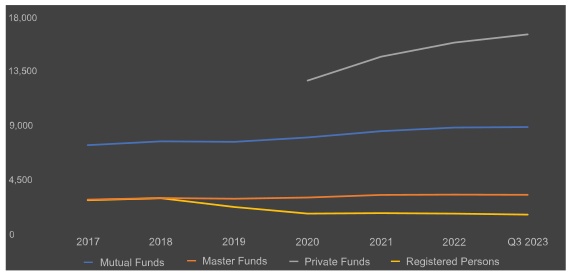
Private funds were brought into the CIMA registration regime in 2020, and the growth in their numbers reflects the strong performance of private equity over the period 2020 to 2022. Registered mutual funds have shown more modest growth, evidencing the challenging conditions for hedge funds in what was, up to 2022, a low interest-rate environment. The number of registered persons (known as ‘excluded persons’ until 2020) has dropped since a peak in 2018. The most likely explanation for this is the introduction of the Cayman Islands economic substance (ES) requirements in January 2019, which imposed ES obligations upon Cayman Islands-domiciled fund managers (but not those engaged in an advisory-only role).
There are several Cayman Islands statutes that govern investment funds, including the Mutual Funds Act (MFA), the Private Funds Act (PFA), the Securities Investment Business Act (SIBA) and the Directors’ Registration and Licensing Act (DRLA).
The MFA regulates open-ended funds in the Cayman Islands. A Cayman Islands-based pooled fund (whether formed as a company, unit trust or partnership) that offers redeemable equity interests to investors must register with CIMA under the MFA. In addition, certain trading subsidiaries of registered funds are defined as ‘master funds’ and are also required to register. The MFA was amended in 2020 to require previously exempt Section 4(4) funds (‘15 investors or less’ funds) to be registered.
Introduced in 2020, the PFA brought all closed ended funds (i.e., those that do not provide the investor with a right to redeem), including private equity funds, under a CIMA registration regime. A private fund is a company, unit trust or partnership that offers or issues investment interests, the purpose or effect of which is the pooling of investor funds with the aim of enabling investors to receive profits or gains from investments, where the investments are managed by or on behalf of the operator of the fund and investors do not have day-to-day control over the investments. Funds regulated under the MFA are specifically excluded from
the scope of the PFA, as are 26 ‘non-fund arrangements’, among them, joint ventures, proprietary vehicles, holding vehicles, preferred equity financing vehicles and individual investment management arrangements.
SIBA governs the registration and licensing of fund managers and fund advisors that are domiciled, or have established a place of business, in the Cayman Islands. Most Cayman Islands fund managers and fund advisors take advantage of the ‘registered person’ pathway under SIBA, which is available to (among others) those providing services to sophisticated and/or high net worth clients (including investment funds that meet this definition). Registration under this category is simpler and quicker than obtaining a full licence under SIBA, and has been the traditional route for fund managers and fund advisors for many years.
The DRLA and its accompanying regulations require registration or licensing of directors of, among others, a registered Cayman Islands mutual fund. Non-professional directors (those acting for less than twenty of such entities) must be registered, and professional directors (those acting for twenty or more covered entities) and corporate directors, must be licensed. The registered office of the relevant fund will receive a unique identification number for each director of the fund. Registration or licensing is then undertaken by the relevant director via CIMA’s web portal.
Directors of Cayman Islands funds that are structured as corporate vehicles, and directors of corporate general partners, are subject to common law directors’ duties. These duties are derived from principles of English common law, which have been substantially confirmed by various decisions of the Courts of the Cayman Islands. Broadly, directors’ duties fall into two categories: fiduciary duties, and duties of care and skill.
The anti-money laundering and combatting of terrorist financing regime of the Cayman Islands applies to all Cayman Islands-based funds. The regime also applies to fund managers, advisors and placement agents licensed or registered under SIBA. The regime requires the implementation of procedures for the identification and prevention of money laundering and the combating of terrorist and proliferation financing. In the case of Cayman Islands based funds, typically the procedures are delegated to the administrator or manager of the fund after suitability and legal review.
Additionally, Cayman Islands funds and SIBA registrants and licensees are required to have regard to financial sanctions in force in the Cayman Islands, which include all United Nations and United Kingdom sanctions.
Cayman Islands funds may be formed as companies (including exempted companies, segregated portfolio companies and limited liability companies), partnerships or unit trusts. The choice of organisational form and the broader fund complex structure will be driven by the legal, tax, regulatory and marketing requirements of the fund promoter, the location of the investors and the nature of the target investments. The Cayman Islands legal and regulatory regime allows maximum flexibility in the structuring of funds to meet these commercial imperatives.
That said, hedge funds and other open-ended funds are usually structured as exempted companies, with the segregated portfolio company form sometimes being utilised where ring-fencing of assets and liabilities within separate cells is desirable. It is also certainly possible, and often preferred, to use an exempted limited partnership or a unit trust as an open-ended fund. Closed-ended funds, including venture capital and private equity funds, are usually structured as exempted limited partnerships because they offer the ability to make distributions more flexibly, in line with capital accounts arrangements. However, again, it is permissible and sometimes desirable to use another type of legal entity for a closed-ended fund.
Fund structures may be as simple as a single legal entity, or comprised of multiple entities, such as a master-feeder structure, or a single fund entity that makes its investments through separate special purpose vehicles.
In October 2023 the Financial Action Task Force (FATF) announced that the Cayman Islands had been removed from the FATF list of “jurisdictions under increased monitoring”. This was the culmination of a process that began in 2021, when the FATF recognised that while the Cayman Islands had satisfied 60 of the 63 actions on its action plan to strengthen its anti-money laundering, counter-terrorism financing and counter-proliferation financing measures, it should be included on the FATF monitoring list pending completion of the final three measures. The Cayman Islands is now regarded by FATF as compliant or largely compliant with all 40 of the FATF’s recommendations.
In 2023, CIMA published two new rules relating to internal controls and corporate governance, and a revised statement of guidance on corporate governance. The main implication of these changes was an expansion in scope from mutual funds, to both mutual funds and private funds. In addition, these changes rendered corporate governance ‘failures’ of investment funds capable of giving rise to substantial administrative fines under CIMA’s administrative fining regime.
Further, investment funds, for the first time, became subject to a rule on internal controls. Investment funds were always under AML internal controls requirements pursuant to the Anti-Money Laundering Regulations and associated guidance; however, the new CIMA rule on internal controls goes to internal controls for the broader business and operations of regulated entities.
In acknowledgement of commercial realities, both new rules allow for proportionate application based on the size, complexity, structure, nature of business and risk profile of a regulated entity’s operations. Further, CIMA recognises that the various documentation requirements may be satisfied via typical fund documents.
These changes also affect Cayman Islands-domiciled investment advisors.
In 2022, CIMA changed its policy on the procedures for de-registration of funds, with the main change being to remove the interim ‘Licence under Termination/Liquidation’ options. These options previously enabled funds to receive a 50% reduction in CIMA’s annual fees pending completion of a de-registration. Since the change, funds instead remain fully registered and liable for the full annual fee amount, until all the requirements for de-registration have been satisfied. The audit requirements for a de-registering fund are strict, with a registered fund being required to submit audited financial statements either from the date of the last financial year-end to the date of the final distributions to investors, or from the date of the last financial year-end to the date of the final net asset value calculation. In limited circumstances, an audit waiver may be available.
The Grand Court of the Cayman Islands tries most types of civil disputes. The Financial Services Division of the Court was established in 2009, in order to handle more complex civil cases arising out of the financial sector. Special procedures were adopted by the Financial Services Division in acknowledgement of the needs of litigants in this area. Decisions of the Grand Court may be appealed, first to the Cayman Islands Court of Appeal, with the final appellate level being His Majesty’s Judicial Committee of the Privy Council.
In the recent Financial Services Division case of Aquapoint LP v Xiaohu Fan CICA 14 of 2022, unreported 4 October 2023 (in which Travers Thorp Alberga acted for the successful petitioner), the Court of Appeal, upholding Justice Doyle’s first instance decision, confirmed that the Court has jurisdiction to wind up an exempted limited partnership upon the presentation of a just and equitable petition by one of the limited partners. The Court emphasised that whether it is just and equitable to wind up a partnership (or a company) will depend heavily on the facts and the evidence before the Court, however in this case the conflicts of interest in the general partner’s decision making was a key factor in Justice Doyle’s decision to grant the petition. The Court’s comments on conflicts of interest and the importance of proper compliance with local requirements will be of particular relevance to directors acting on behalf of general partners, and continues the trend of the Cayman Islands Courts enforcing limited partners’ rights in recent cases.
Also of note is the 2023 decision of the Judicial Committee of the Privy Council, FamilyMart China Holding Co Ltd v Ting Chuan (Cayman Islands) Holding Corporation [2023] UKPC 33, which concerned the interaction of the Cayman Islands statutory winding up provisions, and those relating to arbitration. It was held that, while the winding-up of a company is exclusively to be determined by the Grand Court, there may be elements within a winding-up that can be referred to arbitration, notwithstanding that winding-up proceedings remain extant.
Naturally, fund investment strategies are very sensitive to market conditions. Investment strategies adapt in response to, and in anticipation of, developments in global markets, major political events and macro-economic factors. Examples are the growth of continuation funds and private credit funds in recent years. Continuation funds are created by private equity managers in order to acquire their own funds’ portfolio companies, thereby creating liquidity for investors, and they also offer the benefit of enabling managers to hold on to investments for longer, with the aim of improving returns. A private credit fund is an investment fund that makes loans, ranging from senior secured debt to junior unsecured loans, challenging traditional institutional lenders in this market, which is estimated to be worth US$1.4 trillion globally.9https://www.morganstanley.com/ideas/private-credit-outlook-considerations The Cayman Islands supports such innovation, and imposes no limitations on the investment strategies that funds may adopt.
In contrast to investment strategy, the preferred choice of legal structure is more static and, for the most part, not influenced by market developments. In the structuring of Cayman Islands funds, many considerations are relevant, although familiarity remains of prime importance
to promoters and investors. For that reason, most fund managers tend to adopt a market-standard legal structure, which is slow to adopt change.
An example of such market preference for maintaining the status quo is the introduction of limited liability companies (LLCs) in the Cayman Islands in 2016. A Cayman Islands LLC is a body corporate with separate legal personality, which confers limited liability upon its members. Upon introduction, the LLC form was of great interest to funds lawyers because it has many flexible features, while retaining legal and equitable concepts familiar to users of Cayman Islands exempted companies and exempted limited partnerships. The Limited Liability Companies Act was in-part modelled on the Delaware equivalent legislation. For that reason, LLCs can enable the establishment of an offshore fund vehicle that is a close parallel to an existing Delaware counterpart. However, currently only 218 out of 16,500 registered private funds are structured as LLCs, showing general hesitancy in the market to adopt novel legal forms for fund vehicles, even where there may be many benefits to doing so.10There has also been no significant use of Cayman Islands foundation companies (introduced in 2017) as investment funds, although they are a popular choice for decentralised autonomous organisations (DAOs)
As previously noted, by far the most popular structure for venture capital, private equity and other less-liquid alternative assets is the exempted limited partnership. A trend that continues strongly, especially for start-up fund managers, is the use of a simple and efficient version of this structure. In this model, typically the general partner of the fund will be a Cayman Islands exempted company, and there will be no separate investment manager in the structure. The benefits of this way to organise a smaller fund are that it is simple – which minimises costs – and it is well-understood and recognised in the market. There is also a cost saving in having the general partner hold management discretion over the investment of the fund’s assets, as opposed to establishing a separate regulated entity for this purpose. The key documents for this type of fund are an exempted limited partnership agreement and a subscription agreement. An offering memorandum is not essential for a private fund, as certain limited mandatory disclosures may be simply attached to the subscription agreement.