No spam - just the latest insights!
Join over 30,000 industry professionals who subscribe for free

Subscribe for free!
We'll never share your information or send you spam

Paweł Kuglarz is an attorney-at-law with over 30 years of professional experience working as a partner for international law firms, such as Beiten Burkhardt, Wolf Theiss and Taylor Wessing. He is currently head of the international desk at Tatara & Partners. He is a director of the Austrian Law School at the Jagiellonian University in Krakow, a European Commission expert for preparing a new directive for the harmonisation of insolvency and restructuring law, vice-president for International Matters of the INSO Section of the Allerhand Institute, and Poland’s representative at INSOL Europe Council. He is an author of commentaries on bankruptcy and real estate-related law, including “Commentary to the Act on Land Register and Mortgages”, “Consumer Bankruptcy” and “Bankruptcy of a Developer”. Paweł is a member of the International Exchange of Experience on Insolvency Law (IEEI).

Mateusz Kaliński is the communications manager and lawyer at Tatara & Partners Restructuring & Insolvency Law Firm, and focuses on various aspects of bankruptcy and restructuring law. He graduated from the Jagiellonian University and gained his master’s degree in law from the Catholic University of America. Mateusz handles complex insolvency and restructuring proceedings, both domestic and international. He specialises in dispute resolution
(including directors’ and officers’ liability issues) and corporate and commercial law. He is a secretary of the INSO Section of the Allerhand Institute and a member of INSOL Europe (and also YANIL – younger academics branch), as well as an expert for the World Bank Doing Business report and Global Indicators analysis.

Polish law offers a number of proceedings for businesses and individuals in distress. They span business insolvency proceedings, consumer bankruptcy as well as four restructuring proceedings. These solutions aid debtors but also create opportunities or risks for creditors. Please note that opportunities will arise as a rule for active creditors.
Restructuring proceedings are as follows:
With regard to insolvency proceedings, in Poland there is a regular one, regulated within Bankruptcy Law, as well as consumer bankruptcy, which sometimes can be a useful tool for over indebted former entrepreneurs or members of the management boards.
Within insolvency proceedings, an application for arrangement in bankruptcy may be filed and to such situation, some relevant provisions of Restructuring Law apply.
Corporate insolvency proceedings may be accompanied by pre-pack sale application.
Legal grounds for opening of restructuring proceedings is insolvency or threat of insolvency. Insolvency is defined as within Bankruptcy Law, namely a state, when the debtor lost ability to satisfy the mature pecuniary liabilities.
Other basis (legal grounds – specified in Bankruptcy Law) for insolvency is the over indebtedness – a situation when assets are higher than liabilities and this state of facts lasts for more than 24 months.
Currently in Poland the statistics for insolvency & restructuring raise significantly.
In 2023 we observed 408 companies declared insolvent, 611 bankruptcy petitions dismissed, mainly because of non-sufficient money to conduct the proceedings; and the following numbers of restructuring proceedings:
In Poland, as numbers are growing, the most popular proceeding is arrangement approval proceedings, counting up to over 92% of all restructuring proceedings.
This popularity is because of mainly out-of-court nature of arrangement approval proceedings (“AAP”).
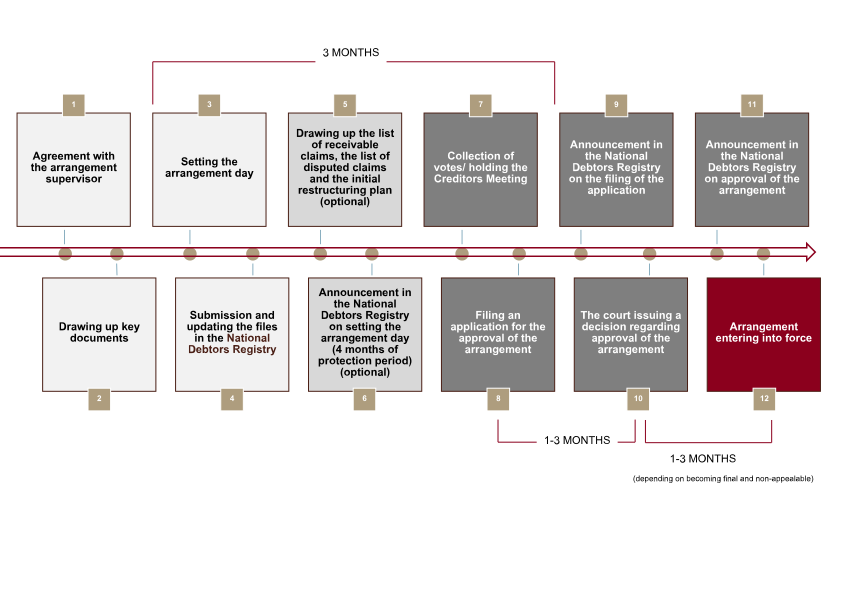
AAP is opened based upon decision of the debtor in cooperation with arrangement supervisor, who should hold insolvency practitioner’s license (regular of qualified one).
The course of the AAP is shown on the graph below:
Since December 2021, in Poland the National Debtors Register (KRZ) operates and all kinds of proceedings should be conducted and carried out within the system – at least with regard to companies.
Unfortunately, the KRZ system is only in Polish language version and is currently under expansion towards other elements, aimed to enhance and facilitate the method of conducting the proceedings.
Poland is ahead of important changes in the restructuring & insolvency framework.
The EU Restructuring Directive (also known as the Second Chance Directive) is still planned to be implemented.
Issues that need to be addressed with this regard include automatic stay of enforcement, cross-class cram-down issues, as well as treating secured creditors.
Moreover, in December 2022, the European Commission published Proposal for a Directive of the European Parliament and of the Council harmonising certain aspects of insolvency law, opening discussions on some of the potential changes into national laws, together with the remarks and positions towards the Proposal.
49 entities issued their positions within this legislative process, and now the European Commission analyses these documents, aiming to propose a Directive soon.
The Proposal covers, according to Article 1.1, the following areas:
Within the whole European Union the level of coherence of the abovementioned issues is relatively low, thus many Member States are now facing the need to assess what changes are required and what amendments to the law are necessary.
The proposed amendments regarding prepared liquidation (pre-pack) merit special attention.
In the section on pre-pack, the Proposal provides, among other things, for the appointment of a special, independent body (the so-called monitor) to evaluate the pre-pack procedure and the benefits to creditors. It is envisaged that this body may next be a bankruptcy trustee and at the same time a party to the pre-pack transaction concluded with the investor. In Poland, such a person could successfully be the Temporary Court Supervisor, who would then become the Trustee of the bankruptcy estate.
The proposal of the Directive also provides for the preparation of a test of the best satisfaction of creditors, as a basis for evaluating the price proposed by the investor.
Such a test is also postulated in the EU Restructuring Directive, and could be standardised, for example, in the practice of drafters, so as to serve the broadest and most reliable knowledge for creditors – parties in bankruptcy proceedings.
The Directive provides for the auction procedure, both with the involvement of an IP or without it. Where the court decides to appoint an IP (insolvency practitioner), the public auction is not required. Where the court refuses to appoint an IP, however, then the public auction procedure is obligatory. Polish insolvency law creates certain risks for an investor who decides to invest in the preparation of the prepack procedure, however. The investor makes a substantial financial effort as they need to carry out the required audits and due diligence reports. Once they lose the bid, all this financial involvement is wasted – the investor stands to recover nothing. Whereas the other participant, who may have offered 1 EUR more in the bidding process and then wins the auction, not only collects the assets (free from any collateral, with the execution sale effect) but also without any financial effort whatsoever on their part connected with the preparation of the pre-pack procedure.
That is why, the popularity of the pre-pack procedure in Poland has collapsed drastically after this rule was introduced in March 2020.
The solution is included in the proposed Directive as it envisages the possibility to get the investor’s ancillary costs of preparing the pre-pack reimbursed. This is an excellent example of how EU law can enormously improve national law.
The proposal of the Directive emphasizes the efficiency of the procedure, but also mentions the need to ensure its transparency. These values must always be properly balanced, as must the often conflicting interests of different categories of participants in the proceedings.
It is expedient to emphasise that pre-pack significantly increases the preservation of the value of the debtor’s enterprise from the point of view of its creditors. It is also of considerable importance from the point of view of preserving the enterprise itself, as well as jobs and the principle of a smooth transition between ownership entities.
Interestingly, also Article 23 of the Proposal explicitly provides for the suspension of enforcement proceedings, including in the case of preliminary proceedings – in the pre-bankruptcy phase.
The Proposal provides for changes to contracts entered into by the debtor, by allowing them to pass to a new buyer and even without the consent of the other party, and it would also be desirable to clarify what happens to the right of first refusal in the case of a sale in a pre-pack liquidation proceedings.
The issue of an appropriate organisational structure for the insolvency-related judicial system, which is nowadays inefficient, despite the idea of reform having been discussed for at least 20 years so far. Secondly, important changes may be introduced to insolvency practitioners formal self-government structures, endowing them with the possibility to enforce disciplinary responsibility.
With regard to the organisation of the judiciary system, nowadays, first instance bankruptcy and restructuring cases are processed in district courts (sądy rejonowe), which are the lowest level of Polish courts, irrespective of the value of the case and its complexity. Therefore, a first-instance judge has to deal with complex restructuring cases valued at billions of Polish zloty as well as simple consumer bankruptcy cases of relatively small value. The workload is overwhelming. First-instance judges are dealing with approximately 200 consumer bankruptcy cases and ten corporate restructuring cases at the same time – an untenable work load.
A better system would leave consumer bankruptcy cases at the district court level, so that individuals would have easy access to justice, whereas complex restructuring cases could be moved to regional courts. Such a reform has been discussed for over 20 years now, and lately has been emphasised by the INSO Section of the Allerhand Institute.
We believe the regional courts should also become specialised second-instance courts for cases from district courts. Moreover, cases heard in regional courts (sąd okręgowy) could be appealed to the appellate courts (sądy apelacyjne), which will help to make judgements more uniform in restructuring cases. Currently, Poland struggles with differing judgements in similar cases, which is a pitfall that needs to be addressed.
There is also a need to create a special chamber or unit within the Supreme Court (Sąd Najwyższy), which would be responsible for restructuring and insolvency cases. In our opinion, this reform complies with the requirements set forth in the Restructuring Directive, which places the stress on efficient judicial systems and also the proper training of insolvency practitioners.