No spam - just the latest insights!
Join over 30,000 industry professionals who subscribe for free

Subscribe for free!
We'll never share your information or send you spam

Masafumi Masuda is a partner at Mori Hamada & Matsumoto, admitted to practice in Japan and New York. He has advised extensively on legal issues in numerous IT and digital matters across various industries – in particular, gaming, metaverse and web services – and is now leading such emerging practices at his firm as head of the IT practice group. He has written extensively on IT and digital issues, including Introduction to Generative AI Law (co-editor, Asahi Shimbun Publications, 2023); Technology Disputes Law Review, 3rd edition (co-editor, Law Business Research, 2023); Law and Practice for App Business (co-editor, Nihon Kajo Publishing, 2022); and Copyright and Rules for Internet Business, 2nd edition (co-author, CRIC, 2020). He earned his B.Eng. from the University of Tokyo (2004), his J.D. from Chuo Law School (2007) and his LL.M. in Law, Science and Technology from Stanford Law School (2016).

Masahiro Ueda is a counsel of the firm, admitted to practise in Japan and New York. He is engaged in general corporate legal affairs with a focus on litigation and dispute resolution related to employment & labour law and intellectual property, and handles a wide range of general corporate matters, including business-to-consumer transactions and digital platforms involving the Act against Unjustifiable Premiums and Misleading Representations and the Consumer Contract Act. His extensive writings on consumer related laws and IT laws include International Comparative Legal Guide to: Class and Group Actions Laws and Regulations Japan 2024 (co-author, International Comparative Legal Guide, 2023), Introduction to Generative AI Law (co-author, Asahi Shimbun Publications, 2023), Law and Practice for App Businesses (co-author, Nihon Kajo Publishing, 2022). and Series on Practical Issues of Corporate Litigation: Internet Litigation (co-author, Chuokeizai-sha, 2017).

Kouki Kadota is an associate of the firm, admitted to practise in Japan. He provides a wide range of legal advice on competition laws and the Act against Unjustifiable Premiums and Misleading Representations and handles general crisis management, IT and digital matters. He has written Law and Practice for App Business (co-author, Nihon Kajo Publishing, 2022).

In Japan, gambling and the sale of lottery tickets are criminal activities under the Penal Code,1 and only the licensed forms of public gambling (horse racing, bicycle racing, boat racing and auto racing)2 and lotteries may be legally conducted. Also, gambling, including online forms thereof, is widely punishable under the law if it involves the acquisition or loss of economic value by means of chance and probability. It should therefore be noted that, for example, random-type sales (where the value of the goods or services purchased by the purchaser is randomly determined to be higher or lower than the paid amount) may be considered gambling under the Penal Code.
In addition, the Act against Unjustifiable Premiums and Misleading Representations (the “AUPMR”) regulates the provision of certain economic benefits as “premiums” if such benefits are provided incidentally to any transactions for products or services, and the value of these premiums must not exceed a certain threshold. While these are essentially regulations to protect consumers, they play a similar role to that of gambling-specific regulation.
In this article, we discuss (i) esports and (ii) online games as major venues where criminal gambling activity has increased and where regulations on premiums have recently been tightened in Japan. We also explain the current status of integrated resort (“IR”) policy planning, as IRs are currently being considered for introduction in Japan.
In Japan, the crime of gambling is punishable by a fine of up to JPY 500,000 or a petty fine.3 The same does not apply to gambling occasionally for recreation (e.g., if the players wager immediately consumable items, such as food, drinks or cigarettes), but this exemption is rarely applied.
In order to constitute “gambling” as referred to in the crime of gambling, “property”must be wagered and the “acquisition or loss” of that property must “be contested” in conditions involving “chance.” Here, “chance” means a state that cannot be predicted or controlled by a party at that party’s discretion, and thus it remains subjectively uncertain for the party. “Property” is not necessarily limited to money or any other tangible objects but refers to economic benefits in a broad sense. “Contesting the acquisition or loss” of property means that there is a winner who gains and a loser who loses the property.
Even if not engaging in gambling themselves, any person who, for the purpose of profit, runs a place for gambling or organises a group of habitual gamblers shall be punished by imprisonment for at least three months to five years.4 Therefore, it should be noted that the act of providing gambling services for users may also be punishable under the Penal Code.
In Japan, the government has not published any official guidelines regarding gambling. However, industry organsations in various industries have expressed certain thoughts about this topic, as explained in section 3 below, which may be helpful for business operators when considering whether their services are punishable as gambling.
In Japan, when a business operator offers economic benefits to consumers as a means of inducing them to purchase goods or services that the business operator itself supplies, such economic benefits are deemed to be “premiums” that are subject to regulations under the AUPMR. The regulations set the maximum value to prevent the inducement of customers to make purchases based on unjustifiable premiums. Specifically, the AUPMR distinguishes between two methods of offering premiums, each with a different maximum:
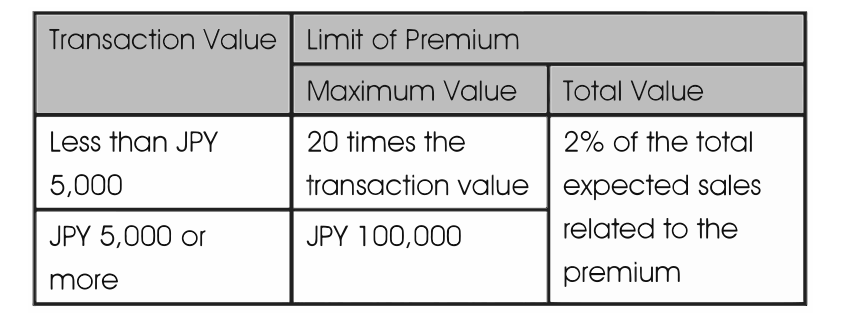
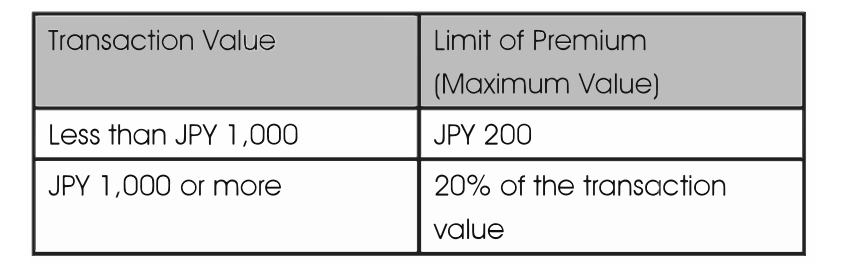
Business operators that violate these restrictions are subject to guidance and cease-and-desist orders from the administrative agencies.5 Although these measures themselves are not criminal penalties, any person (not legal entities) who violates a cease-and-desist order will be punished by imprisonment for up to two years or a fine of up to JPY 3 million, and the employer will also be punished by a fine of up to JPY 300 million.6
(a) Gambling and the JeSU Report
Where participants pay an entry fee to take part in an esports tournament to receive prizes (including money), the question arises whether the conduct of the participants and the operation of the tournament by the organiser fall under gambling and running a place for gambling respectively, as the participants are contesting the “acquisition” of the prize money or the “loss” of their entry fee. In this regard, according to the “Report on the Status of Efforts to Address Legal Issues Related to E-sports” (the “JeSU Report”)7 published by Japan esports Union (“JeSU”) in September 2019, JeSU concludes that it is permissible to conduct competitions by collecting participation fees from participants in cases where:
(i) the prize money/prizes is/are provided by a third party (such as a sponsor) other than the participants or the organiser; or
(ii) (even if the organiser offers prize money) the participation fee is used solely to cover the costs of running the competition, such as venue expenses and staff activities, and not for the prize money/prizes itself/themselves.
This conclusion is based on the assumption that if the winnings are not funded out of the participation fee, the participants are not considered to be contesting the “acquisition or loss” of the prize money/prizes among themselves.
(b) Premiums
If the prize money in an esports competition is awarded on the basis of certain transactions (e.g., if the game is offered for a fee or if the amount charged affects the performance of the player), it may qualify as a provision of “premiums” by means of general prizes under the AUPMR. In such case, the prize money must be offered within the limits described in section 2.2 above. However, according to paragraph 5(3) of the “Implementation Standards for Public Notice on Designation of Premiums, Etc.” (the “Implementation Standards”) published by the Consumer Affairs Agency, “the provision of money or goods that are recognised as compensation for work” does not constitute the provision of “premiums.” Thus, for example, if prize money is offered to participants selected by a certain method as compensation for their attractive performance to enhance the competitiveness and entertainment value of a competition, it is reasonable to consider that the provision of such prize money constitutes the provision of “compensation for work” above (and, therefore, the prize money is not a “premium”). The JeSU Report also expresses a similar opinion.
(a) Gambling
In Japan, offering so-called “gacha” (random in-game items, a.k.a. loot boxes or mystery boxes in other jurisdictions) in online games has generally been considered not to be gambling if those items cannot be redeemed for money. However, in the play-to-earn blockchain games that have emerged in recent years, users are allowed to sell NFTs (non-fungible tokens)
obtained through gacha services (“Gacha NFTs”) to third parties through in-game or external marketplaces and convert them into cryptoassets and/or money. The question arises whether such schemes are considered gambling due to the apparent “acquisition or loss” of the property being contested between NFT game providers and users, or among the users themselves.
In this regard, the Council for Sports Ecosystem Promotion published the “Guidelines for the Establishment of an NFT Package and Secondary Distribution Market for NFTs Using Sports Content”8 regarding services that combine packaged NFT sales and secondary distribution in September 2022, and the Blockchain Collaborative Consortium published the “Guidelines for Random-type Sales of NFTs” with other four organisations (collectively, “BCCC, et al.”)9 in October 2022. According to both sets of guidelines, regarding the relationship between the seller (a gacha service provider) and the user, in principle, it can be interpreted that the service provider will receive money or other consideration (property) equivalent to the actual sales price and the user will receive an NFT (property) whose value is equivalent to the actual amount paid. Therefore, it can be said that there is no “acquisition or loss” of property (unless the possible gacha result includes so-called “drawing a blank” (e.g., no NFTs are delivered)).10 BCCC, et al. also explain their idea that transactions take place between users in the secondary distribution market usually when only both parties agree on the price, so there is no mutual gain/loss relationship where the winner gains and the loser loses property, and no relationship of “acquisition or loss” of property arises.
These interpretations are all attempts to explain that the “acquisition or loss” of property does not arise in gacha services based on the assumption that the user always obtains a Gacha NFT of a value equivalent to the money they paid for the gacha service itself. However, it is not sufficient for NFT game providers to simply make such assertions. For example, if part of a Gacha NFT is sold at a lower price than the price of using the gacha service, the users who obtained the Gacha NFT through the service may be considered to have incurred a “loss” of property equivalent to the difference in price.
(b) Premiums
If Gacha NFTs are considered as “premiums” by means of general prizes under the AUPMR, they must be offered within the limits of premiums described in section 2.2 above. However, according to paragraph 4(4) of the Implementation Standards, “transaction incidentality,” which is one of the requirements of “premiums,” is repudiated when a source of economic gain that would ordinarily constitute the essence of a transaction in light of general commercial customs is provided. Therefore, if users will purchase gacha services for the purpose of obtaining Gacha NFTs, the Gacha NFTs would be regarded as a source of economic gain that would, in light of general commercial customs, ordinarily constitute the essence of transactions comprising the conduct of the purchased gacha services, and thus it would be possible to understand that Gacha NFTs are not incidental to any of the transactions.
In December 2016, Japan enacted the Act on Development of Specified Integrated Resort Districts (the “IR Act”) for the establishment of IRs. An IR is a group of facilities envisioned to consist of an international convention center, exhibition hall, hotels, restaurants, shopping malls, entertainment facilities, casinos, etc. to be established and operated by private business operators. Under the IR Act, a certified facilities operator may, when it has received a license from the Japan Casino Regulatory Commission, legally conduct licensed types of casino business and provide casino gaming methods in the licensed area.11 According to publicly available information, however, Japan’s first IR is not expected to open until autumn 2029 at the earliest.
Although gambling-related regulations may be concerning for broad service providers that randomly provide goods and services for a fee, they are quite general and abstract. Therefore, stakeholders must make individual analyses based on the specific circumstances to determine whether such random-type sales violate the Penal Code or the AUPMR. In conducting that research, it is essential to review the most recent standards and guidelines published by both the government and industry organisations because valuable reference materials in these areas have been frequently made available to the public.