No spam - just the latest insights!
Join over 30,000 industry professionals who subscribe for free

Subscribe for free!
We'll never share your information or send you spam

Paul is an Associate Partner at KPMG Consulting with over 18 years in financial services, specializing in structured finance and securities early in his career in New York and Tokyo, and later as a consultant specializing in regulatory driven and cross-border transformation for leading financial institutions in Tokyo and London. He currently leads KPMG’s global transformation services to financial institutions in Japan.

Jumpei is an Senior Manager at KPMG Consulting with over 7 years in financial services. He currently leads teams providing services to asset management companies including product and service design, market entry feasibility studies, etc. He also provides various services toward local Japanese government bodies including initiatives for establishing Japan and its key cities as an international financial center (program design and support in attracting Fintech and asset management companies from overseas), regional open innovation among financial institutions and municipalities, etc.

Nobu joined KPMG Consulting in 2021 and he is in charge of data analytics and Fintech research at Financial- Services Solution Unit. He has engaged in data analytics and data strategy projects for financial companies, and global financial center related projects to attract overseas fintech companies to Japan.
Prior to KPMG Consulting, he worked for Mizuho Research & Technologies, an IT and consulting company within Mizuho Financial Group, and served as Senior Technology Manager for creating new business based in San Francisco. Also, before moving to San Francisco, he was in charge of management accounting and created customer analysis and product portfolio analysis in order to establish the management plan.

Global investment in the Fintech sector has been trending lower over the past few years, due in part to the impact of COVID-19. In Japan as well, the amount of venture capital investment in Fintech companies has continued to decline since reaching a peak in 2021, and the aggregate investment in 2023 fell below that of 2020 (see Figure 1).1CB Insights, “State of Fintech 2023 Report”, https://www.cbinsights.com/research/report/fintech-trends-2023/ On the other hand, there were concerns that investment was overheating in 2021, and as the market in general recovers going forward, investments in Fintech are also expected to rebound.

Characteristics of Fintech in Japan
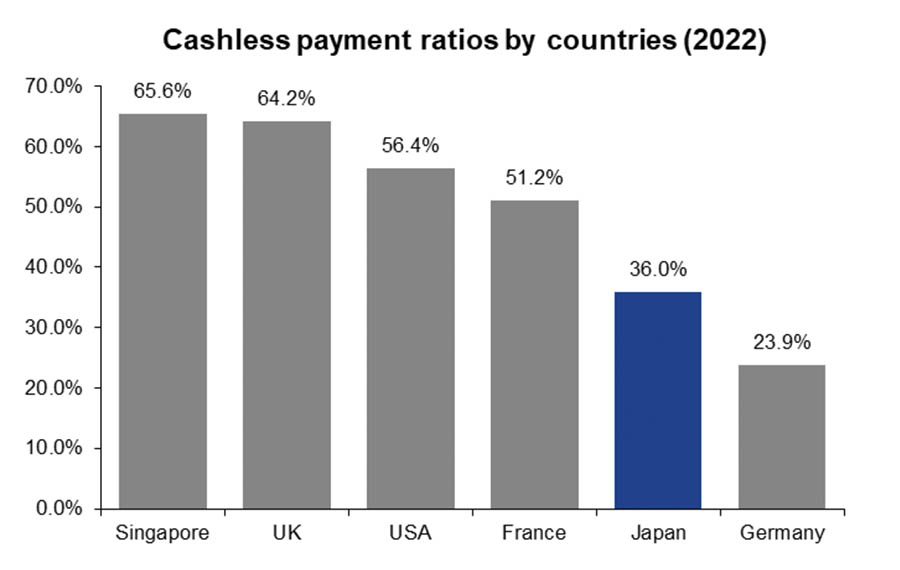
The ratio of cashless payments in Japan is lower compared to many other countries and has long been an issue (see Figure 2 below).2Payments Japan Association. We Calculated the Cashless Payment Ratio of Major Countries for 2022”, https://paymentsjapan.or.jp/news/2022%e5%b9%b4%e3%81%ae%e4%b8%96%e 7%95%8c%e4%b8%bb%e8%a6%81%e5%9b%bd%e3%81%ab%e3%81%8a%e3%81%91%e3%82%8b%e3%82%ad%e3%83%a3%e3%83%83%e3%82%b7%e3%83%a5%e3%83% ac%e3%82%b9%e6%b1%ba%e6%b8%88%e6%af%94/ For that reason, Japan’s Ministry of Economy, Trade and Industry (METI) announced its “Cashless Vision” in April 20183Ministry of Economy, Trade and Industry, “Cashless Vision”, https://www.meti.go.jp/policy/mono_info_service/cashless/image_pdf_movie/cl_vision.pd and has been promoting cashless payments nationwide. Many payment and remittance related services have since emerged in Japan, with numerous new payment platforms being launched, particularly aimed at retail consumers. At the same time some companies have also withdrawn from the market as a sign that competition in this sector is intensifying. According to KPMG’s research there are approximately 400 Fintech companies in Japan4Refers to companies registered with the Financial Services Agency (FSA) of Japan and those that are members of Fintech-related industry organizations, etc., and 30 to 40 percent of them are engaged in payment and remittance related business, indicating that Fintech in Japan is heavily focused on payment related services.
<Figure 3: List of Payment Platforms in Japan (not
exhaustive)>
While Japan, particularly Tokyo, is known as highly technologically advanced, there are certain factors at play that may be holding back Japan’s prominence as a Fintech powerhouse, namely its complex regulatory environment, demographics and culture, and attractiveness as a global financial center.
While Japan is not alone in this sense, its complex set of laws and regulations is not only a challenge to navigate but also presents certain concrete limitations on the growth of Fintech. Each relevant set of rules can be complex on its own, but a further complicating factor for Fintech companies is that they are sometimes overlapping and overseen by different authorities; for example, while the Payment Services Act, the Banking Act and the Money Lending Business Act are enforced by the Financial Services Agency (FSA), the Installment Sales Act is enforced by METI. For a similar reason it has traditionally been viewed that regulatory licenses are difficult to obtain. Language is a further complicating factor – conventional wisdom is that a fluent Japanese speaker who also has deep understanding of the regulatory landscape is a must-have.
The demographic trends of Japan are not necessarily a uniquely Japanese issue, but certainly add complexity to Fintech companies seeking to navigate the Japanese market. With its aging population that is sometimes seen as resistant to change – consider, for example, Japan’s particularly low rate of cashless payment adoption and high ratio of assets held in deposits and even hard cash – a commitment to localization of any Fintech solution may be considered a necessary part of doing business in Japan. The financial services industry in general and even regulators are often viewed as conservative as well, particularly when it comes to adopting new technologies. Although there are movements among Japanese financial institutions to establish digital banks and collaborate with Fintech companies, only 18.3% of banks’ expenditures on IT is accounted for by new system development,5The Center for Financial Industry Information Systems. Results of Questionnaire Survey of Financial Institutions in FY 2023”, https://www.fisc.or.jp/publication/book/006100.php and banks are still only permitted to hold up to a five-percent stake in non-financial (including Fintech) companies.
The points noted above are all contributing factors to Tokyo’s overall attractiveness as a global financial center. Tokyo ranked 20th on the Global Financial Centres Index 36 announced in September 2024, which evaluates the relative competitiveness of major financial centers around the world. In the same report, Tokyo was ranked 36th in terms of its ability to provide a competitive environment for Fintech providers.6Z/Yen Group Limited, “The Global Financial Centres Index 36”, https://www.longfinance.net/media/documents/GFCI_36_Report_2024.09.24_v1.0.pdf3. Ministry of Economy, Trade and Industry, “Cashless Vision”, https://www.meti.go.jp/policy/mono_info_service/cashless/image_pdf_movie/cl_vision.pd An attractive financial center for Fintech must provide ample access to finance, an innovative ecosystem and availability of skilled staff. This ranking is one snapshot indicative of the challenges Fintech companies need to be prepared to face upon entry into the Japanese market.
On the other hand, various governmental bodies, notably the FSA and the Tokyo Metropolitan Government (TMG) are putting improving Japan’s attractiveness as a financial center high on their agendas. In December 2020 the Japanese government published its “New Comprehensive Economic Measures,” including a policy package to promote this objective, and the FSA followed suit in January 2021 by establishing the Financial Market Entry Office, as well as a Financial Start-up Support Program, with a dedicated English language website promoting foreign investors’ entry into the Japanese market.7https://www.fsa.go.jp/internationalfinancialcenter/en/ In 2019, the TMG established The Organization of Global Financial City Tokyo (FinCity.Tokyo) as a public-private partnership with the stated mission “to boost the attractiveness of Tokyo’s financial ecosystem, raising its profile as a top-class global financial city.”8https://fincity.tokyo/en/aboutus/
The FSA made amendments to the Payment Services Act, effective from May 2021, removing caps on fund transfer service by nonbank institutions and providing greater flexibility for new entrants, and made further amendments effective from June 2023 that became one of the world’s earliest stablecoin regulations. The FSA is also currently deliberating on additional amendments to the Payment Services Act to be submitted to the Diet in 2025. While the full effect of these initiatives remains to be seen, they make it clear that there is a recognition of the need to improve Japan’s attractiveness to foreign investors, particularly Fintech companies.
In recent years local governments in Japan have been focusing on attracting and developing Fintech companies. Below we discuss two such activities in particular, namely digital local currencies and establishment of asset management special zones.
As noted above, the shift toward cashless payments in Japan has been accelerating, and recently the introduction of digital local currencies is also gaining momentum. Digital local currencies are often issued in conjunction with local municipal governments and issuers are seeking to collaborate with various government initiatives rooted in the local community. QR (quick response) codes are often being adopted as the form of cashless payment in these cases, but they can only be used within a limited region. There is, however, a reason for deliberately introducing such an inconvenient currency.
In many regional municipalities there is a tendency for consumption to flow out of the region and into large cities, rather than circulating within the region itself. An indicator that shows how much the economy circulates within a specific region is the local economic circulation rate. In municipalities where this figure is low, introducing a regional currency can serve as a way to improve the local economic circulation rate.
In the city of Higashimurayama in the Tokyo Metropolitan area, as an example, subsidies for purchasing energy efficient appliances were provided, and distribution of these subsidies was made using EinPay, the city’s own digital local currency. Digital local currencies like this have a significant advantage over traditional paper-based local promotion vouchers, as their digital nature allows for the utilization of the accompanying data. Issuers of digital local currencies can thereby observe consumer behavior, allowing them to measure the effectiveness of various campaigns and initiatives, and depending on the design of administrative policies, it may also become possible to evaluate the impact of those policies. Traditionally, measuring the effectiveness of administrative policies has not been easy, and many initiatives have been left unmonitored. However, by utilizing digital local currencies it becomes possible to assess the impact of these policies, and this is expected to contribute to the advancement of Evidence-Based Policy Making (EBPM).9EBPM: The process of formulating policies not by relying on one-off, anecdotal episodes, but by clearly defining the policy objectives and basing decisions on information and data (evidence) that are critical to evaluating the effectiveness of the policies In this way, the combination of government and digital payments has the potential to address administrative challenges beyond the realm of finance.
One unique challenge in Japan is the high deposit ratio and low liquidity of funds. While the deposit ratios in the United States and Europe are 12.6% and 35.5%, respectively, Japan’s ratio stands at 50.9%.10Bank of Japan, “Flow of funds statistics”, https://www.boj.or.jp/statistics/sj/sj.htm This indicates that a significant amount of funds remain in cash and cash deposits and are not being utilized for investment purposes, sometimes not entering the financial system at all (see Figure 4 below).

Against this backdrop, the Japanese government announced its “Policy Plan for Promoting Japan as a Leading Asset Management Center” in December 2023.11Cabinet Secretariat, “Policy Plan for Promoting Japan as a Leading Asset Management Center”, https://www.cas.go.jp/jp/seisaku/atarashii_sihonsyugi/bunkakai/sisanunyou_torimatome/ planen.pdf The government is promoting measures directed at households, which are the providers of funds within the investment chain; banks and securities companies that intermediate those funds; asset management firms and asset owners such as pension funds that engage in fund management; and the companies that are beneficiaries of these investments (see Figure 5).
<Figure 5: Policy Plan for Promoting Japan as a Leading Asset Management Center>12Cabinet Secretariat, “Policy Plan for Promoting Japan as a Leading Asset Management Center”, https://www.cas.go.jp/jp/seisaku/atarashii_sihonsyugi/bunkakai/sisanunyou_torimatome/ planen.pdf

to Achieve Special Zones for Financial and Asset Management Businesses” with the aim of concentrating financial and asset management industries in specific regions.13Financial Services Agency, “Publication of the ‘Policy Package to Achieve Special Zones for Financial and Asset Management Businesses’”, https://www.fsa.go.jp/en/news/2024/20240604. html The regional scope comprises the city of Sapporo and prefecture of Hokkaido, the Tokyo metropolitan area, and the cities and prefectures of Osaka and Fukuoka. In each of these regions initiatives are expected to be implemented that leverage the unique characteristics of each respective area. Additionally, the Japanese government plans to provide support for foreign investors and implement measure to attract specialized professionals in fields such as Green Transformation and Fintech from abroad. The four regions designated as Special Zones for Financial and Asset Management Businesses are expected to actively work to attract investments from abroad as well as Fintech and asset managers, following the guidelines shown in Figure 6.
<Figure 6: Areas assigned as the Special Zones for Financial and Asset Management Businesses>14Financial Services Agency, “Publication of the ‘Policy Package to Achieve Special Zones for Financial and Asset Management Businesses’”, https://www.fsa.go.jp/en/news/2024/20240604. html

plans to implement the following measures:
The four Special Zones will implement the following common measures aimed at getting foreign investment management companies and Fintech firms to take root in these regions:
Singapore, Hong Kong (SAR) and Shanghai, which are among the leading international financial centers in Asia, have been focusing on the field of Fintech as a key area for several years (see Figure 7). Each of these financial centers has adopted a policy of actively promoting the digitalization of financial infrastructure, talent development and regulatory easing.
<Figure 7: Fintech initiatives of major global financial centers in Asia>
|
Singapore |
Financial Services Industry Transformation Map 2025 / Monetary Authority of Singapore (MAS) 13 • Announced in September 2022 • MAS’ growth strategies to further strengthen Singapore’s position as a leading international financial center in Asia • Key Strategies • Enhance Asset Class Strengths • Digitalize Financial Infrastructure • Catalyze Asia’s Net-Zero Transition • Shape the Future of Financial Networks • Foster a Skilled and Adaptable Workforce |
|
Hong Kong |
“Fintech 2025” Strategy / Hong Kong Monetary Authority (HKMA) 14 • Announced in June 2021 • The new fintech strategy, which aims to encourage the financial sector to adopt technology comprehensively by 2025 i. All banks go fintech ii. Future-proofing Hong Kong for Central Bank Digital Currencies (CBDCs) iii. Creating the next-generation data infrastructure iv. Expanding the fintech-savvy workforce v. Nurturing the ecosystem with funding and policies |
|
Shanghai |
Fintech Development Plan (2022 to 2025) / People’s Bank of China (PBOC) 15 • Announced in January 2022 • PBOC set out guidelines on the Fintech development in a new era and specified the overall plan • Eight Main Tasks i. Improving governance of fintech ii. Fully unleashing the potential of data as a production factor iii. Building new digital infrastructure iv. Deeping the application of core technologies v. Activating new drivers of digital operation vi. Reshaping financial services with intelligence vii. Strengthening prudential regulation of fintech viii. Consolidating the foundation for the sustainable development of fintech |
As many Asian countries and regions focus on Fintech, it is crucial for Japan to foster a shift in mindset among domestic financial institutions to actively collaborate with Fintech companies, ease regulations, and create an environment (particularly the four Special Zones) that is attractive to foreign companies through regulatory reforms, proactive promotion and other measures. Further, while many Japanese Fintech companies are focused on payment and remittance services, it is crucial to foster and attract investment related Fintech companies in order to further expand investment management activities and realize the goal of becoming a global asset management hub (see Figure 8).