No spam - just the latest insights!
Join over 30,000 industry professionals who subscribe for free

Subscribe for free!
We'll never share your information or send you spam

Tomotaka leads Data Driven Re-Design Strategy Team, a part of Strategic Impact, which offers solutions to social issues.
Before joining EY, he worked for a government financial institution and a global consulting firm.
He spearheads initiatives for solving various social issues, focusing on formulation of data-driven strategies.
In recent years, along with supporting policymaking for tourism, he has been playing a leading role in offering data utilization platform services in cooperation .
with local governments and tourism-related operators throughout Japan. Now he is recognized as one of the leading experts in ecosystem and platform businesses.
Member of the Japanese National Mirror Committee for ISO/TC 228 Tourism and related services.
Committee Member of the Japan Tourism Agency (Promotion of tourism DX)
Committee Member of the Japan Tourism Agency (Functional enhancement for JNTO certified Foreign Tourist Information Centers)
Evaluator for Sustainable Countryside Stay Models Creation Support Program

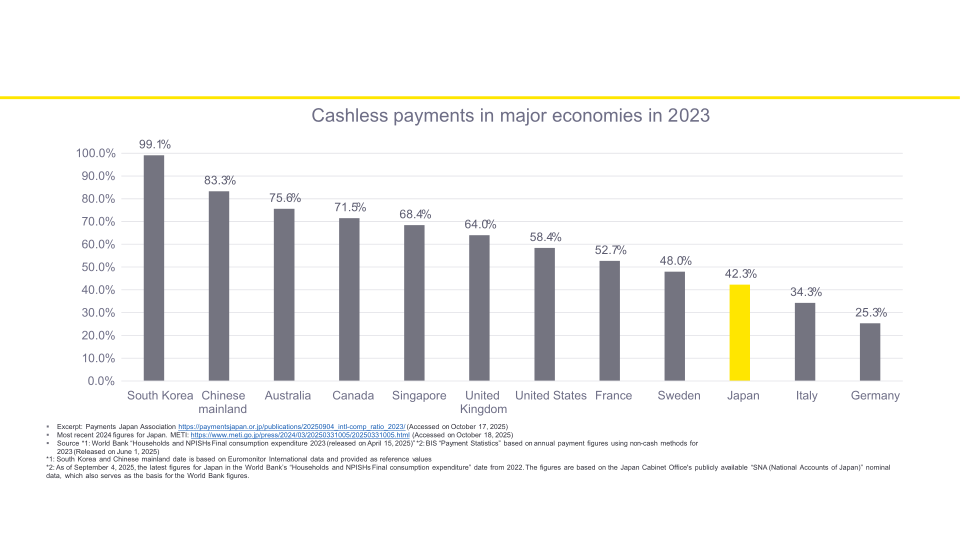
Society’s shift to a digital economy is accompanied by the increasing adoption of cashless payments. The Japanese government announced its “Cashless Vision,”1Japan Ministry of Economy, Trade and Industry (METI) “Cashless Vision” (released in April 2018) https://www.meti.go.jp/policy/mono_info_service/cashless/image_pdf_movie/cl_vision.pdf (Accessed on October 18, 2025) in April 2018, when it set a target to increase the ratio of cashless payments to 40% by 2025, with the long-term goal of achieving the global standard ratio of 80%. Japan reached 42.3% by 2025, achieving its initial target a year ahead of schedule. This success demonstrated significant progress in establishing a cashless landscape in the country. However, while Japan advances toward its 80% target, it still sits below South Korea, the Chinese mainland and Singapore.
Cashless Payments in major economies in 2023
In the development of a cashless landscape in Japan, we note the increasing prevalence of credit card payments and the services offered by domestic payment providers. Japan is currently experiencing a substantial rise in inbound visitors so it should develop a cashless ecosystem that integrates payment systems that they use. Many of today’s travelers prefer to carry minimal or no cash when they travel.
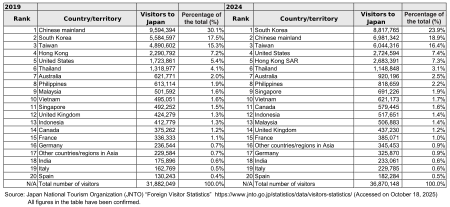
Japan’s inbound tourism has entered a new growth phase, having made a robust recovery from the effects of the COVID-19 pandemic. Visitor numbers reached 36.87 million in 2024, surpassing pre-pandemic levels, with the largest share from Japan’s nearest neighbors in East Asia (the Chinese mainland, South Korea, Taiwan and Hong Kong), as well as Southeast Asian nations such as Thailand, the Philippines, Singapore, Indonesia and Malaysia.
Inbound visitors to Japan (2019 and 2024)
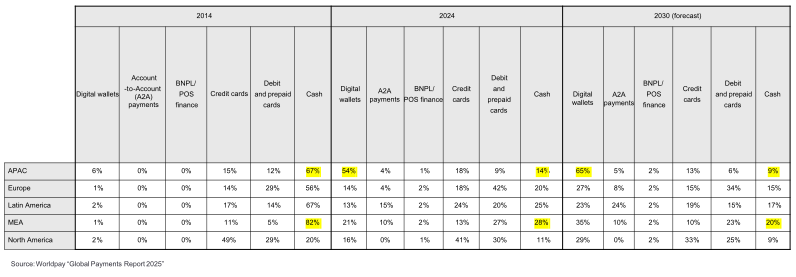
Recent advances in technology have led these countries/regions to adopt cashless payment methods, with an emphasis on the swift expansion of mobile payment platforms, including mobile wallets, alongside traditional credit card payment systems. As Japan’s cashless ecosystem evolves, we believe it should prioritize not only domestic payments but also enhance convenience and satisfaction for the increasing number inbound travelers. Implementing a seamless, cashless experience is crucial to driving additional spending by inbound tourists.
The cashless landscape
As noted, Japan’s tourism sector is experiencing significant growth, driven by a strong influx of international visitors. We expect the introduction of “payment roaming,” which enables travelers to utilize familiar digital payment methods from their home country while travelling overseas, to enhance tourism spending by alleviating the stress and complications often associated with making foreign payments.2The World Travel & Tourism Council (WTTC) projects that the total contribution of travel and tourism to the global economy will reach a record $11.7 trillion in 2025, representing 10.3% of global GDP. The WTTC also forecasts that by 2035, the sector will inject $16.5 trillion into the global economy, accounting for 11.5% of global GDP. This represents a decade-long growth rate of 3.5% annually, outpacing the wider economy’s 2.5%. WTTC “Global Travel & Tourism is Strong Despite Economic Headwinds” https://wttc.org/news/global-travel-and-tourism-is-strong-despite-economic-headwinds (Accessed on October 18, 2025) Exchanging currency to rely exclusively on cash while traveling has significant limitations. In contrast, access to cashless payment solutions, such as credit cards, allows visitors to enjoy travel without being restricted by the amount of cash that they carry.
In the lead-up to the Tokyo 2020 Olympics, as Japan accelerated its shift to a cashless society, Chinese mobile wallets, like Alipay and WeChat Pay, were integrated into Japan’s payment ecosystem and reshaped how Chinese tourists could spend money, with a significant proportion of visitors increasing their use of digital wallets. While travelers from other Asian countries are also increasing their use of credit cards, cash remains their primary form of payment.
However, any future increase in the number of travelers from Asia, particularly of younger people who prefer cashless transactions, requires building a payment ecosystem that includes popular Asian mobile wallets, as a complement to credit cards, to drive consumption by that demographic.3In a report from a project commissioned by METI, a survey was conducted which included the question, “Do you believe that the availability of cashless payments in Japan has contributed to an increase in consumption?” 76% of respondents indicated that “consumption has increased.” Refer to METI’s “Second supplementary budget for FY2022: Digital payment model standardization and overseas collaboration project (Study on the interoperability of unified QR code payments)“ (released in February 2024) https://www.meti.go.jp/meti_lib/report/2022FY/060233.pdf (Accessed on October 18, 2025)
Payments by inbound visitors to Japan

Scanning QR codes is the primary payment technology used in mobile wallets in Asia, which has driven a movement to standardize QR code payments across the region, especially in the ASEAN region.4All ASEAN member states (except for Brunei) and India have launched unified QR code payment systems. Refer to METI’s “Second supplementary budget for FY2022: Digital payment model standardization and overseas collaboration project (Study on the interoperability of unified QR code payments)“ (released in February 2024) https://www.meti.go.jp/meti_lib/report/2022FY/060233.pdf (Accessed on October 18, 2025) As many QR code-based payment providers already operate in Japan, we anticipate that handling transactions by merchant acquirers will become more complex. As a consequence, establishing a framework to unify QR code standards and facilitate approvals for QR code payment providers (issuers) would make it easier to create a more seamless and cashless ecosystem.
The adoption of unified standards across ASEAN has been accompanied by initiatives to also establish cross-border QR code payment systems. In November 2022, five ASEAN central banks — Indonesia, Malaysia, the Philippines, Singapore, and Thailand — signed a memorandum of understanding (MOU) to cooperate on regional payment connectivity. This initiative, led by Indonesia, aims to create more inclusive cross-border payments through standardized QR code payments and the linkage of instant payment systems.5Bank of Thailand “CENTRAL BANKS OF INDONESIA, MALAYSIA, PHILIPPINES, SINGAPORE, AND THAILAND SEALED COOPERATION IN REGIONAL PAYMENT CONNECTIVITY” November 14, 2022, https://www.bot. or.th/en/news-and-media/news/news-20221114.html (Accessed on October 18, 2025) The State Bank of Vietnam joined the RPC initiative in August 2023.6Bank of Thailand “JOINT PRESS RELEASE Regional Payment Connectivity Expansion to Include State Bank of Vietnam” August 25, 2023, https://www.bot.or.th/en/news-and-media/news/news-20230825-02.html (Accessed on October 18, 2025) Signatories to the MOU have initiated bilateral QR payment interoperability.
Japan also intends to implement interoperability of QR payments with other ASEAN countries in 2025. Efforts are now underway to build a payment ecosystem for mobile wallets by integrating Japan’s JPQR standard, developed by the Payments Japan Association (formerly, the Cashless Promotion Council), with ASEAN’s unified QR standards.7Nihon Keizai Shimbun “Japan, ASEAN to launch joint QR code payment services in FY2025” (March 14, 2024) During the Osaka-Kansai Expo 2025, Japan and Cambodia launched Phase 1 of a cross-border QR code payment agreement by linking their respective systems, JPQR and KHQR.8NETSTARS Co., Ltd. “NETSTARS supports first domestic implementation of “JPQR Global” at the 2025 Osaka-Kansai Expo” (July 4, 2025) https://www.netstars.co.jp/news/8372/ (Accessed on October 18, 2025) In spite of some progress, we note that there are still some challenges to overcome, linked to the slow adoption of JPQR in Japan, and leading to issues concerning environmental development and practical implementation.
Payment methods by market in 2024
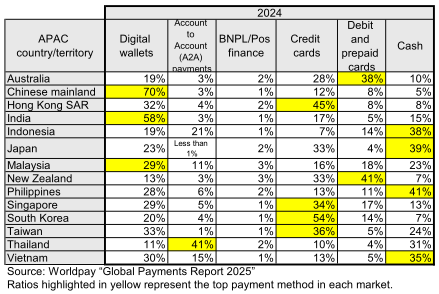
We believe that a standardized cross-border QR code payment system is dependent on addressing transaction fees and currency exchange issues in order to build the user trust essential for its widespread adoption.
As an example, Dynamic Currency Conversion (DCC) is a service that offers individuals the choice to pay in their home currency or the local currency when they use a credit card at an overseas point-of-sale terminal or ATM. While this allows cardholders to see the amount that they are paying for goods or services in their home currency, the DCC option can include exchange rate markups and higher fees.
In recent years, payment providers have emerged to offer low-fee international payment services. They achieve this by combining foreign exchange (FX) trading with risk-hedging tools through institutional intermediaries. We anticipate that the future widespread acceptance of payment roaming will require service designs that also address inherent currency risks and minimize fees.
Merchant fees are a significant reason for the slow adoption of cashless payments in Japan. However, purchases made by an international cardholder typically result in markups and fees payable by the buyer, rather than the merchant. If cashless payments become more expensive, users are unlikely to feel confident about using them. As a consequence, we foresee that integrating payments with foreign exchange (FX) transactions and other financial services will be a critical strategic response by the industry to this issue.
Japan has started to globalize QR code payments with the launch of the JPQR Global code payment service, with Cambodia as the first country to coordinate payment services with the system. To drive the market for cashless payments, we believe that it is crucial to implement and promote these services, taking into account both the countries that attract a large number of Japanese tourists, as well as countries which are the origin of many visitors to Japan.
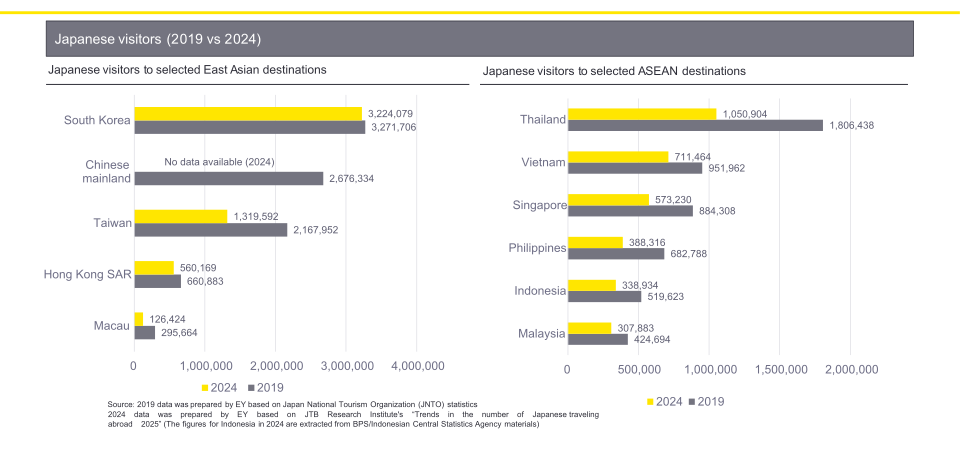
While Thailand, Vietnam, Singapore, the Philippines, Indonesia, and Malaysia remain among the top 6 countries for Japanese travelers to ASEAN, overall Japanese outbound travel has continued its decline since the pandemic. High inbound tourism traffic to Japan and widespread QR code adoption in Vietnam, Indonesia and Malaysia9VISA “THE FUTURE OF COMMERCE ON THE CUSP OF CHANGE Visa Consumer Payment Attitudes Study 2024” https://www.visa.com.sg/content/dam/VCOM/regional/ap/singapore/global-elements/documents/visacpa- 2024-report-smt.pdf (Accessed on October 18, 2025) make these countries prime opportunities for developing services focused on future reciprocal use.
As Japanese QR code payment businesses navigate a highly competitive environment, we anticipate that shifting from exclusive domestic usage to adopting JPQR standards and creating an ecosystem that enables cross-border interoperability during international travel or work assignments could offer a substantial business opportunity.
Cashless payments first surpassed 40% of consumer spending in Japan in 2024. Although credit cards do play a vital role in fostering a cashless environment, we see a need to adopt unified standards for mobile wallet payments — particularly QR code payments, which are increasingly popular in the ASEAN region — when seeking to improve services for inbound customers and broaden business opportunities. Enhancing the cashless environment through payment roaming can boost consumption and support regional revitalization, while also promoting economic growth by establishing a more accessible and inclusive cashless ecosystem. As a result, market development must align with these objectives.
Japanese outbound destinations 2019 vs 2024
*This publication contains information in summary form and is therefore intended for general guidance only. It is not intended to be a substitute for detailed research or the exercise of professional judgment. Member firms of the global EY organization cannot accept responsibility for loss to any person relying on this article.