No spam - just the latest insights!
Join over 30,000 industry professionals who subscribe for free

Subscribe for free!
We'll never share your information or send you spam

Juan Camilo is an attorney and graduate of Universidad de La Sabana, with specialized studies in finance from CESA (Colegio de Estudios Superiores en Administración). He is currently an MBA Candidate at IMF Business School. He serves as Managing Partner at OST ABOGADOS, acts as legal representative for both domestic and foreign companies established in Colombia, and is a member of several boards of directors. Furthermore, he is the author of the book Gaming in Colombia: An Overview of the Regulations) (Ed. Dike, 2025).
Throughout his professional career, he has advised national and international corporations on diverse matters regarding Commercial Law, Corporate Law, Gaming Law, and Labor Law. He possesses over 16 years of experience in the gaming industry, acting as legal counsel for numerous companies within the sector across Colombia and Latin America.

Over the past decades, Colombia’s regulatory model for games of chance has gradually strengthened and consolidated itself as an international benchmark. The legal basis of its operation has been one of the pillars of this regulatory system: in 1991, the Colombian Constitution established a State revenue-raising monopoly over games of chance, with the specific purpose of contributing to the financing of public health services.
The existing legal framework not only allows the State to operate, organise and supervise all gambling modalities conducted in the country, but also requires it to do so under a principle of economic rationality that ensures the profitability and productivity necessary to fulfil the monopoly’s public and social purpose. With the exception of local lotteries, this system operates through concession contracts with private companies, under which exploitation rights are set as a percentage of the GGR (Gross Gaming Revenue) generated by the operation.
By aligning the interests of the State with those of private operators, the model has fostered a technical regulatory framework built through consultation. This explains the Colombian State’s interest in adjusting the regulatory framework to permit the operation of online platforms and to consolidate a formal, supervised and attractive market for domestic and international operators, making Colombia a Latin American pioneer in 2015.
However, the country has gone through a period of legal instability in tax matters that has particularly affected the online betting industry, to the detriment not only of private operators but also of the social principle on which it is founded.
This article analyses the negative impact of the extraordinary decrees adopted in 2025 and 2026, which reflect a lack of understanding of the dynamics of this industry and, by contrast, underscore the importance of ensuring that the laws and regulations governing this sector rest on a technical foundation that truly understands how the market operates and invest of investors.
Under Law 1753 of 2015, operators of novel games, including those operated via the internet, must pay exploitation rights at a rate of 17% of gross revenue less prizes paid, reducible to 15% when the player return rate is equal to or greater than 83%.[mfn]Law 1753 of 2015. Exploitation rights for internet-operated gambling are equivalent to 17% of gross revenue, or 15% of gross revenue less prizes paid when the player return rate is equal to or greater than 83%.[/mfn]
In addition, online gambling operators must pay an annual licence equivalent to 811 monthly legal minimum wages.
At the end of 2024, in response to the fiscal crisis facing the country, the Government submitted to the Congress a financing bill intended to cover the deficit in the National General Budget. Among other measures, the bill proposed imposing value-added tax (VAT) on internet betting.
The Government argued before public opinion that the VAT exemption applicable to internet-operated games constituted an unjustified tax privilege, considering that other gambling modalities, as well as most basic goods and services, are subject to this tax. It also presented an exorbitant projected revenue estimate based on taxing each individual wager rather than the outcome of the operation.
Although Congress shelved the bill for reasons unrelated to the specific levy on online gambling, this development set off alarm bells among different actors in the industry. Not only because it placed the Government’s intention to tax online gambling squarely on the table, but also because the proposed model revealed a lack of understanding of how the market works.
Subsequently, during 2024 and 2025, the Government issued three transitory decrees introducing specific levies for this sector, this time without congressional approval, as they were adopted under different forms of constitutional emergency powers. Each of these decrees sets out a different version of the tax model, once again demonstrating the absence of a consolidated diagnosis of the sector’s economics.
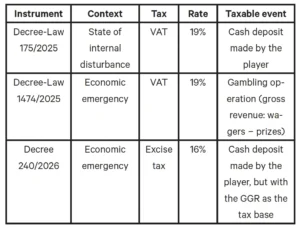
Decree-Law 175 of 2025 defined the taxable event for VAT purposes as the cash deposit made by the player, treating the “right to wager” as the tax base. Although, in theory, under this model the player bears the tax burden, the significant difference between the amount paid and the amount available for wagering discourages the use of regulated platforms, thereby encouraging players to migrate to the illegal market.
In addition to limiting the competitiveness of legal operators, the measure also reduces revenue from the occasional gains tax.
In response, some platforms sought to absorb the tax through promotional bonuses. This strategy increases operating costs, disadvantages smaller operators and reduces overall GGR, since promotional bonuses may ultimately generate real winnings.
This may result in a twofold reduction in transfers to the health public system, which reflect the legal principle on which the model is built. On the one hand, part of the revenue is derived from a one-off annual payment made by each operator, so a reduction in the number of legal operators runs contrary to the State’s interests. On the other hand, reducing GGR results in lower monthly transfers to the health public system.
Although later struck down, the Decree is still worth analysing for the model it proposed.
Unlike the previous Decree, this one defined the taxable event for VAT purposes as the gambling operation itself, that is, the GGR. In principle, this comes closer to the economic logic of the market and does not legally constitute a case of double taxation, since exploitation rights are not taxes. However, by taxing the same base on which exploitation rights are charged, the total percentage deducted from GGR places the very existence of the market at risk.
Among the justifications set out in the Decree was a nominal increase in the gross revenue of the operation, and emphasis was placed on the allegedly inelastic nature of demand, as if it were a good or service unaffected by changes in price. These claims appear to overlook two facts. First, the operating costs of the business, including corporate income tax and the annual licence, are covered by the remaining share of GGR after exploitation rights and, in this case, VAT have been paid. Second, the principles by which goods and services are described as inelastic do not apply to betting, since the only scenario in which one could consider there to be a “price increase” would be through a reduction in the player return rate, which would violate other principles of the regulatory framework governing games of chance.
Although this tax model does not directly affect the player, it makes the operation economically unviable, which contradicts the principle of economic rationality that must guide the regulation of this industry.
Only two and a half months after Decree 1474 of 2025 was issued, the Government enacted this Decree establishing a new tax model. Although the previous Decree had at that time been provisionally suspended, the possibility that such suspension might later be lifted created a new legal problem. Because it involved a different tax — no longer VAT, but an excise tax — and arose from a different taxable event, reverting to the cash deposit made by the player, the new tax did not necessarily imply the automatic repeal of the previous one.
This further erodes the credibility of an industry that has consolidated itself thanks to the legal certainty resulting from the constitutional protection afforded by the State’s revenue-raising monopoly.
The real impacts of regulatory improvisation
The figures reported to date only allow an assessment of the impact of the first of the three decrees mentioned above. Three indicators make it possible to gauge its negative effect:
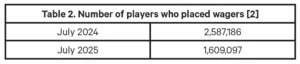
This reduction suggests that, despite the efforts made by online gambling operators to mitigate the impact of the tax through promotional bonuses, the measure may have displaced players toward illegal platforms.
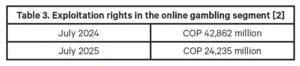
During the same period, revenue generated by land-based gambling increased by 7.8%, showing that this was not a general market contraction, but one specifically affecting the online channel. This is particularly serious given that, by August 2025, online gambling accounted for 39% of the total market. [mfn]Coljuegos, Informe Estadístico: Operación de Juegos de Suerte y Azar, July 2024 and July 2025, available at: https://www.coljuegos.gov.co/documentos/213765/informes-estadisticos- 2025/[/mfn]
Colombia’s online gambling model was a regulatory success because the structure of the revenue-raising monopoly encouraged technical coordination between the State and operators. Both shared an interest in ensuring that the legal market remained viable: operators needed sustainable economic conditions, while the State needed a formal channel capable of producing health-earmarked revenue.
The recent decrees replace that coordination with decisions adopted without a sector-specific diagnosis. The variation among the selected taxable events, the absence of analysis regarding the difference between deposits and real revenue, and the issuance of three different instruments in less than two years reveal improvisation in relation to a market whose characteristics required the opposite.
The data confirm what theory anticipated: the regulated online channel contracted both in exploitation rights and in active players, while the land-based industry grew during the same period. If that contraction translates into a sustained reduction in the monopoly’s revenue, the State will have weakened the constitutional instrument that enables it to financing health public services through this activity.
The Colombian case offers a clear lesson for any jurisdiction regulating online gambling: tax policy for this sector cannot be designed in isolation from its economic structure. When rules are built on a technical foundation and through consultation, the system produces regulation, revenue and traceability. When they are improvised without understanding how the market works, the result is exactly the opposite.