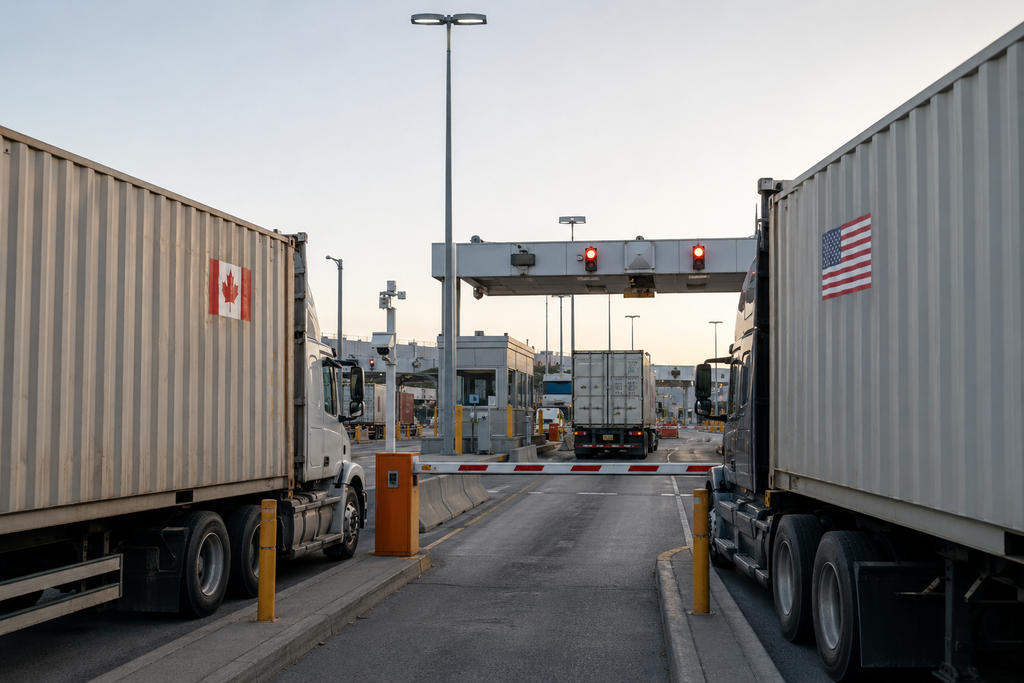
Summary: U.S.–Canada trade negotiations ended without an agreement, allowing new 50% U.S. tariffs on approximately $20 billion of Canadian products to take effect. Canada plans an equivalent response from September 8. Although the measures cover only part of bilateral trade, they deepen uncertainty around North American supply chains and the approaching review of the USMCA trade agreement.
A Weekend Escalation With Lasting Consequences
The United States and Canada entered a more dangerous phase of their trade dispute over the weekend after last-minute negotiations failed to produce an agreement.
New U.S. tariffs of 50% took effect on Saturday, August 22, covering around $20 billion, or C$28 billion, of Canadian goods. Prime Minister Mark Carney subsequently announced that Canada would impose dollar-for-dollar counter-tariffs on selected U.S. products beginning September 8.
The targeted Canadian exports reportedly include products such as dairy goods, alcoholic beverages, agricultural products, cement and hockey equipment. The measures affect roughly 5% of Canada’s annual goods exports to the United States, meaning the immediate scope is narrower than the headline tariff rate might suggest. AP’s breakdown of the measures
Nevertheless, the escalation is economically significant. It raises costs within a deeply integrated trading system and introduces new uncertainty just as businesses are preparing for the formal review of the United States-Mexico-Canada Agreement.
Why the Negotiations Failed
The two governments offered sharply different accounts of the breakdown.
Carney said Washington made last-minute demands that Canada considered unfair and economically unacceptable. His government suspended the negotiations and recalled its negotiating team, arguing that the proposed terms offered insufficient relief while placing excessive constraints on Canadian policy.
U.S. Trade Representative Jamieson Greer disputed that account. He said Canada introduced new demands and stepped back from earlier commitments after the United States had offered tariff relief covering areas such as steel, automobiles and lumber.
Because the negotiating texts have not been published in full, the exact sequence remains contested. What is clear is that neither government was willing to accept the other side’s final terms before the deadline.
The U.S. measures draw on Section 338 of the Tariff Act of 1930, which the administration says permits action against discriminatory treatment of American exports. Washington previously said the tariffs were intended to address Canadian policies affecting U.S. vehicles, alcoholic beverages and dairy products. U.S. Trade Representative statement
Canada Prepares Its Response
Canada’s planned counter-tariffs are expected to target approximately the same value of U.S. trade. Ottawa has identified sectors including steel, dairy, household appliances, agricultural equipment, pulp and paper, and electronics.
The measures are scheduled to begin on September 8, the Tuesday after Canada’s Labour Day holiday. Carney has also indicated that additional support for affected Canadian workers and businesses will be announced.
Canada’s federal, provincial and territorial leaders discussed the response during a First Ministers’ meeting on Saturday. The official readout confirmed the dollar-for-dollar approach and emphasized coordination between the different levels of government. Prime Minister of Canada meeting readout
Ottawa still faces an asymmetry problem. The U.S. economy is approximately ten times larger than Canada’s, making equivalent retaliation potentially more painful for Canadian businesses and consumers. Carefully choosing products with available substitutes will therefore be essential if Canada wants to maximize political pressure while limiting domestic costs.
The Supply-Chain Risk
The main investor concern is not simply the value of goods covered. It is the effect of tariffs on interconnected production networks.
Manufacturers on both sides of the border routinely move components between the two countries during production. A tariff imposed at one stage can therefore increase costs for downstream companies in the importing country, including businesses that consider themselves primarily domestic.
Importers initially pay the duty, but the burden can ultimately be divided among exporters, importers, retailers and customers. Companies may absorb part of the increase through lower margins, renegotiate supplier contracts or raise prices.
Agricultural equipment, appliances, electronics and paper-based packaging are particularly relevant because they feed into other business activities. Cost increases in these areas can travel further than the directly affected product categories.
The new tariffs also differ from some earlier measures because they can apply even when goods would otherwise qualify for preferential treatment under USMCA rules. That weakens the predictability companies ordinarily expect from a regional trade agreement. Reuters reporting on the negotiations and tariff structure
Inflation, Growth and Currency Implications
For Canada, the dispute creates simultaneous pressure on growth and prices. Exporters face weaker competitiveness in their largest market, while retaliatory tariffs could make selected U.S. imports more expensive.
That combination complicates the Bank of Canada’s task. A tariff shock can weaken activity and employment while also increasing consumer or producer prices. The central bank must determine whether the inflationary effect will be temporary or broad enough to influence expectations and wages.
The Canadian dollar weakened as Asian and European markets began trading on Monday, providing an initial indication of investor concern. A softer currency can support exporters, but it also raises the domestic price of imported goods. The Guardian’s market coverage
For the United States, the direct macroeconomic effect is likely to be more limited because the targeted trade represents a small share of the overall economy. Certain importers, manufacturers and regional economies may nevertheless experience meaningful cost increases.
The Bigger Issue: USMCA
The escalation arrives at a sensitive moment for North American economic policy.
The United States, Canada and Mexico must review USMCA in 2026. That process was intended to assess how the agreement is functioning, but the current confrontation makes the review more consequential. Businesses now have to consider whether the dispute will remain confined to a defined list of products or spread into broader negotiations over automobiles, metals, agriculture and cross-border investment.
The absence of further scheduled talks adds to that uncertainty. Even if the two governments eventually return to negotiations, companies may postpone investment, build larger inventories or seek alternative suppliers in the meantime.
Those defensive decisions are rational at the company level but can reduce efficiency across the wider economy.
What Investors Should Monitor
The next major development is Canada’s final counter-tariff list and whether Ottawa introduces direct support for exposed industries. Investors should also watch for exemptions, implementation guidance and any sign that negotiations will resume.
Corporate disclosures will be important. Companies with concentrated cross-border supply chains may begin quantifying tariff exposure, pricing responses and plans to shift sourcing. The most relevant signals are likely to emerge from transportation, manufacturing, consumer goods, agriculture and industrial distribution businesses.
The practical takeaway is that the 50% headline does not apply to all U.S.–Canada trade. Its immediate economic effect should therefore be assessed sector by sector. The more important long-term risk is that repeated tariff escalation undermines the stability businesses have historically associated with the North American trading system.