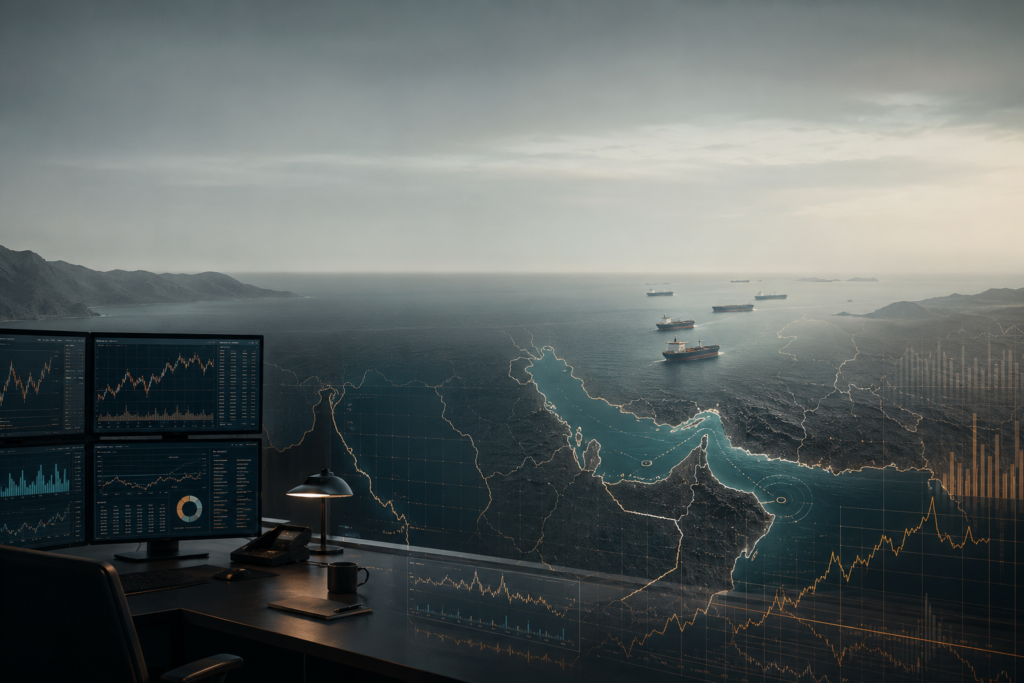
Summary: Renewed U.S.-Iran hostilities around the Strait of Hormuz briefly pushed oil higher and kept investors focused on energy security, inflation risk, and the durability of the latest diplomatic pause. A reported halt in attacks and planned talks in Qatar helped calm some market pressure, but the core issue remains unresolved: whether commercial vessels can move through one of the world’s most important energy chokepoints without renewed disruption.
Why This Story Mattered
The biggest global finance story from June 28 was not only a geopolitical headline. It was a market structure story.
The Strait of Hormuz is one of the world’s most important energy transit routes. The U.S. Energy Information Administration says oil flow through the strait averaged 20 million barrels per day in 2024, equivalent to about 20% of global petroleum liquids consumption. It also estimates that roughly one-fifth of global LNG trade moved through the strait in 2024, primarily from Qatar.
That is why even a temporary escalation can ripple across asset classes. Oil prices feed directly into inflation expectations, central bank assumptions, corporate margins, transport costs, and household fuel prices. In a market already wrestling with high rates, a strong dollar, and stretched AI-linked equity valuations, the Hormuz risk premium quickly became the central macro variable.
What Happened
Over the weekend, the U.S. and Iran exchanged renewed strikes after an Iranian projectile reportedly hit a cargo vessel in the Strait of Hormuz last week, according to Reuters-syndicated market reporting. Both sides accused the other of violating an interim ceasefire.
Axios reported on June 28 that the U.S. and Iran had agreed to stop attacking each other and planned to meet in Doha on Tuesday to address the dispute over the strait. The same report said a senior U.S. official described the pause as a halt to “kinetic activity,” while another official said vessels could move freely “for now.”
That wording matters. “For now” is not a settlement. It is a pause.
The Guardian’s analysis pointed to the deeper problem: the memorandum of understanding between the U.S. and Iran appeared to leave critical Hormuz arrangements vague. Iran had committed to make “best efforts” to allow safe passage of commercial vessels, but the practical questions of routing, maritime coordination, and authority over the strait remained contested.
How Markets Reacted
Markets initially treated the renewed strikes as an oil risk event. Al Jazeera reported that Brent crude rose about 0.9% on Monday after the weekend escalation renewed doubts about a return to normal shipping through the strait.
But once reports emerged that Washington and Tehran had agreed to halt attacks and resume talks, the tone improved. Reuters-syndicated coverage said European stocks and U.S. futures ticked higher, with the STOXX 600 up 0.1% and S&P 500 futures up 0.7% in morning trading. Brent cooled to around $72.20 a barrel, roughly unchanged on the day and down 22% for the month.
The move showed a familiar pattern from this crisis: oil rallies on disruption risk, then gives back gains when diplomatic headlines suggest shipping flows may normalize.
That does not mean the risk has disappeared. It means markets are pricing a probability-weighted path between renewed escalation and partial reopening.
The Inflation Link
The most important market implication is inflation.
Lower oil prices reduce near-term pressure on headline inflation, and that can support growth-sensitive assets. But the broader macro picture remains complicated. Reuters noted that investors were still pricing at least one Federal Reserve rate hike this year, a sharp reversal from earlier expectations for two rate cuts before the conflict began.
This is where Hormuz intersects with central banks. A sustained energy shock would make it harder for policymakers to look through inflation. A credible reopening, by contrast, would ease one of the clearest external inflation pressures.
For investors, this makes energy prices a signal for more than energy equities. Oil is now feeding into expectations for rates, currencies, credit conditions, and sector rotation.
The Supply Chain Dimension
The International Energy Agency described the near closure of Hormuz as the largest supply disruption in history, with cumulative Middle East producer losses exceeding 1.3 billion barrels and flows through the strait falling from around 20 million barrels per day before the conflict to an average of 2.7 million barrels per day in March, April, and May.
The IEA also noted that Gulf producers have adapted. Saudi Arabia increased exports through its East-West pipeline to the Red Sea, while the UAE used pipeline and storage infrastructure around Fujairah. These adjustments have helped cushion the global market, but they do not fully replace normal Hormuz flows.
That is the key point: alternative routes can reduce the shock, not eliminate it.
Equity Market Implications
For equities, the story has two layers.
First, lower oil is supportive for consumers, transport, industrials, and parts of emerging markets that are sensitive to imported energy costs. It may also help ease pressure on margins in sectors exposed to freight and fuel.
Second, the relief rally came as investors were already questioning the durability of AI-linked valuations. Reuters reported that Nasdaq futures rebounded after the index had slumped more than 4% the prior week. In other words, Hormuz was not the only market issue, but it became the swing factor for risk appetite.
A durable diplomatic path could allow investors to refocus on earnings, rates, and AI capital spending. A renewed breakdown would likely bring energy hedges, defensive sectors, and dollar strength back into the foreground.
Practical Takeaway
The market is not trading a clean peace agreement. It is trading the credibility of a fragile pause.
For investors and finance professionals, the key indicators to watch are straightforward: verified tanker flows through Hormuz, Brent crude’s reaction to diplomatic headlines, insurance and shipping conditions, central bank commentary on energy-driven inflation, and whether equity leadership broadens beyond defensive or AI-linked pockets.
The immediate risk has eased, but the underlying issue remains unresolved. Until commercial shipping through Hormuz becomes regular, verified, and politically uncontested, the strait will remain one of the most important macro variables in global markets.
Sources Used
Reuters-syndicated market report via WHTC; Axios reporting on U.S.-Iran talks; Guardian analysis of the memorandum and Hormuz routing dispute; Al Jazeera oil market report; EIA data on Hormuz oil and LNG flows; IEA analysis of the supply disruption and rerouting response.