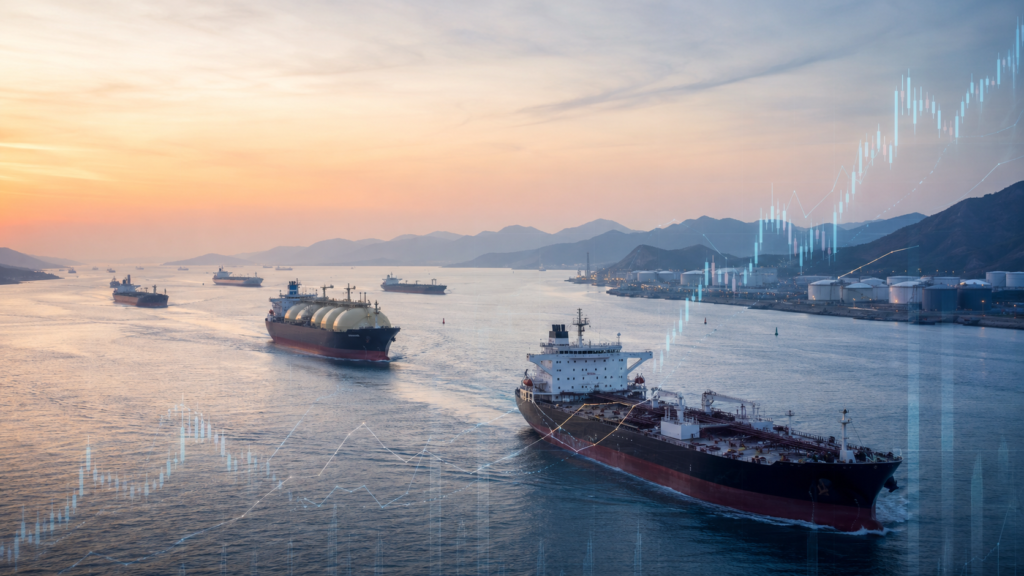
Renewed attacks on commercial vessels near the Strait of Hormuz and subsequent U.S. strikes on Iran pushed energy risk back to the center of global markets on July 7. Oil prices rose, bond yields moved higher, and investors were reminded that the fragile recovery in Gulf energy flows remains one of the most important variables for inflation, monetary policy, and global risk appetite.
The biggest financial story from July 7 was not simply another geopolitical headline. It was a direct challenge to the market’s recent assumption that energy flows through the Strait of Hormuz were gradually normalizing.
According to reporting on the incident, U.S. Central Command said it launched strikes against Iran after what it described as Iranian attacks on three commercial vessels in the Strait of Hormuz. Qatar said one of the vessels hit was a Qatari LNG tanker, and the incident occurred close to Oman, near a proposed alternative shipping corridor. (theguardian.com)
The escalation came after a period in which investors had started to price in a partial easing of Middle East energy risk. That made the July 7 events especially important: they reopened a risk premium that had only recently been fading.
Why Investors Care About This Waterway
The Strait of Hormuz is not just a regional shipping lane. It is one of the most important energy chokepoints in the world.
The U.S. Energy Information Administration has said that oil flows through the strait averaged about 20 million barrels per day in 2024, equivalent to roughly 20% of global petroleum liquids consumption. The EIA also notes that in 2024 and early 2025, Hormuz accounted for more than one-quarter of global seaborne oil trade and about one-fifth of global LNG trade. (eia.gov)
The International Energy Agency’s more recent conflict monitoring also underscores the concentration risk. In 2025, around 25% of the world’s seaborne oil trade moved through Hormuz, while more than 110 billion cubic meters of LNG passed through the strait. The IEA estimates that this represented almost one-fifth of global LNG trade, with no practical alternative routes for those volumes. (iea.org) (iea.org)
That is why even limited attacks can have an outsized market impact. The issue is not only physical supply. It is also insurance, shipowner willingness, route reliability, and the potential for delays that ripple through crude, refined products, LNG, petrochemicals, fertilizers, and inflation expectations.
Market Reaction: Oil and Rates Move
Oil prices moved higher as the news developed. Trading Economics reported that crude rose about 5% on July 7 to around $72 per barrel after the U.S. Treasury revoked a waiver that had allowed Iran to sell oil, following tanker attacks in the strait. (iea.org)
By July 8, MarketWatch reported that Brent crude had climbed more than 2% to trade above $76 per barrel, while West Texas Intermediate moved above $73, with both benchmarks reaching their highest levels since June 23.
The move was not confined to commodities. MarketWatch also reported that the 10-year U.S. Treasury yield rose to about 4.54% as oil and yields jumped after the U.S. canceled the Iran oil-sanctions waiver.
That bond-market reaction matters. A higher oil price can feed inflation expectations, particularly if it affects fuel, freight, chemicals, and food inputs. In turn, that can complicate the path for central banks that were already trying to balance slowing growth risks against stubborn price pressures.
The Bigger Market Message
The July 7 episode matters because it challenged three assumptions that had been supporting risk assets.
First, investors had been assuming that Middle East supply conditions were improving. The June U.S.-Iran understanding and renewed shipping flows had helped pull oil prices down from earlier crisis levels. The new attacks and U.S. response suggest that the political and security framework behind that recovery remains fragile.
Second, markets had been treating energy disinflation as a useful tailwind. Lower oil prices can ease pressure on consumers, airlines, transport companies, and import-heavy economies. A renewed risk premium reverses part of that support.
Third, the incident reminded investors that inflation shocks can come from outside the usual macro calendar. Employment data, central-bank speeches, and earnings still matter, but geopolitical supply risk can reset the entire inflation discussion quickly.
Sector Implications
Energy producers may benefit from higher crude prices, but the picture is not one-dimensional. Companies with direct Middle East exposure, shipping dependencies, or refinery feedstock constraints may face operational risk even as headline prices rise.
Airlines, shipping users, chemicals, and consumer-facing companies are more vulnerable to sustained fuel-price increases. Emerging markets that import energy are also exposed, especially if higher oil coincides with a stronger dollar or higher U.S. yields.
For Europe and Asia, LNG risk is particularly important. The IEA notes that most LNG exports from Qatar and the UAE move through Hormuz, and most of those volumes go to Asia. A prolonged disruption would therefore be a regional energy-security problem and a global pricing problem at the same time. (iea.org)
Practical Takeaway
The practical takeaway is not to make a binary call on war or peace. It is to recognize that energy-risk pricing has returned as a live macro variable.
Investors should watch three indicators closely: actual shipping flows through Hormuz, the durability of the U.S.-Iran interim framework, and whether oil-price gains start feeding into inflation expectations and central-bank pricing.
For now, the story is a warning about fragility. The market reaction was significant, but not yet a full crisis repricing. That distinction matters. Oil is higher, but still below earlier wartime peaks. The risk is that repeated incidents could turn a temporary geopolitical premium into a more durable inflation and growth shock.
This is not personalized investment advice. It is a market-context update based on public reporting and energy-market data.