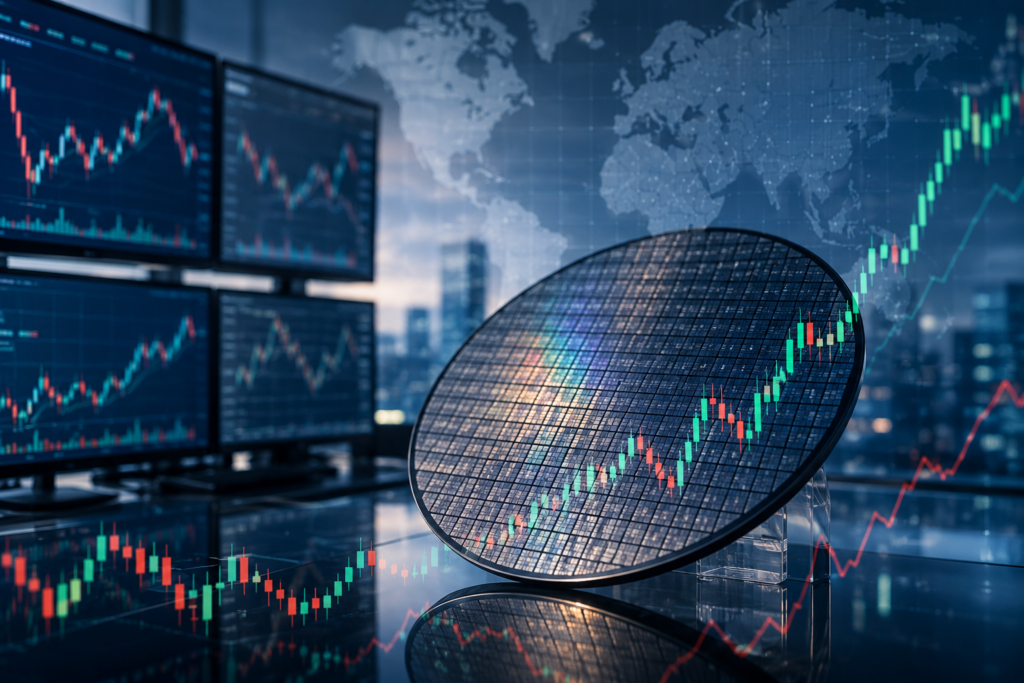
Summary: Global markets spent Monday, June 8, digesting a sharp reset in the AI and semiconductor trade. A Friday selloff erased more than $1 trillion in market value from U.S.-listed chipmakers, then spilled into Asia and Europe before Wall Street recovered some ground. The move matters because it combines three investor concerns: stretched AI valuations, stronger U.S. data that raises the risk of tighter monetary policy, and renewed Middle East tensions that continue to affect oil prices and inflation expectations.
The AI Trade Hit a Stress Point:
The most important financial story from Monday was not a single earnings report, policy decision, or commodity move. It was the market’s reassessment of one of the dominant investment themes of the past year: artificial intelligence infrastructure.
Reuters reported that U.S.-listed chipmakers lost more than $1 trillion in market value on Friday, June 5, with losses concentrated in companies tied to AI demand, including Nvidia, Micron Technology, AMD, Broadcom, and Marvell. The PHLX semiconductor index fell almost 8.5% during that session, while Nvidia alone lost more than $300 billion in market capitalization.
That selloff did not remain a U.S. story. On Monday, the pressure moved across global markets. South Korea’s chip-heavy Kospi fell 8.3%, according to Reuters and AP, while Japan’s Nikkei dropped almost 4% and Taiwan’s benchmark index sank 3.5%. In Europe, shares of AI-linked technology companies including ASML and BE Semiconductor Industries also came under pressure.
The significance is straightforward: the AI trade has become large enough that a repricing in semiconductor shares can influence global equity sentiment, currency positioning, and expectations for central bank policy.
Wall Street Stabilized, But Not Convincingly
By the time trading moved to New York, markets had recovered some of the earlier stress. AP reported that the S&P 500 rose 0.3% on Monday after falling 2.6% on Friday, while the Nasdaq Composite gained 0.9%. Reuters reported that the S&P 500 technology index was up 2.3% on Monday after tumbling 5.8% on Friday.
Chip stocks led the rebound. Micron rose 9.9% after a steep Friday decline, and Marvell gained 9.6% after S&P Dow Jones Indices said the company would join the S&P 500. That helped stabilize the tone, but the rebound did not erase the central question for investors: whether Friday’s move was merely a positioning correction or the start of a more durable reassessment of AI valuations.
The answer is not yet clear. The semiconductor sector remains strongly up for the year, which means some investors may still see pullbacks as buying opportunities. But the scale and speed of the Friday move suggest that the market is becoming less tolerant of vague AI optimism and more focused on earnings delivery, capital discipline, and return on investment.
Rates Are Now Part of the AI Valuation Debate
The AI trade is not being tested in isolation. It is also being tested by higher-rate risk.
Reuters reported that U.S. nonfarm payrolls increased by 172,000 in May, well above economists’ forecast of 85,000. The unemployment rate held at 4.3%, and prior months were revised higher. That stronger labor data prompted markets to increase the probability of a Federal Reserve rate hike later in 2026.
This matters for AI and semiconductor valuations because many of the companies most exposed to the AI buildout have been priced for substantial future growth. Higher interest rates tend to make future earnings less valuable today, especially for companies trading at elevated multiples. They can also raise funding costs for the broader AI infrastructure boom, including data centers, power capacity, chips, networking equipment, and cloud expansion.
In short, the market is not only asking whether AI demand is real. It is asking whether the expected cash flows justify current valuations in a world where rates may stay higher, or even rise.
Oil and Geopolitics Added Another Layer
Middle East tensions also shaped Monday’s market tone. Reuters reported that U.S. crude futures were up 1.42% at $91.83 a barrel after earlier trading above $95, while Brent was up 1.82% at $94.78 after earlier rising above $98. Prices pared gains after Iran and Israel signaled a pause in attacks, but uncertainty remained.
For investors, the oil move is important because it reinforces the inflation concern already embedded in the U.S. rates debate. If energy prices remain elevated, the Fed has less room to ease policy and more reason to maintain a restrictive stance. That creates a difficult mix for equity markets: strong employment, persistent inflation risk, and expensive growth stocks.
The dollar also reflected this dynamic. Reuters reported that the dollar traded around its highest level in nearly two months after the strong U.S. jobs report, while the yen remained under pressure.
Why Investors Should Care
The broader message from Monday is that market leadership is becoming more demanding. AI remains a powerful investment theme, but investors appear less willing to reward every company connected to the theme without clearer evidence of monetization and capital efficiency.
This is healthy in one sense. Markets that distinguish between strong and weak AI beneficiaries are more durable than markets driven mainly by momentum. But it also means volatility may stay elevated in sectors where expectations are crowded, valuations are rich, and positioning is one-sided.
The next tests are clear. Investors will watch whether semiconductor earnings and guidance can justify current valuations, whether AI infrastructure spending remains disciplined, whether the Fed signals a tighter policy path at its June 17 meeting, and whether Middle East tensions continue to feed oil volatility.
Practical Takeaway
The AI trade is not over, but Monday showed that it is entering a more selective phase. Investors should separate companies with visible revenue growth, pricing power, and balance-sheet strength from those relying mainly on broad enthusiasm for the theme.
For finance professionals, the key point is that AI exposure is now a macro-sensitive trade. It is tied not only to chip demand, but also to rates, oil, currency moves, index concentration, and global risk appetite. That makes risk management as important as thematic conviction.