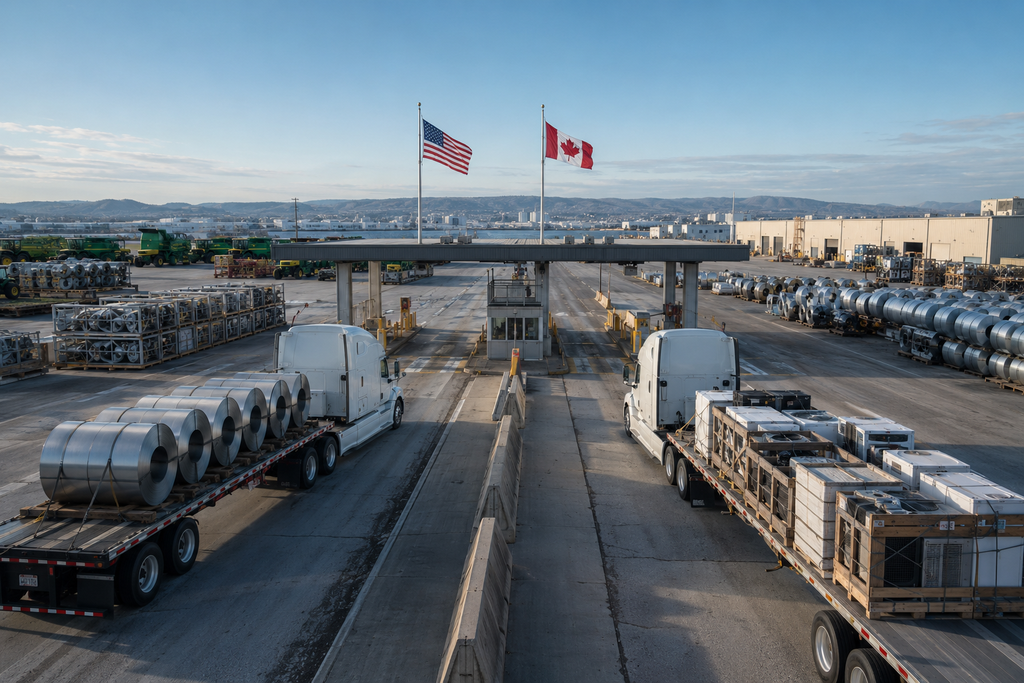
Canada escalated its trade dispute with the United States on August 25, announcing new tariffs on C$27.6 billion of American goods.
The measures will take effect on September 8 and apply at rates of 15%, 25%, and 50%. Ottawa said each product’s rate would correspond to the rate applied by the United States to comparable Canadian exports.
The announcement followed the introduction of 50% U.S. tariffs on C$27.6 billion of Canadian products on August 22. Canada described its response as “dollar for dollar, rate for rate.” Department of Finance Canada
Products facing Canada’s highest rate include certain steel and aluminum goods, furniture, clothing, and apparel. Appliances, dairy products, seafood, and some steel and aluminum derivatives will be subject to 25% tariffs. Existing Canadian countermeasures covering American vehicles will remain in place.
Canada also announced C$7.5 billion in additional support for affected businesses and workers. The package includes financing for smaller companies, liquidity assistance, regional development funding, worker income support, and retraining programs.
How the dispute reached this point
The United States originally announced additional tariffs against Canada in July, invoking Section 338 of the Tariff Act of 1930. The White House said the measures responded to Canadian policies affecting American vehicles, dairy products, and alcoholic beverages.
The U.S. measures apply to covered goods even when those products satisfy the rules of the United States-Mexico-Canada Agreement. That distinction is commercially important because companies can no longer assume that compliance with the regional trade agreement automatically protects every shipment from additional duties. White House fact sheet
Negotiations intended to prevent the tariffs subsequently broke down. President Donald Trump has also threatened to raise tariffs on Canadian vehicles, automotive parts, and steel to 50% from January 1, 2027. That proposal remains a future threat rather than a measure currently in effect.
Canada’s latest action covers more than 700 American products. Officials say the measures are intended to reduce imports and improve the competitive position of Canadian suppliers, rather than primarily to generate government revenue. Associated Press
Why this matters beyond Canada
The United States and Canada do not operate as two isolated production systems. Companies routinely move raw materials, intermediate components, and finished products across the border, sometimes several times during a single manufacturing process.
Tariffs imposed at multiple stages can therefore accumulate. A higher duty on steel does not affect only steel producers. It can also raise input costs for machinery, construction products, appliances, transportation equipment, and numerous smaller manufacturers.
Companies unable to substitute domestic suppliers quickly may face a difficult choice: absorb the additional expense, raise customer prices, renegotiate contracts, or reorganize production. Each response can place pressure on margins, working capital, and delivery schedules.
The uncertainty may be nearly as significant as the tariff rates themselves. Businesses making capital-investment decisions need to know whether today’s costs will remain in place for several months or become a longer-term feature of North American commerce. Unclear policy timelines can encourage companies to delay projects or hold more inventory as protection against disruption.
Markets remain cautious rather than alarmed
The immediate market reaction was measured.
The Canadian dollar strengthened approximately 0.1% to C$1.3835 per U.S. dollar on August 25, recovering only a small part of its previous decline. Canada’s 10-year government bond yield fell 3.8 basis points to 3.646%. Reuters reporting via Kitco
U.S. equity benchmarks also advanced despite the announcement. That suggests investors have not yet treated the dispute as an immediate systemic shock.
The relatively calm response should not be confused with confidence that the economic effects will be negligible. Some measures do not begin until September, while the threatened expansion affecting vehicles is dated for 2027. Markets may be assigning a meaningful probability to renewed negotiations before the full set of threatened measures takes effect.
Investors may also believe that the affected trade value is manageable within the two large economies. The more consequential risk, however, is whether the dispute broadens into additional sectors or causes companies to make permanent changes to sourcing and investment.
The monetary-policy complication
The dispute creates an awkward combination for the Bank of Canada.
Tariffs and trade disruption can weaken economic activity by reducing exports, delaying investment, and pressuring employment in exposed industries. Retaliatory duties can simultaneously raise the domestic prices of imported products and production inputs.
That combination makes monetary policy harder to calibrate. Lower interest rates could support demand and employment, but they could also add to price pressure. Higher rates could contain inflation expectations while increasing the strain on tariff-affected businesses and households.
Investors should consequently avoid viewing the dispute as automatically positive or negative for Canadian bonds. The eventual policy response will depend on whether weaker growth or higher prices become the dominant effect.
What investors should monitor next
Three developments will determine whether the latest announcement becomes a temporary negotiating tactic or a deeper economic rupture.
First is the September 8 implementation date. Any exemptions, remissions, delays, or renewed negotiations before then would signal that both governments are still searching for an off-ramp.
Second is corporate guidance. Manufacturers, retailers, logistics providers, and agricultural businesses may begin quantifying their tariff exposure, potential price increases, and sourcing changes during upcoming earnings updates.
Third is the proposed January 2027 expansion affecting vehicles and parts. The automotive industry’s tightly integrated production network makes that threat substantially more important than its distant effective date might suggest.
For portfolio analysis, the practical task is to identify companies with significant cross-border inputs, limited supplier alternatives, thin margins, or contracts that prevent rapid price adjustments. Businesses with flexible sourcing, strong pricing power, and production on both sides of the border should generally be better positioned to manage the disruption.