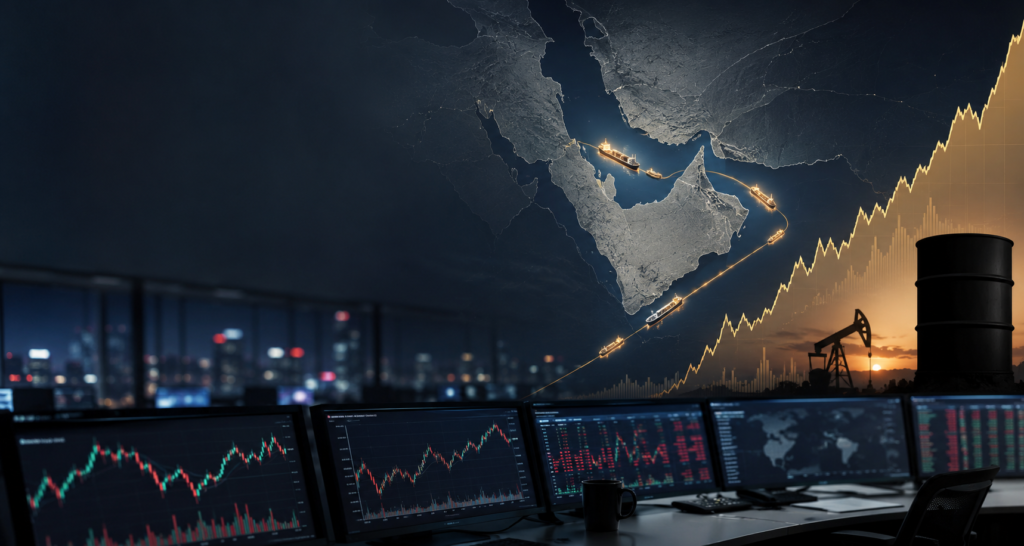
Summary: Renewed U.S.-Iran hostilities around the Strait of Hormuz pushed oil prices higher and unsettled global markets. The immediate market reaction was not limited to energy: Asian equities sold off, semiconductor stocks came under pressure, U.S. futures weakened, and investors refocused on the inflation and interest-rate risks that higher oil prices can create.
A Geopolitical Shock With Direct Market Transmission
The biggest global financial story from July 12 was the renewed escalation between the U.S. and Iran, centered on the Strait of Hormuz, one of the world’s most important energy transit routes. Markets responded quickly because this was not a distant geopolitical event with only theoretical financial consequences. It touched the oil market first, then spread into equities, rates expectations, currencies, and investor risk appetite.
AP reported that Brent crude gained 4.7% to $79.59 a barrel, while U.S. benchmark crude rose 4.8% to $74.85. The move followed U.S. strikes after an alleged Iranian attack on a container ship and Iranian retaliatory strikes across the region. MarketWatch similarly reported that Brent and WTI rose about 4% as stock futures dipped after the latest flare-up.
For investors, the key point is that oil remains a macro asset. A sharp rise in crude can feed inflation expectations, complicate central-bank policy, pressure fuel-sensitive industries, and reduce confidence in equity valuations that already depend on optimistic earnings assumptions.
Why Hormuz Matters
The Strait of Hormuz matters because it is a narrow passage through which a large share of seaborne crude and liquefied natural gas exports move. Any threat to shipping through the area can quickly produce a risk premium in oil prices, even if physical flows have not yet been materially disrupted.
That distinction is important. Markets often move before confirmed supply losses because investors price probability, not just current barrels. The more credible the risk to transit, insurance, freight, or regional production becomes, the more likely energy buyers and traders are to bid up crude as protection against disruption.
In this case, the story was also complicated by conflicting claims. MarketWatch reported that Iran asserted the strait was closed, while the U.S. said shipping traffic remained uninterrupted. That uncertainty is exactly the kind of backdrop that tends to widen trading ranges and lift volatility.
Risk-Off Trading Spread Beyond Oil
The equity-market response showed that this was broader than a simple energy-price story. AP reported that Tokyo’s Nikkei 225 fell 2.2%, while South Korea’s Kospi dropped 8.2%. Semiconductor shares were central to the move: SK Hynix fell 13.3%, and Samsung Electronics dropped 10.5%.
That matters because global equity leadership has been heavily tied to artificial intelligence and semiconductor exposure. When geopolitical stress hits at the same time investors are already debating whether AI-linked valuations have run too far, the market reaction can be sharper than the oil move alone would imply.
FT’s market coverage also framed the move as a global risk-off episode, highlighting falling global stocks, pressure on Asian memory chipmakers, and an oil jump as U.S.-Iran hostilities escalated.
The Inflation Channel Is Back in Focus
Higher oil prices matter most when they threaten to change the inflation outlook. Energy price increases can show up directly in headline inflation and indirectly through transport, manufacturing, aviation, logistics, and consumer expectations.
For central banks, the problem is not just one day of higher crude. It is whether a geopolitical risk premium becomes persistent. If oil stays elevated, central banks may become more cautious about easing policy or may keep rates higher for longer. That can pressure equities through higher discount rates and make bond markets more sensitive to inflation data.
MarketWatch noted that investors were also looking ahead to inflation data and Federal Reserve commentary, with earnings season beginning in the same week. That combination matters: oil shocks, inflation readings, and corporate guidance can reinforce each other. If companies warn that fuel, logistics, or input costs are rising, markets may begin to reassess margin assumptions.
Sector Implications
Energy producers and some oil-linked assets can benefit from higher crude prices, at least in the short term. But the broader market impact is more mixed.
Airlines, transport companies, cruise operators, chemicals, and other fuel-intensive sectors are usually vulnerable when oil rises quickly. Consumer-facing companies can also face pressure if higher energy costs reduce disposable income. Meanwhile, banks and financials may react more to the rate implications than the oil move itself.
The semiconductor sell-off showed another layer: crowded market leadership can become fragile during macro shocks. AI-related companies have been among the most closely watched parts of global markets. When risk appetite weakens, investors often reduce exposure first where prior gains have been strongest.
What Investors Should Watch Next
The first question is whether the oil move persists. A brief spike that fades quickly is different from a sustained repricing of Middle East risk. Brent holding near or above recent highs would keep inflation concerns alive, while a retreat would reduce pressure on rates and fuel-sensitive sectors.
The second question is whether shipping through the Strait of Hormuz remains operational. Verified disruption would be far more serious than rhetorical escalation. Investors should distinguish between confirmed interruptions, insurance and freight cost increases, military headlines, and diplomatic signals.
The third question is whether the AI and chip sell-off spreads. If semiconductor weakness remains concentrated in Asia, markets may treat it as a positioning reset. If it pulls down U.S. mega-cap technology and broader growth equities, the story becomes a larger valuation event.
Finally, the upcoming earnings season will test whether companies can defend margins in a more uncertain macro backdrop. Guidance on input costs, demand resilience, capital spending, and AI infrastructure investment will matter more than backward-looking profit numbers.
Practical Takeaway
This was the kind of news event that connects geopolitics directly to portfolios. Oil rose because the risk to a critical energy transit route increased. Equities fell because higher oil can worsen inflation, complicate rate expectations, and challenge crowded risk positions. Semiconductor stocks were hit because AI-linked leadership had become a major source of market concentration.
The sensible investor takeaway is not to overreact to a single headline, but to monitor whether the shock becomes persistent. If oil stabilizes and shipping remains uninterrupted, markets may refocus quickly on earnings and inflation data. If tensions escalate or energy prices keep rising, the risk-off move could broaden.
This is a macro story first, an energy story second, and a positioning story third. That is why it became the most important global finance development from the previous day.