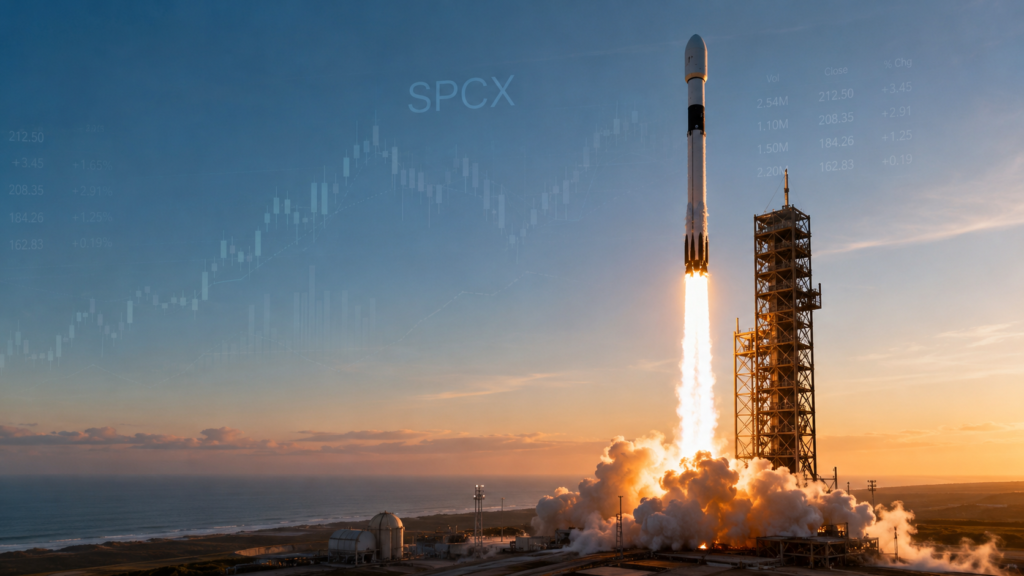
SpaceX is approaching one of the most closely watched IPO moments in years. The latest public filings and credible reporting point to a planned Nasdaq debut under the ticker SPCX, with final pricing expected on June 11, 2026 and trading expected to begin on June 12. The key number remains an expected or indicative $135 per share, which would raise roughly $75 billion and imply a valuation around $1.75 trillion to $1.8 trillion, depending on final share count and over-allotment assumptions.
The market signal is strong but not simple. Reports say the order book is heavily oversubscribed, while valuation skeptics argue that SpaceX’s IPO story now depends not only on rockets and Starlink, but also on capital-intensive AI ambitions.
The Latest Development: Pricing Is Expected Today
The most important current development is timing. SpaceX’s IPO process is now in its final pre-trading stage.
A SpaceX free writing prospectus filed with the SEC says the IPO roadshow began on June 4, the final IPO share price is expected to be set on June 11, and shares are expected to begin publicly trading on June 12. The same filing says SpaceX has applied to list Class A common stock on Nasdaq under the ticker SPCX. SEC filing
An Australian prospectus included in the SEC materials describes $135 per share as the expected indicative price and says that, at that price and before any over-allotment option, the global offer would raise about $74.4 billion in net proceeds after underwriting discounts, commissions, and estimated expenses. It also says the shares are expected to trade on Nasdaq and Nasdaq Texas on June 12. SEC filing
That means today is not just another rumor-cycle day. It is expected to be the day the IPO price is finalized.
Demand Appears Strong, But Oversubscription Has Limits
The latest credible reporting suggests SpaceX has drawn intense investor demand.
Bloomberg reporting, republished by The Business Times, said the IPO was well oversubscribed, with multiple institutional investors placing orders of about $10 billion or more. The same report said institutional order books were expected to close after the U.S. market close on June 10, ahead of June 11 pricing and June 12 trading. The Business Times / Bloomberg
Forbes, citing Reuters, reported that demand had topped $250 billion, far above the roughly $75 billion SpaceX is seeking to raise. Forbes
That is a strong signal, but it should be interpreted carefully. IPO order books can be inflated because institutions often ask for more shares than they expect to receive. Oversubscription shows appetite; it does not prove where the stock will trade after the opening print.
What Investors Are Really Buying
SpaceX is no longer being presented only as a launch company.
Its IPO materials frame the business around three areas: space, connectivity, and AI. The roadshow materials included in SEC filings show 2025 revenue of $18.7 billion, up from $14.0 billion in 2024 and $10.4 billion in 2023. The same materials show the connectivity business, largely Starlink, growing from $3.9 billion in revenue in 2023 to $11.4 billion in 2025. SEC filing
That matters because Starlink has become the financial center of gravity in the SpaceX story. Launch remains strategically important, and Starship remains central to the company’s long-term ambitions, but the revenue scale is increasingly tied to satellite connectivity.
The new complication is AI. The IPO materials describe a much larger claimed market opportunity around AI infrastructure and enterprise applications, but they also include substantial cautionary language. SpaceX says AI is capital intensive, has involved significant operating losses, and may take a multi-year investment horizon before producing sustained positive segment adjusted EBITDA. SEC filing
In other words, the IPO valuation is not only a bet on reusable rockets or broadband satellites. It is also a bet that SpaceX can turn infrastructure, compute, and AI demand into a major business.
The New Google Cloud Agreement Adds to the AI Narrative
One notable new filing item is SpaceX’s disclosure of a cloud services agreement with Google.
A June SEC free writing prospectus says SpaceX entered into a Cloud Service Agreement with Google on June 5, 2026, involving access to compute capacity including about 110,000 NVIDIA GPUs plus related infrastructure. Under the agreement, Google is expected to pay $920 million per month from October 2026 through June 2029, with ramp-up provisions and termination rights after December 31, 2026. SEC filing
This is material because it gives the AI infrastructure story a named commercial customer and a large headline revenue stream. It also reinforces why investors are debating whether SpaceX should be valued like a space company, a communications platform, an AI infrastructure company, or some blend of all three.
The Valuation Debate Is Wide Open
The valuation gap is unusually large.
At the expected $135 per share price, SpaceX would be valued around $1.75 trillion to $1.8 trillion, putting it among the largest public companies globally from day one. Reuters-linked coverage says that target valuation has already prompted debate over whether the IPO reflects business fundamentals or a substantial “Musk premium.” Reuters via LinkedIn
Morningstar has taken a much more cautious view. It values SpaceX at $780 billion, about 48% below the private-market valuation implied by the IPO target, while giving the company a narrow economic moat rating. Morningstar’s concern is not that the launch and satellite businesses lack value, but that the AI segment creates a wide range of outcomes and a risk of value destruction. Morningstar
That contrast is the core story today. The IPO may price at a record-setting valuation, but credible analysts disagree sharply on whether that valuation is justified.
Governance Is Another Key Risk Factor
The IPO also comes with a concentrated-control structure.
The Australian prospectus included in SEC materials says Elon Musk will beneficially own a majority of the voting power after the global offering and that SpaceX will be a controlled company under Nasdaq and Nasdaq Texas listing rules. The filing also says this concentration of voting power will limit or preclude Class A common stockholders from influencing corporate matters and director elections. SEC filing
That is not unusual for founder-led technology companies, but it is still material. Public investors would be buying economic exposure with limited governance influence.
What To Watch Next
The next checkpoints are straightforward.
First, confirm the final IPO price after June 11 pricing. The current public materials point to $135 per share, but the final number matters.
Second, watch allocation. If the deal is as oversubscribed as reported, many investors may receive fewer shares than requested.
Third, watch the first trading day on June 12. A strong opening would validate near-term demand, but it would not settle the long-term valuation debate.
Finally, watch how SpaceX explains its capital allocation after listing. The company says proceeds may be used for AI compute infrastructure, launch infrastructure, satellite constellations, and general corporate purposes. That mix will shape how public-market investors judge the company after the IPO.
For now, the credible state of play is clear: SpaceX appears to be on the edge of a record-scale public offering, with strong reported demand, a planned Nasdaq debut, and a valuation debate that remains unresolved.