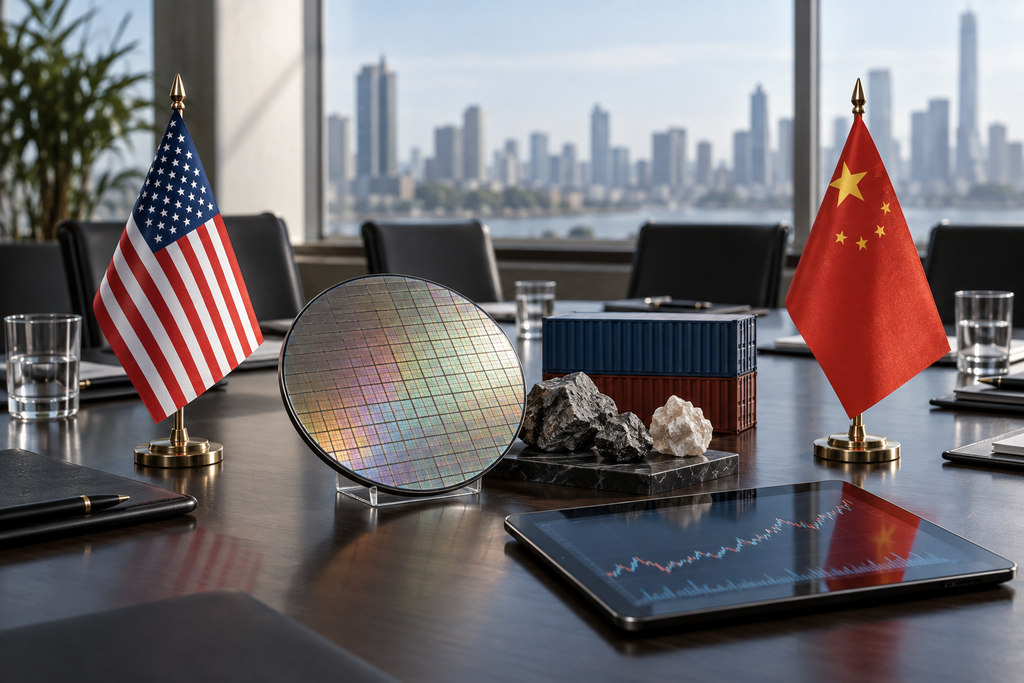
Summary: U.S. Treasury Secretary Scott Bessent and Chinese Vice Premier He Lifeng held high-level talks in New York on Sunday, laying the groundwork for this week’s meeting between Presidents Donald Trump and Xi Jinping. Officials described the discussions as constructive and agreed to continue an AI dialogue, but they announced no comprehensive trade settlement. For investors, the important questions concern tariffs, critical-mineral supplies, agricultural trade and whether greater policy visibility can reduce risk across global markets.
New York talks prepare the ground
Senior U.S. and Chinese officials met on September 20 for consultations covering trade, artificial intelligence and other economic issues ahead of Xi Jinping’s state visit to Washington.
The U.S. delegation was led by Treasury Secretary Scott Bessent and U.S. Trade Representative Jamieson Greer. China’s delegation was headed by Vice Premier He Lifeng, Beijing’s principal official for economic and financial policy.
After the meeting, Bessent characterized the engagement as highly successful. China’s official account described the exchanges as candid, in-depth and constructive. The two descriptions indicate a positive negotiating atmosphere, although neither side disclosed a detailed package of binding commitments.
The talks addressed implementation of earlier understandings and issues affecting bilateral trade and investment. They also continued discussions about a proposed framework for commerce in non-sensitive goods and opened a more formal channel for dialogue on AI.
The immediate objective was to prepare for the September 24 meeting between Trump and Xi. Officials therefore presented Sunday’s session as groundwork rather than a final negotiation. China’s official readout, Reuters reporting
Progress on process, but no comprehensive deal
The clearest outcome was institutional rather than commercial.
The two governments agreed to continue a U.S.-China AI dialogue. Washington also proposed a notification mechanism through which the countries could communicate about AI incidents with national-security implications. The proposal reflects an acknowledgment that strategic competition does not eliminate the need for limited coordination between the world’s two leading AI powers.
Officials also discussed operationalizing a “Board of Trade” first outlined during Trump’s visit to Beijing in May. The initiative is intended to facilitate bilateral commerce in goods considered non-sensitive.
Greer said discussions were continuing over which products might qualify for lower tariffs. Potential categories included consumer goods, agricultural products, energy and medical devices, but no final list or timetable was announced. Associated Press, White House background
That distinction matters. The meeting reduced the risk of an immediate breakdown in communication, but it did not resolve the central economic disputes between the two countries.
Tariffs and the trade truce remain unresolved
Tariffs are likely to be among the most market-sensitive subjects at the leaders’ summit.
China has publicly expressed interest in securing further reductions, while the United States continues to press for changes in Chinese trade and industrial policies. Negotiators must also address the existing trade truce, which Reuters reports is due to expire on November 10.
The commercial relationship has already contracted substantially. According to the U.S. Trade Representative, total U.S.-China goods and services trade fell 25.1% in 2025 to an estimated $494.6 billion.
U.S. goods imports from China dropped to $308.7 billion, while exports fell to $106 billion. Nevertheless, the bilateral goods deficit remained $202.7 billion. Census Bureau data show a further $91.2 billion goods deficit during the first seven months of 2026. U.S. Trade Representative, U.S. Census Bureau
Any reduction in tariffs on non-sensitive goods could support selected manufacturers, retailers, logistics businesses and agricultural exporters. A failure to extend the truce, however, would revive uncertainty over costs, sourcing decisions and inflation.
Critical minerals remain a strategic pressure point
Rare earths and other critical minerals are another unresolved issue.
These materials are essential to electric vehicles, electronics, defense equipment, renewable-energy systems and advanced manufacturing. China holds a dominant position in several stages of their production and processing.
The White House said in May that China had agreed to address U.S. concerns about shortages involving minerals including yttrium, scandium, neodymium and indium. U.S. officials have since argued that supplies remain insufficient.
This makes mineral flows both an industrial issue and a source of negotiating leverage. Investors should focus on operational evidence: export licences, shipment volumes, delivery times and factory inventories will be more informative than broad diplomatic language.
Producers outside China could benefit from continuing efforts to diversify supply, but new mines and processing capacity require substantial capital and long development periods. Even a diplomatic improvement would not remove the strategic case for alternative supply chains.
AI adds a new dimension to economic diplomacy
The inclusion of AI makes these talks different from a conventional tariff negotiation.
The two countries are competing for leadership in semiconductors, data centres, advanced models and military applications. At the same time, both face risks from system failures, cyber incidents and the misuse of increasingly capable models.
A notification channel could reduce misunderstanding following a serious AI-related incident. It would not, however, settle disagreements over chip-export controls, access to computing capacity, model development or technology investment.
For semiconductor and cloud-computing investors, the distinction is important. Dialogue over shared risks does not necessarily imply broader liberalization of technology controls. Investors should avoid interpreting cooperation on AI safety as evidence that strategic competition is ending.
Markets welcome dialogue, but confirmation is needed
Early Asian trading on Monday reflected a cautiously constructive response. Regional equities and U.S. futures advanced as investors considered the positive tone of the talks and the approaching summit. Technology shares also received support from continuing demand linked to AI investment. Associated Press market report
Still, the talks took place against a difficult macroeconomic background. Global bond markets have been adjusting to renewed monetary tightening, while energy prices and geopolitical tensions continue to complicate the inflation outlook.
A U.S.-China understanding could remove one source of uncertainty, but it would not neutralize those broader pressures. Market reactions may therefore remain sensitive to the precise scope, enforceability and duration of any announcement.
What investors should watch next
The summit’s value will depend on whether political language is converted into measurable policy.
The most important signals will be:
- A detailed list of goods eligible for lower tariffs.
- An extension or replacement of the November trade truce.
- Specific commitments covering rare-earth and critical-mineral shipments.
- Chinese agricultural or energy purchase agreements.
- The scope and timing of the proposed AI incident-notification mechanism.
- Any changes to semiconductor or technology-export restrictions.
Sunday’s talks were significant because they kept negotiations moving and introduced mechanisms that could improve communication. They did not produce a comprehensive economic settlement.