No spam - just the latest insights!
Join over 30,000 industry professionals who subscribe for free

Subscribe for free!
We'll never share your information or send you spam
-scaled.jpg)
Tomotaka leads Data Driven Re-Design Strategy Team, a part of Strategic Impact, which offers solutions to social issues. Before joining EY, he worked for a government financial institution and a global consulting firm. He spearheads initiatives for solving various social issues, focusing on formulation of data-driven strategies. In recent years, along with supporting policymaking for tourism, he has been playing a leading role in offering data utilisation platform services in cooperation with local governments and tourism-related operators throughout Japan. Now he is recognised as one of the leading experts in ecosystem and platform businesses. Committee Member of the Japan Tourism Agency (Promotion of tourism DX) Committee Member of the Japan Tourism Agency (Functional enhancement for JNTO certified Foreign Tourist Information Centres)

Japan was no exception to the temporary slowdowns in global economic activity induced by the spread of the covid-19 pandemic in early 2020. The Japanese government responded to these developments by providing — through Japan Finance Corporation and Shoko Chukin Bank — a policy-based directed credit program available to small and medium enterprises (SMEs) impacted by COVID-19 (known as “zero-zero loans”), wherein interest was forgiven and repayments deferred for a period of 3 years from the date of the loan. There was a large influx of applications when the program began in March 20201, and in May 2020 private financial institutions also began to finance loans under equivalent terms by leveraging the aid provided to policy-based directed credit programs provided by Japan’s prefectures made possible through the credit guarantee system.2
Given the record-breaking amounts lent during the height of the COVID-19 pandemic and the increasing demand for financing as the COVID-19 pandemic begins to subside, the total outstanding balance of loans made to small and medium enterprises by a total of 99 regional banks stood at JPY302,000 billion, a 5% increase year-on-year. This marks a 150% increase of the JPY201,000 billion in outstanding loans by regional banks as of 31 March 2011, a JPY100,000 billion increase over just twelve years. This rate of increase is substantially greater than the nearly 20% increase in loan balances seen in urban banks over the same time period.3
Major societal changes, such as the imposition of restrictions on the freedom of movement due to the COVID-19 pandemic, continue to generate new expectations for the roles to be played by regional financial institutions.
One such development is that regional banks have begun to establish regional trading companies through which they provide support to private companies operating within their given region. Much is expected of the regional trading companies established in this manner, including the identification of exceptional products and services within the region, utilisation of new sales channels and branding campaigns to increase profits to unprecedented levels, and distribution of the knowledge and profits generated through such activities to the region; as well as the discovery of latent talent and resources alongside the building of a larger community of non-resident individuals with ties to the region (a concept known in Japan as the “related population”).
The process of establishing a regional trading company was streamlined with the revision of the relevant Supervisory Guidelines (the Comprehensive Guidelines for Supervision of Regional Financial Institutions) in 2019, which provided clarity regarding the examination of advanced banking service companies and the rules pertaining to investments in regional trading companies.4 Exposure to the dampened profits of regional companies during the COVID-19 pandemic forced regional banks engaged in regional company financing to enhance the management support functions they provided to such lendees (e.g., product development and sales channel development), and the additional risks to the recovery of outstanding liabilities posed by inaction is likely to have further accelerated the adoption of regional trading companies as a means of providing such support.
Further reform of the Banking Act in May 2021 provided for a “Revision of restrictions to the scope of services” and a “Revision of restrictions on investments.” These revisions contained measures providing for the relaxation of the restrictions on the scope of services respectively permitted to banks and the subsidiaries or sister companies of such banks enacted with the intention of addressing the impact of the COVID-19 pandemic to enable the formation of a sustainable society through means such as digitalisation and regional revitalisation; as well as measures pertaining to restrictions on investments, providing for the ability to conduct investments amounting to 100% of voting rights in a non-listed regional development business to facilitate a wide range of support activities conducted through bank financing including the multi-dimensional revitalisation of regions.5
Following the relaxation of such restrictions, regional financial institutions began to accelerate the pace at which they establish regional trading companies as well as the operation of registered staffing services and a diverse range of consulting services.
The COVID-19 pandemic forced even companies apprehensive about digitalisation to adapt and led to the rapid acceleration of ongoing digitalisation activities, particularly those involving contactless or unattended services. The tourism industry was particularly hard-hit by the COVID-19 pandemic and is now faced with the challenge of determining how best to digitalise existing data and utilise that data to further collect and leverage the potential of regional-level data. Many regions are currently engaged in the process of implementing digitalisation and other DX initiatives, with one notable example seen in
Hyogo Prefecture’s Kinosaki Onsen Town, which has begun utilising regional-level data generated and collated from various property management systems — used to manage bookings and other aspects of its local ryokan inns and hotels — to track vacancies throughout the area and enable short-term demand forecasting. Demand forecasting enables additional forecasting for employee shift planning and procurement planning, as well as the optimisation of profits through revenue management, and is expected to increase profits throughout the region and to provide opportunities for corporate-level enhancement of both profits and productivity.6
However, many such initiatives to have local businesses provide data to the region and track demand throughout the area are stuck in a cycle where an idea is raised, fails to see fruition, and yet another idea takes the place of the first. One major obstacle to such initiatives can be found in the data acquisition process, e.g., the inability to reach a regional consensus or the reluctance of individual companies to share their data. Although it is a given that any such data will be anonymised prior to its use, resistance to releasing company data is well-entrenched as the parties involved often have their interests directed towards besting their regional competitors. Distributing point of sales (POS) data (including data on purchases) to the region allows for a clear picture of the amount of purchases made throughout the entire region as well as the assessment of the size of the regional market. Pairing this information with occupancy rate data enables the estimation of visitor demand, which could generate increased expectations for new business opportunities in the area and provide opportunities for new entrants to the regional market. It remains a fact, however, that regardless of how well the parties involved understand the benefits, regions nevertheless struggle to make real progress on any such initiative.
Regional financial institutions place high value on the support of regional SMEs as a means for both institutional and regional growth. Continuous support for company growth is predicated on the ability to have a timely assessment of the status of a company’s business, but financial institutions have only limited opportunities to make such assessments via, e.g., annual financial statement data, the trial balances companies are required to provide on a periodic basis, or (if the bank is the main bank utilised by the company) account withdrawal and deposit data. Access to more dynamic data at timely intervals would have a significant impact on the positions taken in regard to the support of SMEs.
Dynamic data acquisition is already a reality in the FinTech space, wherein EC businesses utilise the transaction data and other information sourced from EC sites in transaction lending. However, as such data is limited to that pertaining to online transactions, it is insufficient for use in the provision of support to regional SMEs.
As discussed above, one of the primary obstacles to regional-level data tracking is that companies refuse to provide the data necessary to do so. SMEs face the constant challenge of securing access to working capital and capex in preparation for business expansions. A financial institution successful in encouraging companies to share transaction data daily and leveraging that data to conduct financing would be in a position to provide both capital and business management advice in the interest of regional growth.
A few use cases are discussed in detail below. Zero-zero loans, originally a measure meant to support SMEs during the COVID-19 pandemic, may now be acting as a significant barrier to the growth of the rapidly recovering tourism market. Business operations in the tourism industry suffered extensively from the pandemic and debt redemption periods for such businesses currently exceed pre-COVID-19 levels. The ability to accurately predict regional-level bookings, room occupancy, average daily rates and other factors several months in advance could increase the willingness of lenders to provide additional working capital. In-depth communication with lodging facility operators about such data and demand predictions on the scale of several years could also increase the willingness of lenders to provide access to funds for capital investments without overreliance on real estate collateral.
The benefits extend beyond increased willingness to lend capital, and into the recoverability of debts; the early detection of financial distress in lendees, for instance, could enable financial institutions to more easily provide management advice or opportunities for debt rescheduling.
Figure 1: Debt redemption periods by industry and stated capital
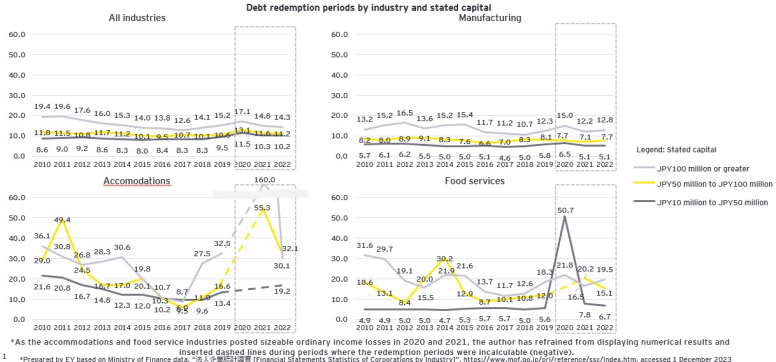
Access to data about the business conditions of a given region facilitates the ability to provide financial support to the SMEs that act as the pillars of the regional economy, and thus contributes to the growth of the regional economy itself. The ability to track the economic conditions of a given region, including via predictive data, also helps attract investment from non-local parties, and even holds the potential to facilitate the formation of an ecosystem amenable to the market entry of startups.
Collaboration between regional financial institutions and their local counterparts to collect, collate and leverage such region-level data for the development of the region and in support of local companies will provide the means necessary to build a circular economic model into the regional economy.
In the light of a decreasing and aging population, there are only two possible pathways for maintaining a regional economy: meeting non-local demand through the sale of products in non-local localities (export and inter-regional trade) or enticing non-local demand into the region and inducing local consumption (tourism). During the height of the COVID-19 pandemic, there was accelerated adoption of regional trading companies, which place a focus on export and inter-regional trade, in the interest of supporting SMEs in the development of products and sales channels. Given the nature of financial institutions, however, it is advisable that such institutions also place an emphasis on the latter point, i.e., the question of how to entice non-local demand into the region and induce local consumption. This is the very definition of tourism, which requires participation not only from lodging business operators, restaurants and retailers, but industries of all shapes and sizes, as it involves the provision of products and services to non-residents. Tourism has the potential to act as the foundations of innovation, which involves analysing data to identify needs and using that information to develop new products and services.
The case could even be made that what is truly required to accomplish these aims is support for regenerative economic growth via a framework adopted and led through the partnership of regional financial institutions and other regional actors, one which generates the sustainable regional-level growth captured only when regional actors operate in unison to exploit the potential of regional resources.
Figure 2: Data-enabled model for regenerative economic growth