No spam - just the latest insights!
Join over 30,000 industry professionals who subscribe for free

Subscribe for free!
We'll never share your information or send you spam

Ian has been with KPMG for over 20 years and is Head of Financial Services for KPMG Ireland, which includes the Banking, Aviation Finance, Asset Management, Insurance and Private Equity sectors. In total c.2,500-3,000 people in KPMG Ireland work in Financial Services. Ian is also Head of Regulatory Consulting for KPMG Ireland and works with all domestic and international banks and a number of asset managers, payment firms and fintechs in Ireland.
Ian is a regulatory / risk specialist and has overseen many regulatory and risk engagements with domestic and multinational companies. His banking experience includes a secondment with the Irish Central Bank where he was the Head of Financial Measures Programme working closely with the Irish authorities and international partners in the ECB, IMF and European Commission. Ian also works directly with a number of the new entrants into the Irish Financial Services sector such as fintechs and is a Fintech and Payments Association of Ireland Council Member.

Noleen is a Director in KPMG’s Risk and Regulatory Consulting team with 10 years’ experience in the financial services industry. Noleen specialises in banking, payments and fintech regulation and provides risk and regulatory related advice to clients on all stages of the regulatory lifecycle including authorisation, supervision and enforcement. Her experience includes supporting firms with engaging with the Regulator, offering insights and industry standards and helping clients to operationalise regulatory requirements with regards to, inter alia, risk management frameworks and associated policies, governance and organisational structures, outsourcing and AML requirements.
Noleen has recently advised a number of clients on applications for authorisation, including electronic money institutions, payment institutions, account information service providers, payment initiation service providers and retail credit firms. She is also working with a number of payment and e-money firms in providing advice and strategic direction in relation to risk management practices, compliance and outsourcing requirements as well providing support in relation to existing and upcoming regulation.

Tony joined KPMG Ireland as an Associate Director in Management Consulting, with a focus on the banking and payments sectors. Tony brings to the firm 13 years’ industry experience, during which time he held a variety of technology and business roles within the banking and fintech space.
His experience includes heading up the Irish Correspondent Banking business for a European Bank, supporting a fast growth fintech on International Payments and FX strategy, and developing a SEPA Credit and Debits payments systems using SQL and .NET for an Irish based direct participant bank, which grew to process €60bn+ annually.
Tony is passionate about payments and holds expertise across ISO 20022, SEPA and SWIFT. He has most recently started exploring Blockchain based payments solutions such as Ripple On Demand Liquidity (ODL), Stablecoin and CBDCs.

The European payments landscape has changed considerably since the introduction of Payment Services Directive 2 (PSD2) in 2015. Demand for cashless payments has increased greatly over the past number of years, further accelerated by the Covid 19 pandemic, while the launch of new payments rails such as SEPA Instant Payments in 2017 have shifted the European payments landscape considerably.
In parallel, there has been significant technological advancements with institutions delivering more sophisticated customer journeys and full-featured digital wallets, while providing customers with more choice around payments to reflect the ubiquity and popularity of contactless payments.
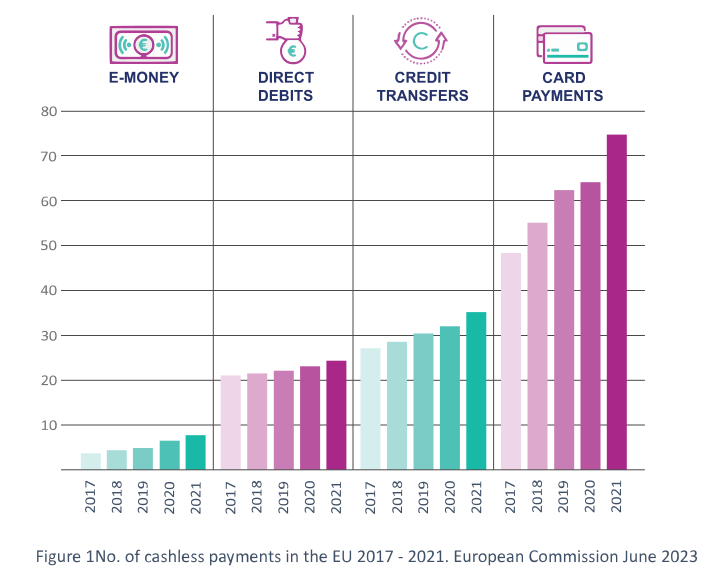
The growth has created lots of opportunities for new players but obstacles still remain for Payment Service Providers (PSPs). For example, the introduction of Open Banking has allowed consumers to access financial data efficiently and securely, but Account Information Service Providers (AISPs) and Payment Initiation Service Providers (PISPS) still have trouble accessing data.
To address some of the challenges in the payments market and to keep pace with consumer and business requirements a new legislative framework has been proposed by the European Commission; Payment Services Directive 3 (PSD3) and the Payment Services Regulation (PSR).1The proposals will be reviewed by the European Parliament and Council. The exact timelines for entry into force are not yet known. Based on the usual legislative process, the final versions may become available by the end of 2024. Since Member States are usually granted an 18-month transition period, the Directive and Regulation will likely start to apply somewhere in 2026. The proposed requirements aim to strengthen customer protection and define parameters within which Open Banking should operate, enhancing opportunities in this space. They will also help level the playing field for all participants across the payments industry by allowing, for the first time, non-banks to participate directly in the SEPA payment schemes.
In addition to PSD3 / PSR, new SEPA Instant Payments legislation has been provisionally agreed and is expected to enter into force in Q1 2024. This will most notably make participation in the instant payment scheme mandatory for all PSPs who currently offer SEPA Credit Transfer to their customers. This is a welcome move which reflects the relative lack of uptake for this scheme thus far and supports the vision that instant payments in euro will be affordable, secure, readily available and processed without hindrance across the EU.
In Ireland, we have seen the Central Bank of Ireland’s (CBI’s) supervisory approach to payments and e-money institutions intensify over the past 24 months with the publication of two industry Dear CEO letters and the focus will continue to grow through the shift to instant payments, growth in open banking and broader regulatory landscape.
In this article, we provide an overview of some of the key regulatory changes including the impacts of PSD3/PSR and the evolution of instant payments. The pace of change is challenging leaders like never before and Fintechs should not only be aware of these upcoming changes but should be preparing for them in the short, medium and long term.
Macro drivers of change since PSD2
The highly anticipated proposals for the PSD3 and PSR were published by the European Commission on 28 June 2023. To understand the impact PSD3/PSR will have on European Payments and Open Banking, it is perhaps useful to reflect on what has brought us to this point.
During a European Commission evaluation2The proposals will be reviewed by the European Parliament, Council and Commission. The exact timelines for entry into force are not yet known. Based on the usual legislative process, the final versions may become available by the end of 2024. Since Member States are usually granted an 18-month transition period, the Directive and Regulation will likely start to apply somewhere in 2026. of the PSD2 implementation, the European Commission found that while PSD2 positively impacted fraud prevention through SCA (70-80% lower for remote card payments) and brought increased efficiency, transparency and choice of payment instruments, some improvements were still required. They found that AISPs and PISPs experienced issues accessing data as the APIs varied in quality and performance. In some member states, including Ireland, there is no publicly available data showing API volumes, efficiency, uptime etc, as distinct from other jurisdictions which do publish regularly.3E.g. UK, API performance stats – Open Banking
An evolution, not a revolution
The findings from the European research formed the basis of the EU proposals for PSD3/PSR. The proposals aim to achieve four key objectives and introduce a number of revisions and improvements to PSD2:4KPMG Netherlands, PSD3 & PSR: New EU proposals game-changing for payments?, https://kpmg.com/nl/en/home/insights/2023/06/psd3—psr-.html
Proposed fraud and liability improvements:
Proposed consumer rights and information improvements:
While these proposals have been put forward as evolutionary rather than revolutionary, they do represent a welcome move to strengthen Open Banking and level the playing field for participating Fintechs across the European payments landscape.
The proposals for PSD3 / PSR will undoubtedly evolve but firms should not delay in considering the likely impacts the regulatory requirements will have on their business models. Firms will need to prepare by undertaking a gap analysis against the PSD3/PSR requirements to identify a remediation plan. Firms should identify the impacts of regulatory change on their business and strategy to determine the necessary changes in process, capability, technology etc. and undertake implementation of the necessary requirements to meet the enhanced regulatory regime.
Merging the E-money and Payment firm regimes
A key proposed change in PSD3 is the merger of the licencing and authorisation frameworks applicable to Payment and E-money Institutions to increase harmonisation of the regulation and supervision process across Europe with the removal of the Electronic Money Directive. With the consolidation of their legislative basis, E-money firms will become a subset of Payment Institutions and all existing PSPs will have to reapply for authorisation under PSD3.
What that re-authorisation will look like for firms, depends on a number of factors, including:
The authorisation requirements should not change significantly from previous requirements, however some of the key changes are outlined below:
Payment and E-money Institutions will need to prepare for re-application for authorisation. This may include preparation of re-authorisation material, discussion with the CBI and remediation of any areas of deficiency identified as part of the re-authorisation process or the regulatory regime more broadly.
Instant payments; the new normal?
In parallel to the PSD3/PSR draft legislation, work to finalise the SEPA Instant Payments legislation has been provisionally agreed on 7 November 2023 by European Parliament and Council allowing up to €100k to be transferred within 10 seconds, anywhere in the SEPA zone 24 hours a day, 7 days a week and every calendar day of the year.
The legislative intervention was brought about as the current non-mandatory SEPA instant payments scheme, which was launched in 2017, has not seen the impacts and uptake initially envisaged. Today 61% of PSPs operating in the SEPA Credit Transfer scheme (SCT) in Europe also operate in Instant.5As at 15 October 2023 That number is significantly less in Ireland, with only 11 of 195 SCT participants operating in the SEPA Instant scheme.6Registers of Participants in SEPA payment and payment related schemes | European Payments Council

Research conducted by the European Commission indicates lack of uptake was largely down to four reasons:
As such, the new SEPA Instant Payments mandate, which is intended to co-exist alongside the mandatory SEPA Credit Transfer scheme, needs to be seen as affordable, secure and the ‘new normal’.
The incoming legislation is expected to enter force in Q1 2024 and sets out:
The legislation’s final implementation timeline for the receiving and sending of SEPA Instant Payments is nine and 18 months, respectively. Separately, the name and IBAN matching requirement will be applicable at 18 months, while the new sanctions screening requirements will be applicable at nine months.

The real value of Instant Payments
For consumers, online and mobile banking payments have jumped 60% in Ireland in the last 5 years.8BPFI Payments Monitor – Q2 – Banking & Payments Federation Ireland Consumers are tapping for 85% of their in-store transactions, showing the customer preference for digital and quick, frictionless payments – which Instant Payments will support. Migrating payment flows from same day to instant will allow the releasing of funds that are locked in the financial system (currently €200bn in Europe at any given time)9https://ec.europa.eu/commission/presscorner/api/files/attachment/873809/2022-10-instant-payments_en-.pdf.pdf, making them immediately available to end users for consumption and investment.
For businesses, instant payments mean better real-time visibility of cash and an improved cash flow. For e-commerce retailers particularly, it means less risk, since they can fulfil orders immediately (for comparison, online card payments take up to three days to settle).
In order to be ready for ready for SEPA Instant Payments, Firms should prioritise the performance of a gap analysis to understand the areas of work that must be completed to bring your current environment to the desired end state.
This should include, for example,:
The movement from a bulk processing environment Mon – Fri (as is the case with SCT), to having all channels, across all accounts, operating in real time (less than 10 seconds) 24 x 7 x 365 means significant change. Firms that embrace these opportunities with their customers will be the long-term winners.