No spam - just the latest insights!
Join over 30,000 industry professionals who subscribe for free

Subscribe for free!
We'll never share your information or send you spam

Yuta is a Managing Director at KPMG AZSA LLC with over 23 years of experience in financial services. Early in his career, he was primarily engaged in financial statement and internal control audits for banking and capital markets clients in Japan and New York. He later became a consultant specializing in sustainability disclosures and SX transformation for financial institutions in Japan. Currently, he leads sustainability disclosure advisory services to financial institutions in Japan.

Jasang joined KPMG AZSA LLC in 2025 and has since been engaged in sustainability advisory work for Japanese financial institutions. To date, he has been involved in SSBJ (Sustainability Standards board of Japan) standard disclosures for commercial banking groups and ESG research for government-affiliated financial institutions. Jasang also has experience calculating and analyzing financed emissions calculation and portfolio-level carbon accounting and holds PCAF accreditation.

Ryo joined KPMG AZSA LLC in 2025 and has since been engaged in sustainability advisory work for Japanese financial institutions. To date, he has been involved in sustainability-related projects for insurance companies and government-affiliated financial institutions. Following the commence of regulatory disclosure, Ryo also has experience in supporting sustainability disclosure for a P&C insurance company. Prior to joining KPMG, he devoted much of his student years to extracurricular activities related to biodiversity. For instance, Ryo managed a general incorporated association that enabled youth in Japan to engage in biodiversity-related activities such as, participating in CBD-COP15 and COP16 as a youth to track international debates in biodiversity conservation.

Despite global headwinds facing sustainability, Japan continues to pursue carbon neutrality by 2050 and 150 trillion yen mobilization in capital from both the public and private sectors. It is without a question that Japan’s financial institutions have a significant role in fulfilling the goal of Japan’s green transformation (GX).
The sheer scale of the financing needs of companies coupled with the sophistication of transformation approaches, require Japanese financial institutions to enhance their credit risk evaluation as well as to assess the overall resilience of their loan and investment portfolio and business risks in the context of climate-related risks exposure. At the same time, financial institutions cannot address the risk by themselves, as they require more forward-looking and comparable financial-related disclosures from companies to better understand the nature of the associated risks and opportunities.
The following discussions are intended to provide an overview of Japan’s GX strategy and the role that Japanese financial institutions are expected to play in providing climate and sustainable finance, while also taking a closer look at the emerging trends in mandatory disclosure requirements and evolution of risk management by financial institutions.
The content of the discussions below solely represents the view of the authors and does not represent the view of KPMG AZSA LLC.
The momentum towards decarbonization in Japan has become prominent in October 2020, when Japan declared to be carbon neutral by 2050, to be in alignment with the global trends. In February 2023, the “Basic Policy for the Realization of GX” was adopted, outlining the pathway towards successful GX in Japan. Simultaneously, the “Act on the Promoting Transition to the Decarbonized Growth Economic Structure” (GX Promotion Act) was enacted to establish the legal foundation for promoting GX in Japan. The GX Promotion Act consists of 5 pillars of action:1Ministry of the Environment (000110823.pdf)
Later in July that year, the GX Promotion Strategy was approved by the Cabinet, positioning GX as a central policy in Japan. Following the revision of the GX Promoting Act in February 2025, 2Ministry of Economy, Trade and Industry (climate.transition.bond.allocation.impact.report.eng.pdf),3Ministry of Economy, Trade and Industry (https://www.meti.go.jp/policy/energy_environment/global_warming/index.html) Japan is now further advancing the implementation of growth-oriented carbon pricing.
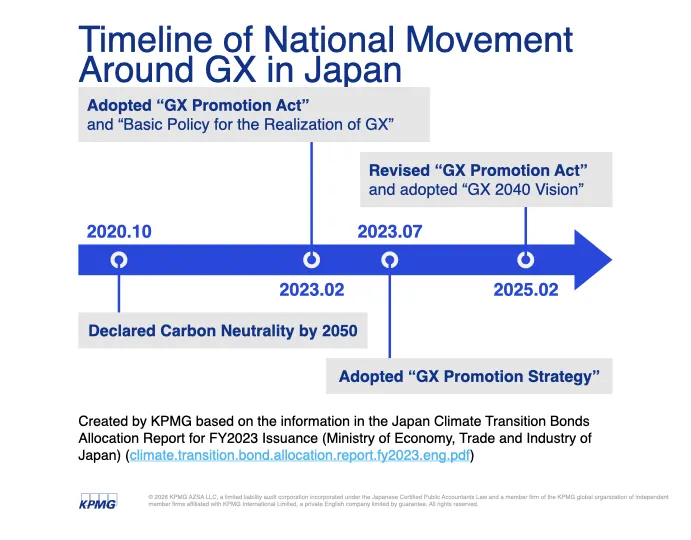
(Created by KPMG based on the information in the Japan Climate Transition Bonds Allocation and Impact Report2)
In the context of implementing growth-oriented carbon pricing, the Ministry of Economy, Trade and Industry established the “GX League” in April 2023: a voluntary forum where companies, government, and academia can collaborate to achieve both carbon neutrality and economic growth. Companies participating in the GX League can set their own emissions reduction targets and disclose their progress through the GX Dashboard. Another function provided by the GX League is GX-ETS: an emissions trading scheme in which companies that have exceeded their reduction targets can trade their excess emission reductions with companies that have yet to achieve their targets.4Ministry of Economy, Trade and Industry (https://gx-league.go.jp/en/),5Ministry of Economy, Trade and Industry (https://www.meti.go.jp/policy/energy_environment/global_warming/transition_finance.html) After 2 years of experimentation, this emissions trading scheme was legalized through the revision of the GX Promoting Act in 2025, making it mandatory for covered companies to participate in the emissions trading mechanism. This demonstrates Japan’s dedication to carbon neutrality. Yet, achieving this is not as straightforward. Especially for the so-called “hard-to-abate sectors” such as power, oil and gas, and chemical sectors. For this reason, most GX policies in Japan emphasize the necessity to mobilize 150 trillion yen to fund companies to achieve decarbonization transition over the next 10 years.6
To facilitate financing for GX, the Japanese government began issuing GX Economy Transition Bonds in 2023, which may also be issued under the label of “Climate Transition Bonds.” As government issuance will only account for 20 trillion yen out of the required total of 150 trillion yen, financial institutions will inevitably need to play a significant role in order to close the 120 trillion yen financing gap.
To qualify as Climate Transition Bonds, issuers in Japan are required to comply with the requirements set out in the International Capital Markets Association’s “Climate Transition Finance Handbook”6International Capital Market Association (https://www.icmagroup.org/assets/documents/Sustainable-finance/2025-updates/Climate-Transition-Finance-Handbook-November-2025.pdf) and the Japanese government’s ” Basic Guidelines on Climate Transition Finance”7Financial Services Agency, Ministry of Economy, Trade and Industry; Ministry of the Environment (https://www.meti.go.jp/policy/energy_environment/global_warming/transition/basic_guidelines_on_climate_transition_finance. pdf) (Basic Guidelines). Per the Basic Guidelines, the issuer is recommended to disclose its climate transition strategy and governance, material issues based on its business model and environmental materiality, science-based climate transition strategy and targets and transparency in the implementation of such strategies. It should be noted that within the Basic Guidelines, there is reference to IFRS S2 “Climate-related Disclosures” and the Sustainability Standards Board of Japan’s (SSBJ) “Climate-related Disclosure Standards” to fulfill disclosure requirements of the Basic Guidelines. As explained in the next section, Japan is mandating the application of the SSBJ standards for listed companies, with the aim of fostering dialogue among investors, investee companies and policy makers.
Since the publication of the TCFD framework in 2017, many listed Japanese companies have voluntary disclosed the impacts of climate and sustainability issues on their operations. As of March 2025, 94% of companies either publish sustainability reports or include a dedicated section on sustainability in their integrated reports. On the other hand, sustainability information is generally disclosed later than financial statements, which are provided prior to the annual shareholders meeting. Furthermore, the content of the disclosures generally varies across different sustainability reporting outlets, with disparity in the level of third-party assurance applied to the disclosed information. These are among the issues which limit transparency in how reported risks and opportunities are reflected in the forward-looking financial outcome of the company. Based on KPMG Japan’s annual survey of corporate disclosures of TOPIX 100 and Nikkei 225 companies, many Japanese companies disclose both integrated reports and sustainability reports within a similar timeframe of 6 to 7 months after the fiscal year end. However, there are noticeable disparities in the content and the quality of information between the two reports.
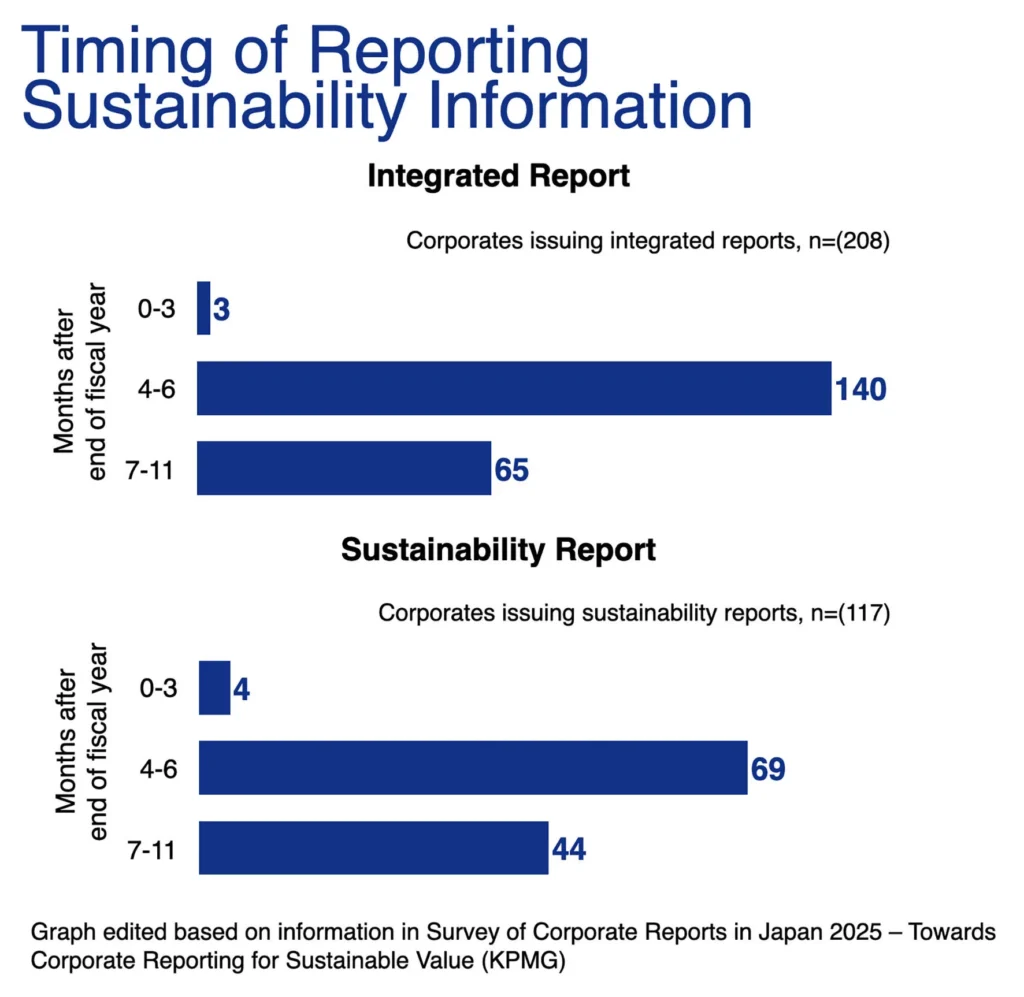
(Graph edited based on information in Survey of Corporate Reports in Japan 2025 8KPMG Japan (https://assets.kpmg.com/content/dam/kpmgsites/jp/pdf/2026/jp-sustainable-value-corporate-reporting-2025-v2.pdf.coredownload.inline.pdf))
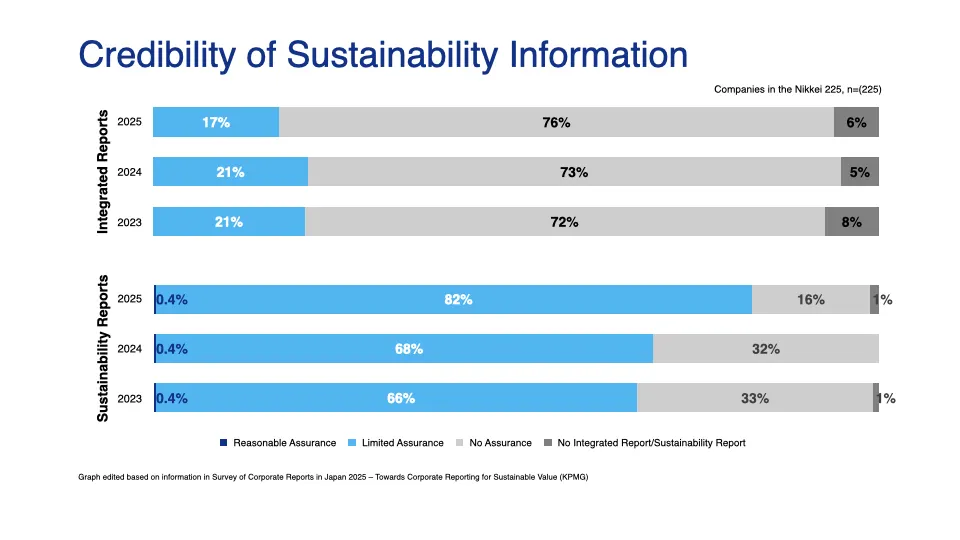
For example, KPMG Japan’s survey identified differences between the proportion of assurance obtained for GHG emissions and other sustainability related indexes reported in the integrated reports, compared to that for sustainability reports. While disclosure practices may vary among reporting companies, inconsistencies between the reliability of these reports represent one of the key factors underpinning investor support for mandatory disclosures based on the SSBJ standards. Following the amendment of the Cabinet Office Ordinance in March 2026, Japanese listed companies are required to report sustainability-related disclosures as part of their annual filing with the Tokyo Stock Exchange, based on the officially endorsed SSBJ standards. The application of mandatory SSBJ standards will be on a phased basis, depending on the company’s market capitalization. In addition, the Financial Instruments and Exchange Act will be amended to require limited assurance over governance and risk management disclosure, as well as Scope1 and Scope 2 of GHG emissions from the second year of mandatory reporting.
Upon the adoption of the SSBJ standards, companies will be required to satisfy all disclosure requirements to state compliance with the SSBJ standards. In addition, as SSBJ standards are based on IFRS S1 and S2, Japanese companies will be required to disclose information based on four pillars – governance, strategy, risk management and targets and metrics – not only for climate-related matters, but also for human capital, biodiversity and other specific sustainability topics that are relevant to their value chain and business operations.
Specifically for financial institutions, financed emissions (FE), an indicator of how transition risks transcend to risk exposure of a financial institution, will be mandated for banks, insurance companies and asset management companies. While the trajectory of voluntary disclosures by financial institutions is positive, with the level of quantity and qualitative information increasing on a year-to-year basis, many still experience difficulties disclosing FE information due to uncertainty of the measurement itself, compounded by data quality issues and exposure to potential reputation and regulatory risks. In conjunction with the introduction of SSBJ mandatory disclosure requirements, Japanese regulators have expanded the safe-harbor rule to cover Scope 9Ministry of Economy, Trade and Industry (https://www.meti.go.jp/policy/energy_environment/global_warming/GX-league/gx-league.html) disclosures to remediate concerns by financial institutions.10Financial Services Agency (https://www.fsa.go.jp/news/r7/shouken/20260220/20260220.html) While the safe-harbor rule is intended to accelerate disclosures while reducing risks, financial institutions will nevertheless need to continue to improve their measurement of emissions data to be in time for the mandatory application of the SSBJ disclosures.
As Japanese companies prepare for mandatory reporting, many are recognizing that the key challenge is integrating climate -and other sustainability topics- into core business strategy and risk management practices. Some companies are also beginning to streamline their reporting channels in order to communicate in a clearer and more timely manner to investors. While the maturity of these disclosures is expected to evolve over time, their improved usability is likely to provide investors with more decision-useful information for assessing climate-related risks and opportunities.
Since the publication of the TCFD Recommendations in 2017, Japanese financial institutions have played a pivotal role in voluntarily incorporating climate-related risks into their risk management frameworks. Furthermore, in 2022, internationally active Japanese banks (29 banks, including 10 regional banks) were required to align with the Basel Committee on Banking Supervision’s “Principles for the Effective Management and Supervision of Climate-related Financial Risks”. In the same year, Japan’s Financial Services Agency (JFSA) issued the “Supervisory Guidance on Climate-related Risk Management and Client Engagement”11Financial Services Agency (https://www.fsa.go.jp/news/r7/shouken/20260220/20260220.html) and has been issuing annual progress reports on practices and challenges on climate-related risk management by financial institutions.
Against this backdrop, Japanese financial institutions have been strengthening their capabilities year by year, particularly in their scenario analysis, which is resource-intensive and requires specialized expertise. Leading institutions are increasingly moving beyond stand-alone scenario exercises toward integrating climate considerations into risk modeling, strategic planning, and credit decision-making. Some have also begun to expand their scope beyond climate change to other sustainability-related risks, such as biodiversity loss and circularity.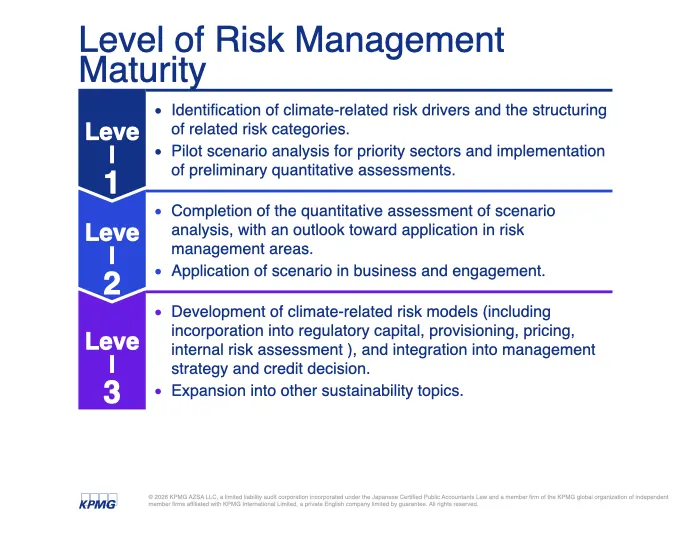
After many years of efforts to articulate, the financial and strategic relevance of climate transition-both for financial institutions and their customers-remains underestimated. This is often the case because transition dynamics are obscured by multiple market forces, the timing and potential disruption are difficult to observe, and data and forward-looking signals remain limited.
Given their interconnected and mutually reinforcing relationship with climate change, Japanese companies are increasingly engaging in biodiversity initiatives to better understand the implications to their business models and operations. Japan stands out as one of the few countries where the TNFD framework has been widely adopted on a voluntary basis, with 41 Japanese financial institutions disclosing biodiversity-related information in line with TNFD.12Financial Services Agency (https://www.fsa.go.jp/en/news/2022/20220715/03.pdf) At present, most Japanese financial institutions are at an early stage of mobilizing resources and deepening their understanding of how their portfolios depend on, or impact biodiversity. The assessment is typically done in accordance with the TNFD recommendations, using the LEAP approach with ENCORE being the most used tool. Despite these efforts, the understanding of their dependencies and impacts on biodiversity are still behind climate change. This is primarily due to data limitations and unique complexity of biodiversity. Furthermore, unlike climate change, there are no commonly accepted metrics for biodiversity, and challenges related to observability are more evident, especially given the lack of practical approaches to comprehensively assess impacts on biodiversity loss beyond an entity’s value chain.
Despite the challenges in evaluating climate and biodiversity risks, financial institutions are pursuing a balanced, long-term approach to align their business models with credible transition pathways, while strengthening their risk strategies to manage climate-related risks. Core elements typically include clear risk objectives, targets and metrics, effective governance, and robust business and client engagement strategies. Together, these steps can help financial institutions sustain their focus on sustainability, while improving resilience amid climate-related risks, geopolitical uncertainties, and broader macroeconomic volatilities
The direction of trajectory of GX in Japan is becoming increasingly clear. In the face of a highly volatile environment, continued efforts are being made to improve disclosures on the nature of transition risks and the strategies individual companies are adopting to manage them. Leveraging enhanced disclosures, financial institutions that strengthen better risk management to support resilience and value preservation are better positioned to navigate the transition and achieve competitive advantage, ultimately contributing to sustainable business outcomes in the Japanese market.