No spam - just the latest insights!
Join over 30,000 industry professionals who subscribe for free

Subscribe for free!
We'll never share your information or send you spam

Dr. Andreas Glarner works with international companies in the technology and entertainment sectors. He heads MME’s gaming team and is a general member of IMGL. Next to his gaming practice, Andreas has extensive experience in fintech, blockchain technology applications and e-payments – both from a legal and compliance perspective. Andreas has published various articles on topics related to his practice areas.
MLaw Stefan Keller works with international companies in the gaming and entertainment sectors. He is part of the MME’s gaming and litigation team. Next to his gaming practice, Stefan has extensive experience in the private client sector.

Since 1 January 2019, casino games, lotteries, sports betting and skill games have been regulated by the Money Gaming Act (“MGA”) and the Ordinance on Money Games (“MGO”). These laws generally regulate money games in which there is the chance to win a prize or other monetary advantage in return for a stake/monetary transaction to enter the game. The MGA distinguishes between casino games, lotteries, sports betting and skill games. Lotteries, sports betting and skill games can be categorised into large-scale (executed automatically, intercantonal or online) and small-scale games (neither automated, intercantonal nor online) (Art. 2 MGA).
Licensed land-based casinos can apply for an extension of their licence to offer online gaming. Licences for (online) betting and lotteries will only be given to Swisslos and Loterie Romande. Foreign providers cannot apply for a licence and their websites are blocked (DNS-blocking) by the Swiss authorities if the provider does not block the access to the games from Switzerland itself.
2.1 Types
Swiss law distinguishes between terrestrial casino licences and the extension of the terrestrial licences for online gaming, lottery and betting licences and licences for small games (not executed automatically, online or intercantonal).
A-type casino: no limits in stakes and the number of offered games and slot machines, connected jackpots and maximum winnings possible. Only casinos with a licence “A” qualify as Grand Casino (Art. 6 MGA).
B-type casino: usually for spa or resort casinos, with a limited number of table games (three) and slot machines, limited stakes and no connected jackpots. The limit per stake for automated games in B-type casinos is CHF 25/game.
The number of licences is determined by the Swiss Federal Council (“SFC”), whereby the locations are distributed evenly among interested regions (Art. 7 MGA). A licence is usually granted for a period of 20 years and can be renewed (Art. 12 MGA). The licence can be extended for the offering of online games (Art. 9 MGA).
The concession is not transferable (Art. 14 MGA).
In order to be able to offer large-scale matches, an organiser’s licence and a gaming licence are required. These are issued by the Swiss Gambling Supervisory Authority (“Gespa”), with the cantons deciding on the maximum number of lottery and sports betting operators (Art. 23 MGA). Only Swisslos and Loterie Romande receive licences for large-scale games. The licence is not transferable to third parties (Art. 30 MGA).
Small-scale games operators can apply for a cantonal licence with the competent cantonal authority. There are separate regulations concerning small lotteries and sports betting in the cantons.
The SFC decides on the maximum number of the terrestrial casino licences that may be granted, and also defines the geographical locations of such casinos.
The written application for the casino licence must be submitted to the Swiss Federal Gaming Board (“SFGB”). SFGB reviews the application and submits a proposal to the SFC. The SFC decides whether or not to grant a licence. Casinos holding a Swiss casino licence can apply for an extension of their licence to offer online games. The process of the application is the same as for a terrestrial casino licence.
Applicants of large-scale games must submit their application to Gespa (only Swisslos and Loterie Romande can receive a licence) and operators of small games must submit theirs to the cantonal authority.
Duration
A casino licence is usually granted for a period of 20 years (Art. 12 MGA). After the 20-year period has elapsed, the licence can be extended or renewed. In certain circumstances, the licence may be revoked, restricted or suspended. A revocation of the licence is possible if any of the following apply (Art. 15 MGA):
The licence for large-scale or small games is not subject to a fixed term but can be limited in time and be renewed. In addition, the licences can be subject to conditions and obligations (Art. 29 MGA). If the legal requirements for the licence are no longer given, Gespa (or in cases of small games, the cantonal authority) can withdraw the licence. The licence may also be suspended, restricted or subject to additional conditions and obligations (Art. 31 MGA).
Casino games: the limits on the types of games, stakes and the maximum number of slot machines depend on the type of the licence (A licence or B licence, see question 2.1 above).
Large-scale lotteries: may only be offered by Swisslos or Loterie Romande.
Small lotteries (cantonal licence): the maximum stake for a single bet is CHF 10, with a maximum of CHF 100’000 for total stakes (Art. 37 MGO, total stakes of CHF 500’000 if the goal of the lottery is to finance an event of supra-regional importance). The value of the prizes must be at least 50% of the maximum total stakes.
Small local sports bets (cantonal licence): maximum stake of CHF 200 per bet, with a maximum of CHF 200’000 for total stakes on one competition day (Art. 38 MGO).
Small poker tournament (cantonal licence): maximum entry fee of CHF 200 and CHF 20’000 total entry fees. There are additional restrictions regarding the number of tournaments, number of participants, duration of tournaments, etc. (Art. 39 MGO).
Tombola: maximum total stake of CHF 50’000 (Art. 40 MGO).
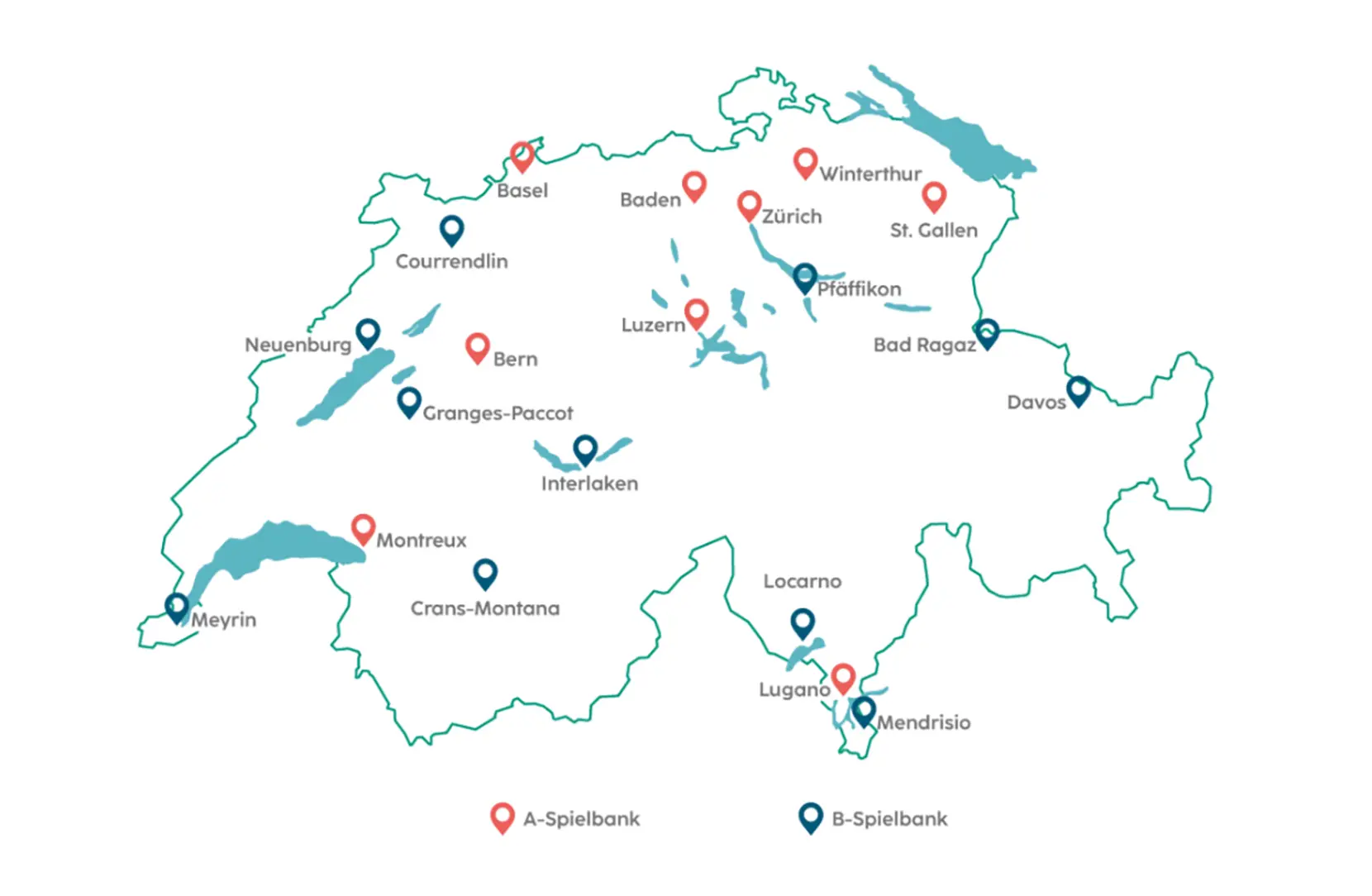
On 29 November 2023, the SFC granted casino concessions for the period from 2025 to 2044.
There are 20 licensed casinos in Switzerland. Of these, 9 hold an A licence (Casino A) and 11 hold a B licence (Casino B).
The casino landscape from 2025 onwards looks as follows:
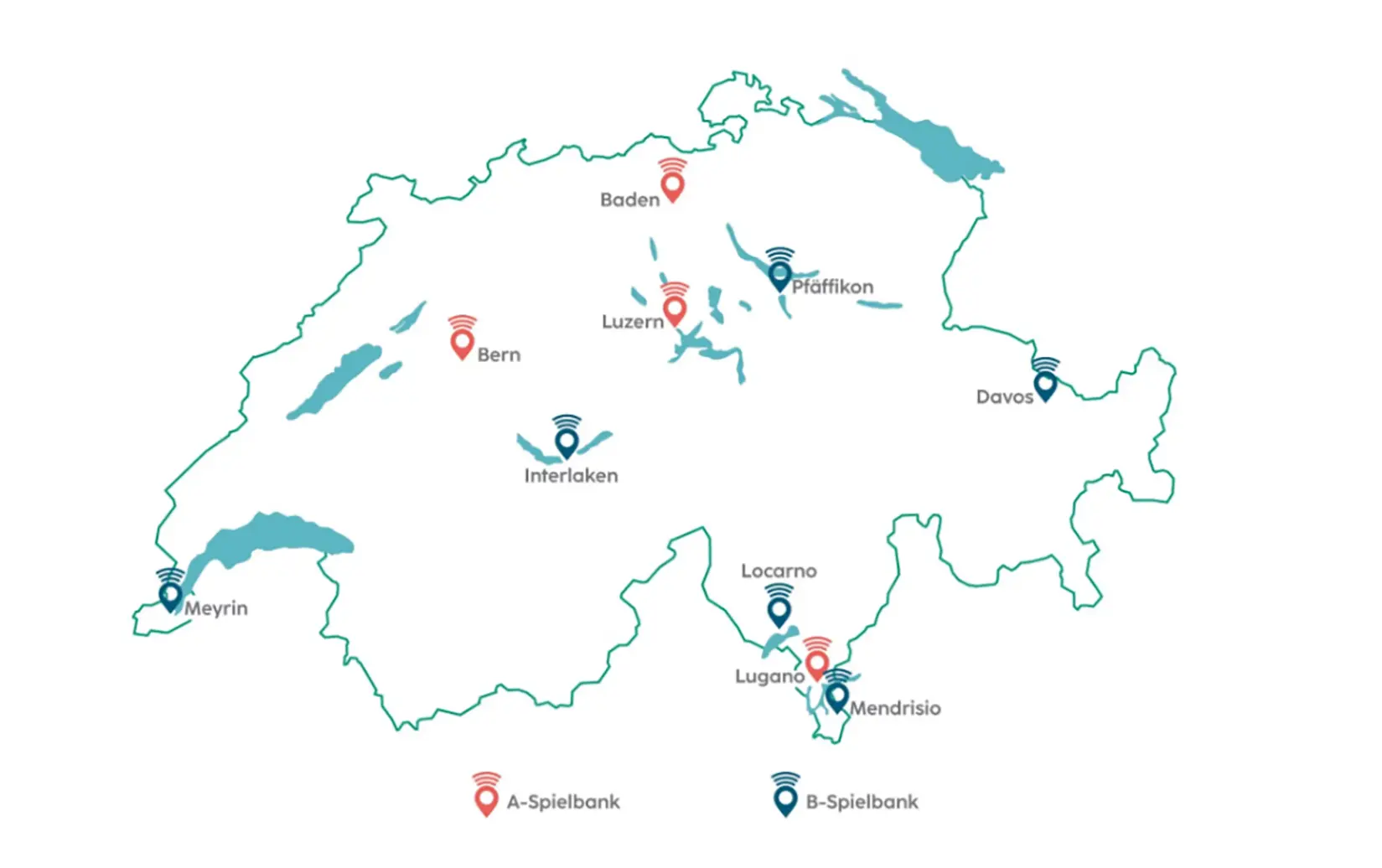
The SFC also approved the extension of concessions for online casino games for the following 10 Swiss casinos:
Foreign online gambling or betting operators may not apply for a licence and enter the Swiss market independently. Though, foreign online gambling or betting providers may get access to the Swiss market by entering into a partnership with a local terrestrial licence holder (art. 46 MGA, art. 31 MGO).
According to art. 8 MGO, foreign online gambling operators only qualify as cooperations partners, if they did not actively target the Swiss market for five years prior to the application and are or were not blacklisted by SFGB and Gespa (“good reputation”).
Suppliers of money games or online gambling platforms (B2B supply only) can fulfil the requirement of the good reputation even if they deliver or have delivered games to operators that do not have a good reputation (art. 8 para. 4 MGO).
According to art. 31 MGO, Gespa can allow the cooperation of an operator of lotteries and sports bets (i.e. Swisslos or Loterie Romande) with a foreign operator, if:
the foreign operator has a good reputation,
Poker tournaments may only be offered by the licensed casinos. However, art. 18 MGO allows Swiss casinos to cooperate with foreign operators for the organisation of online poker games. The requirements for the foreign poker operator are different from the requirements for other cooperation partners (for sports betting or online casino games). In particular, the foreign poker operator does not have to enjoy a good reputation according to art. 8 MGO but must only provide its foreign licences and proof for its reliability and professional suitability (art. 18 para. 1 lit. a, b MGO). In addition, the foreign poker operator must close the access of Swiss players to its unlicensed additional offer (sports betting and casino games, art. 18 para. 1 lit. e MGO).
One of the main objections to the deregulation of the casino market is the assumption that deregulation would result in an increase in gambling addiction. Therefore, applicants must present a social concept, including measures to prevent gambling addiction and strict security policies (Art. 76 MGA).
The social concept of casinos and providers of online games must include the following measures:
To access online games, a gaming account with the operator is required. To be able to open an account, a player must be over 18 years old, Swiss-resident and not be banned from gaming. The provider of online games must identify the players. Winnings from licensed gambling can only be transferred to accounts in the name of the player (Art. 45 et seq. MGO).
5.1 Liability
The following parties are liable for breaches of the relevant legislation:
5.2 Enforcement Actions
The licence may be withdrawn from domestic casinos or large-scale operators. In addition, prison sentences and high fines of up to CHF 500’000 can be imposed (Art. 131 MGA).
Websites of foreign gaming providers can be blocked, and the provider will be listed on a public blacklist (Art. 86 MGA).
5.3 Enforceable Debts
In general, under Swiss law, gambling and betting debts do not give rise to a claim (non-actionable claim; Art. 513 of the Swiss Code of Obligations).
A claim may arise if the claim arose during a licensed lottery game or during a game in a casino licensed by the competent authority (Art. 515 of the Swiss Code of Obligations).
5.4 Key Development
In a decision of the Federal Supreme Court in May 2022, the Federal Supreme Court decided that the blocking measures (DNS-blocking) issued by SFGB/Gespa and implemented by the telecommunications service providers as well as the blacklisting of the respective domains were conducted in compliance with the MGA and the Swiss Constitution. On the other hand, however, there was no instruction to foreign gambling operators to implement its own technically adequate blocking measures.
Substantive legal aspects in connection with the services of foreign gambling operators, such as the question of whether foreign gambling operators are operating an unauthorised gambling platform in Switzerland or are violating Swiss law, were not subject to the decision. Moreover, the decision of the Federal Supreme Court did not deal with the question of whether Swiss criminal law is applicable to the offer of foreign gambling operators according to the principle of territoriality. The Federal Supreme Court’s decision only dealt with the legal conformity of the issued measures (blacklisting and blocking measures) by the authorities.
In a decision of the Federal Supreme Court in January 2023, the Federal Supreme Court dealt with the question whether a pure IP blocking is sufficient in order to be removed from the blacklist. This legal question was disputed until this decision. The Federal Supreme Court decided that the foreign online gambling or betting operator must actively ensure that no player with residency in Switzerland can register on the website in order to be removed from the blacklist. Thus, the mere IP blocking is not sufficient in order to be removed from the blacklist.