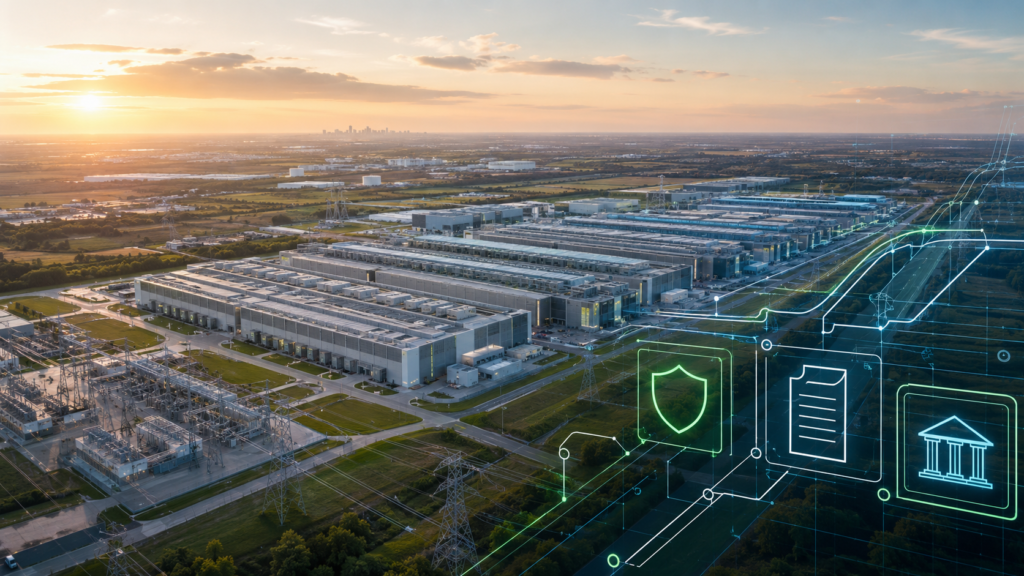
Summary: Nvidia has agreed to provide conditional credit support of up to $105 billion for an AI data-centre campus that SB Energy will lease to OpenAI in Ohio. The agreement could reinforce demand for Nvidia’s computing systems, but it also places part of the financial risk behind that demand on Nvidia’s own balance sheet.
A new scale for AI financing
Nvidia’s latest agreement shows how quickly the artificial-intelligence investment cycle is moving beyond conventional capital expenditure.
On August 17, the chipmaker disclosed a multi-year partnership with SB Energy covering the PORTS-Pike Technology Campus in Pike County, Ohio. SB Energy will build, own and operate the campus under a 20-year lease to OpenAI, while Nvidia will be its exclusive AI computing-infrastructure provider.
OpenAI has contracted for approximately eight gigawatts of IT capacity. The first phase, covering 800 megawatts, is expected to become available in 2028, with subsequent capacity delivered in stages. Nvidia’s initial credit support covers about 4.25 gigawatts, while the company retains the option to support roughly another 3.8 gigawatts. Nvidia’s announcement, OpenAI’s project statement
The headline figure is enormous, but it needs careful interpretation. Nvidia is not immediately transferring $105 billion to OpenAI or SB Energy. It has entered into residual-value guarantees whose aggregate payment obligation is capped at that amount.
How the guarantee works
Under the agreements, Nvidia’s guarantee generally becomes effective as each relevant portion of the campus becomes ready for service and its lease commences.
A potential payment would be triggered if OpenAI became insolvent and defaulted, or if it otherwise failed to meet its lease payments. Nvidia would then cover the shortfall between a contractually defined minimum value and the amount SB Energy could recover by selling or re-leasing the affected facilities.
Nvidia could also assume the lease, direct SB Energy to find another tenant, initiate a sale or allow the lease to terminate. OpenAI has agreed to reimburse Nvidia for amounts Nvidia actually pays under the guarantees. The obligations may end earlier if, among other conditions, OpenAI achieves a satisfactory credit rating. Nvidia’s August 17 Form 8-K
This structure limits Nvidia’s immediate cash outlay, but it is still economically significant. The company is using its credit strength to make a project financeable on terms that may not have been available based solely on the tenant’s credit profile.
Why Nvidia is willing to take the risk
The strategic rationale is clear. Every completed section of the campus is intended to host Nvidia’s full-stack DSX platform, including GPUs, CPUs and networking equipment. Supporting the physical infrastructure can therefore help secure many years of demand for Nvidia systems.
The project is also designed to accommodate repeated hardware upgrades. That matters because a data-centre shell may operate for decades, while the computing systems inside it are replaced much more frequently.
Nvidia is effectively trying to secure the land, power and buildings required for several product generations rather than waiting for each customer to arrange those resources independently. It is also investing $1.5 billion directly in SB Energy, joining SoftBank and OpenAI as an investor in the infrastructure developer. Nvidia
For shareholders, the potential benefit is a stronger and more predictable pipeline. The arrangement could increase visibility into future system deployments while reinforcing Nvidia’s position across the wider AI infrastructure stack.
The investor concern: who is underwriting demand?
The central issue is not whether demand for AI computing exists. It is whether the returns generated by that computing will eventually justify the financing structures now being assembled around it.
Nvidia is simultaneously a supplier to the project, an investor in its developer and a guarantor of part of its residual value. OpenAI, meanwhile, is both the tenant and the principal customer for the computing capacity.
That interconnected structure has prompted comparisons with vendor financing, in which a supplier supports customers financially so they can continue purchasing its products. The comparison is imperfect: Nvidia is not simply lending OpenAI money to buy chips, and its guarantee is conditional rather than an immediate expense. Nevertheless, the structure reduces the separation between product demand and the financing used to create that demand.
If OpenAI’s revenue and cash generation develop as projected, the guarantee may never require a material payment. OpenAI says it will begin paying only when completed capacity becomes available and expects to fund its commitments through revenue, cash flow and investor capital. OpenAI
If demand disappoints, however, Nvidia could be left with exposure to highly specialised infrastructure whose economic value depends heavily on continued AI investment.
Project risk remains substantial
The campus is not a finished asset. Its development remains dependent on permits, environmental reviews, financing, transmission infrastructure and the timely construction of new power capacity.
The project’s supporters expect the six-year buildout to create 35,000 construction jobs and 2,500 long-term operating positions. SB Energy has also committed to funding the necessary grid upgrades, including at least $4.2 billion of regional transmission investment. Those numbers are projections and commitments, not completed economic benefits. PORTS-Pike project information
Execution risk therefore matters alongside credit risk. Delays could push back the date on which OpenAI receives usable capacity and Nvidia records associated equipment demand. Technological advances could also alter the amount or type of infrastructure required before the full campus is completed in 2032.
What investors should watch
The first indicator will be how Nvidia accounts for and describes the guarantee in future quarterly filings. Investors should distinguish the $105 billion maximum exposure from the company’s expected loss, recognised liability and actual cash payments.
Other important signals include the pace at which capacity becomes operational, OpenAI’s ability to meet its lease obligations from internally generated cash, and whether additional AI projects adopt similar guarantees.
The larger implication extends beyond one Ohio campus. Nvidia is evolving from a semiconductor supplier into an organiser and underwriter of AI infrastructure. That may deepen its competitive advantage, but it also changes the company’s risk profile.
The crucial question is no longer simply how many chips Nvidia can sell. It is how much financial exposure the company must accept to support the next wave of those sales.