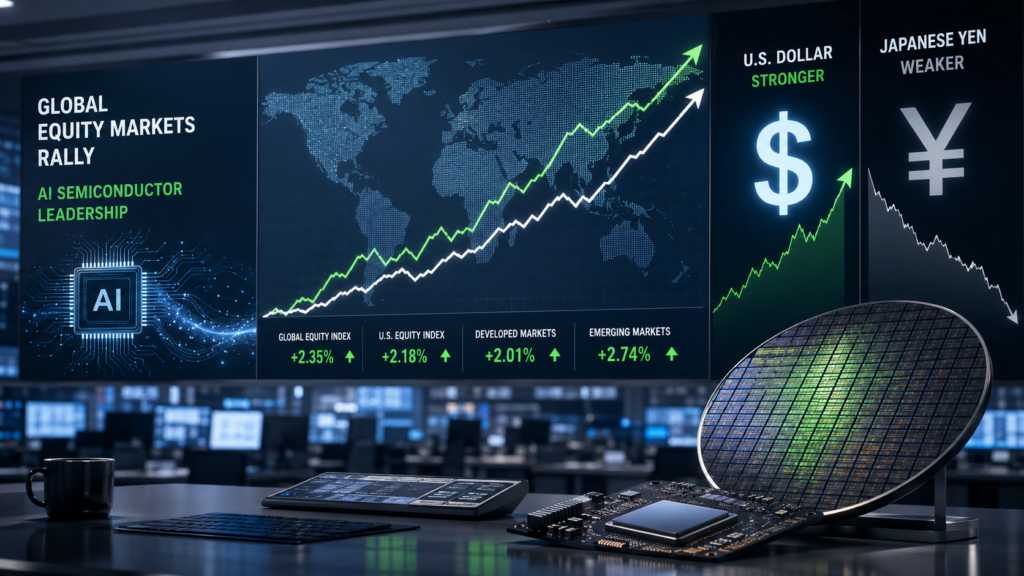
Summary: Global markets ended June 30, 2026 with a powerful quarter-end equity rally, led by U.S. technology shares and chip-heavy Asian markets. The same session also highlighted important cross-market tensions: Treasury yields rose, oil eased, gold remained under pressure, and the Japanese yen weakened near a four-decade low against the U.S. dollar.
A Quarter-End Rally With Global Reach
Global investors ended the second quarter focused on one dominant market story: equities had staged a major rebound, and the rally was no longer confined to one regional pocket.
In the U.S., the S&P 500 rose 0.8% on June 30 to close at 7,499.36, while the Nasdaq Composite climbed 1.5% and the Dow Jones Industrial Average added 0.3% to another record close, according to AP. Investopedia reported that the S&P 500 and Nasdaq gained roughly 15% and 21%, respectively, over the quarter, their best quarterly performances since the second quarter of 2020.
The rally was not purely a U.S. story. Reuters reporting carried by Zawya said the MSCI All-World index rose almost 14% in the quarter, its strongest second-quarter performance since 2020. In Asia, Japan, South Korea, and Taiwan were at the center of the move, reflecting the market’s continuing preference for semiconductor and AI-linked exposure.
AI and Semiconductors Remained the Market’s Engine
The strongest narrative behind the quarter-end rally was the continued repricing of AI-related growth. Investors have been willing to pay up for companies tied to AI infrastructure, memory, semiconductors, data centers, and related hardware demand.
That theme was especially visible in Asia. Reuters reported that Japan’s Nikkei was on course for a quarterly gain of more than 36%, its largest on record, while South Korea’s KOSPI was still set to rise nearly 65% in the second quarter. Taiwan’s benchmark index was also headed for a quarterly gain of more than 40%, supported by demand for semiconductor stocks.
This is a useful reminder that the AI trade is global. U.S. mega-cap technology companies may dominate headlines, but the supply chain runs through Asian manufacturers, memory producers, chip equipment firms, component suppliers, and energy-intensive data infrastructure. For investors, the second-quarter rally was less about one index and more about a synchronized repricing of AI-linked earnings potential.
The Dollar Was the Other Side of the Trade
The equity rally did not occur in isolation. Currency markets sent a different, more cautious signal.
Reuters reported that the dollar was heading for a fourth consecutive quarterly gain after markets revised expectations away from rate cuts and toward possible U.S. rate hikes, citing stronger economic data and inflation pressure. The yen weakened to 162.41 per dollar in Asian trade, its weakest level in four decades, raising the possibility of intervention by Japanese authorities.
That matters because yen weakness is not just a currency-market footnote. A weaker yen can support Japanese exporters and help explain some of the enthusiasm for Japanese equities, but it also raises import-cost and inflation concerns for Japan. For global investors, persistent yen pressure can affect hedging costs, capital flows, and risk appetite across Asia.
Bonds, Oil, and Gold Complicate the Bullish Picture
The cross-asset backdrop was not uniformly bullish.
AP noted that Treasury yields rose as oil prices eased. Investopedia reported that the 10-year Treasury yield rose to 4.46% from 4.38% at Monday’s close. Higher yields can eventually test equity valuations, especially for long-duration growth stocks whose expected profits sit far in the future.
Oil moved in the opposite direction. Investopedia said West Texas Intermediate crude slipped around 1% to roughly $70 a barrel, while Brent was near $73.40. Reuters also reported that oil had eased back toward pre-war levels as concern over conflict-related supply disruption faded.
Gold was another pressure point. Reuters said dollar strength had weighed on gold, which was heading for its largest quarterly fall in more than a decade. That relationship is important: a stronger dollar and higher real-rate expectations often reduce the appeal of non-yielding assets such as gold.
Why Investors Should Care
The June 30 market action matters because it showed both the strength and fragility of the current rally.
The strength is obvious: broad equity indexes rallied sharply, AI-linked sectors continued to attract capital, and risk appetite improved despite earlier volatility. The rally also had breadth across regions, with U.S., European, and Asian markets all participating to varying degrees.
The fragility is more subtle. The same forces supporting parts of the equity market may also raise risks. If U.S. inflation remains sticky and the Federal Reserve is pushed toward a more hawkish stance, higher yields could challenge expensive equity valuations. If yen weakness intensifies, Japanese authorities may intervene, which could create volatility in foreign exchange and carry trades. If AI earnings expectations become too aggressive, the market may become more vulnerable to disappointment.
Practical Takeaway
For investors and finance professionals, the quarter-end rally argues for respect, not complacency.
The market has shown that AI infrastructure, semiconductors, and global technology supply chains remain powerful drivers of performance. But the leadership is increasingly tied to high expectations, higher capital spending, and a macro backdrop shaped by rates and currencies.
The key questions for the next phase are straightforward: can earnings justify the rally, can the AI trade broaden without becoming speculative, and can global markets absorb a stronger dollar without triggering financial stress elsewhere?
This was a bullish quarter-end, but not a simple one.