No spam - just the latest insights!
Join over 30,000 industry professionals who subscribe for free

Subscribe for free!
We'll never share your information or send you spam

Marie Lee is a Director in the Restructuring and Recovery division at Baker Tilly Singapore.
With over a decade of experience in corporate restructuring and insolvency, she has built her career at Baker Tilly, specialising in judicial management, liquidation, schemes of arrangement, and bankruptcy solutions.
During her extensive tenure at Baker Tilly, Marie has not only honed her craft but has also been actively involved in assisting experienced insolvency practitioners. Her dedication has seen her assisting and gaining firsthand experience through many landmark cases.
Marie collaborates with companies, creditors, and stakeholders to maximise recoveries and streamline financial restructuring across various sectors including funds, healthcare and technology. Clients frequently commend her problem-solving ability, practicable advice and attentiveness to their concerns, reinforcing her reputation for exceptional service and effective results. She is a licensed insolvency practitioner and a member of the Institute of Singapore Chartered Accountants.
Beyond her professional duties, Marie is committed to advancing her interest in the field of restructuring and insolvency through continuous professional development. She is deeply interested in reading judgments written by judges on insolvency matters, acquiring progressive knowledge of the decisions and intricate understanding of how the laws were interpreted.
Marie’s comprehensive approach and unwavering commitment make her an invaluable asset to Baker Tilly and a trusted advisor to her clients. Her ability to navigate complex financial landscapes and devise innovative solutions continues to drive her success and influence in the industry.

Victor Goh leads the Restructuring and Recovery division at Baker Tilly Singapore.
With over 25 years in corporate restructuring and insolvency, he has amassed extensive experience with international firms before founding his own practice and subsequently joining Baker Tilly. Victor specialises in judicial management, liquidation, schemes of arrangement, and bankruptcy solutions, focusing on asset protection and value preservation.
Victor possesses an exemplary track record in managing intricate insolvency cases and extensive knowledge and judicious decisions have resulted in his involvement in several landmark insolvency cases. His strategic approach and innovative solutions have garnered recognition from both peers and clients alike, solidifying his reputation as a leading expert in the field.
His industry expertise spans banking, construction, logistics and beyond, making him a versatile and knowledgeable advisor in various sectors. Victor is a licensed insolvency practitioner and a fellow of Institute of Singapore Chartered Accountants, Association of Chartered Certified Accountants and the Insolvency Practitioners Association of Singapore. He is also an active member of INSOL International and the Singapore Institute of Directors, where he contributes to advancing professional standards and best practices.
Victor’s dedication to excellence and his ability to navigate the complexities of corporate restructuring have made him an exceptional insolvency practitioner and a trusted advisor to peers and clients alike. His contributions to the field have shaped the landscape of insolvency practice in Singapore and his daring decisions to pursue unexplored areas of insolvency law also garnered respect amongst many advisors.

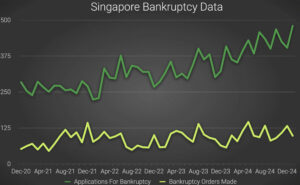
Apart from being known for having the most powerful passport in the world12025 Henley Passport Index (https://www.henleyglobal.com/passport-index/ranking), Singapore also held the title for the highest average GDP per capita (adjusted for purchasing power parity)2World Bank Group data (https://data.worldbank.org/indicator/NY.GDP.PCAP.PP.CD?most_recent_value_desc=true) in the world in 2023. With a culture of conspicuous consumption and a rising trend in “buy now pay later” schemes, people are increasingly enticed to spend beyond their means. It is hardly surprising that applications for bankruptcy in Singapore have been rising year on year while bankruptcy orders granted crept stealthily in the past 4 years3The Bankruptcy Act has since been repealed. The bankruptcy and corporate insolvency laws of Singapore have now been consolidated in the Insolvency, Restructuring & Dissolution Act 2018..
The Singapore Bankruptcy Act (Cap 20, 2009 Rev Ed) 3 was amended in August 2016 to introduce a differentiated discharge framework with a rehabilitative element for the debtors and the infusion of private trustees in the system. The mandated appointment of private trustees was initially limited to bankruptcy applications filed by institutional creditors only – deliberately crafted as such to relieve the burden on public resources expended in pursuit of private debts. This radical move allowed insolvency practitioners to showcase their multifaceted expertise, navigating the boundaries of legal frameworks governing insolvency and bankruptcy procedures, assessing and recovering debtor’s assets for the benefit of creditors, and devising viable contribution plans to offer the debtor hope of financial rehabilitation.
Very often, insolvency practitioners find themselves confronted with the insurmountable issue surrounding the lack of available funds in the estate to actively pursue the recovery of assets. The ability to conduct comprehensive investigations paving the way to legal actions was a luxury in the insolvency world. This hurdle naturally obstructs the way forward, hinders access to justice and results in lower recovery rates for the creditors. Taking reference from global trends, Singapore insolvency practitioners would logically turn to Third Party Litigation Funding (“TPLF”) to aid in their endeavours. But alas, despite the abolishment of the antiquated doctrines of maintenance and champerty in 1967, uncertainties surround the viability of TPLF in Singapore.
We first uncovered grave issues surrounding a bankrupt engaging in dubious transactions (amongst others, undervalued transactions and fraudulent conveyances) with the intent to defraud his creditors in 2017. The funds available in the bankruptcy estate of Fan Kow Hin allowed us (the trustees in bankruptcy) to engage solicitors and commence legal actions but these funds were woefully inadequate to see the actions to fruition. With debts exceeding S$100 million filed against the bankruptcy estate, we were determined to chart a new path to recover as much assets as possible on behalf of the creditors.
We were aware of the growing acceptance and implementation of TPLF globally and that this innovative approach allows external entities to fund litigation efforts in exchange for a portion of the proceeds from successful claims. However, the absence of clear legal precedent on TPLF in Singapore posed as a significant challenge. Recognising that TPLF could provide a viable solution to our funding constraints, we decided to seek court approval for its use. Our proposal was to sell a portion of the anticipated proceeds from our clawback claims, a strategy aimed at funding the ongoing litigation. By doing so, we hoped to ensure that our legal advisors had the necessary resources to pursue justice vigorously and effectively. This approach not only promised to bolster our chances of success but also offered a pragmatic way of managing financial limitations.
Ultimately, we remained steadfast to our objective: to protect the interests of the creditors and achieve the best possible financial outcome for all parties involved. In our application to court, we asserted that the proceeds from insolvency clawback claims were part of the estate in bankruptcy and can be assigned. We relied on precedents from Australia, which permitted the assignment of the
proceeds of statutory claims and contended that the proposed assignment was neither champertous nor an abuse of process as TPLF was aimed at providing access to justice in the context of insolvency.
Subsequently in the landmark judgement, the Singapore Court provided insightful interpretation of the following sections in the (now repealed) Bankruptcy Act (Cap 20, 2009 Rev Ed):
The Court agreed that the proceeds from insolvency clawback claims belonged to the estate of the bankrupt and could be assigned by the Trustees. Using TPLF for this case was not champertous since the Trustees controlled the litigation instead of the funder. This distinction was crucial because it meant that the Trustees maintained full authority over strategic decisions in the legal proceedings and was able to ensure that the interests of the estate were prioritised above any external influences from the funders.
Assigning proceeds from clawback claims is also aligned with public policy and ensures access to justice in insolvency cases where other funding is not viable. Without the option of TPLF, most if not all insolvent estates face the lack of financial resources to pursue valid claims, potentially leaving creditors without recourse. This approach helps democratise access to legal actions, affording insolvent entities the opportunity to pursue claims they would otherwise be unable to finance.
Consequently, Re Fan Kow Hin became a key precedent for TPLF in Singapore, shedding light on its permissibility and offering judicial guidance for future cases. This ruling has far-reaching implications, as it provides a robust framework under which trustees can seek third-party funding without fear of legal repercussions tied to champerty or maintenance accusations. The case underscores the evolving nature of legal funding mechanisms and their critical role in facilitating justice. It reassures trustees and legal practitioners that, when used appropriately, TPLF is an acceptable and pragmatic tool in complex insolvency proceedings, thus shaping the landscape of modern insolvency litigation.
The Insolvency, Restructuring and Dissolution Act 2018 (“IRDA”) was introduced in Parliament in 2018 to consolidate the Bankruptcy Act (Cap 20, 2009 Rev Ed) and the Companies Act provisions relating to insolvency. After much anticipation, IRDA finally came into effect on 30 July 2020, codifying and expanding the ability of liquidators and judicial managers to assign proceeds of actions to third party funders through Sections 144(1)(g) and 177(1) (a) of the IRDA. However, TPLF is still not explicitly permissible for bankruptcy matters and trustees are likely to continue to rely on Re Fan Kow Hin (amongst others) as precedent in navigating the boundaries of TPLF arrangements. We envision that more practitioners will soon chart this journey together after the IRDA was amended in 2023 for private trustees to administer bankruptcy estates in all cases (except those that are of public interest, which are retained under the purview of the Official Assignee).
TPLF drastically levels the playing field by enabling insolvency practitioners to pursue meritorious claims against deep-pocketed defendants. It has now become an integral part of Singapore’s legal landscape, a far cry from when we started the journey in Re Fan Kow Hin. It offers numerous benefits to litigants, law firms, and the broader judicial system. This shows that it is possible to use progressive legal reforms as a lever of change to balance the need for access to justice with the protection of the integrity of the judicial process. As TPLF continues to grow and evolve, it will undoubtedly shape the future of litigation and arbitration in Singapore and beyond. The ongoing collaboration between regulators, funders, and the legal community will also be crucial in ensuring that TPLF fulfils its potential as a tool for justice and economic growth.
Although Singapore is deeply rooted in the common law, we have gradually developed our own jurisprudence by interpreting and adapting English legal principles to suit our specific needs. By recognising the changing dynamics of the local legal and commercial environment, the acceptance, adoption and growth of TPLF in Singapore has progressively enabled insolvency practitioners to pursue legitimate claims and promoted access to justice.
The history of third-party litigation funding in insolvency or bankruptcy in Asia has been characterised by a gradual shift from prohibition to acceptance and regulation.
This shift aligns with the broader trend of jurisdictions embracing innovative legal funding mechanisms to ensure the effective administration of justice. As the legal and economic environments continue to evolve, TPLF is likely to play an increasingly significant role in the resolution of insolvency and bankruptcy proceedings across Asia.
Eventually as the legal and business communities gets acquainted with the ideology of TPLF and the benefits of TPLF became more evident, the hope is that the increased acceptance and use of TPLF as a legal strategy in Singapore will gain momentum. Our city’s humble success in infusing TPLF into its legal system may serve as a model for other countries in the region looking to adopt similar frameworks, leading to greater harmonisation of TPLF regulations regionally and internationally to facilitate cross-border litigation and arbitration.
However, as practitioners, we must remain vigilant in understanding the implications of TPLF, its regulatory landscape and the ethical considerations TPLF entails. It is imperative to remain cognisant of the varying maturity levels of the TPLF market in different countries and how it may affect the availability and accessibility of funding. With the growth and evolution of TPLF, there may also be a push toward increased regulatory oversight to balance investors’ protection and claimants’ access to justice against the commercial realities of litigation funding. Enhanced due diligence and improvements in risk management practices would definitely be required to ensure accountability and support investor confidence.