No spam - just the latest insights!
Join over 30,000 industry professionals who subscribe for free

Subscribe for free!
We'll never share your information or send you spam
Fuyuki Uchitsu is a partner who practises in the real estate, construction, structured finance and banking. He handles a wide range of real estate projects, including acquisitions, developments, large-scale redevelopments, management and sale of office buildings, residentials, hotels, retail facilities, and logistics facilities. He also has extensive experience and considerable expertise handling cross-border projects, including US real estate investment and financing as well as inbound investment by foreign investors.
Mori Hamada & Matsumoto has a real estate practice that extends from traditional acquisition and leasing transactions to complex fund structures involving a special purpose vehicle or a trust, or even investment structures for overseas properties. The team’s work in this practice primarily involves private fund formation for domestic and overseas properties, J-REITs, real estate acquisition, development and disposition, and real estate financing.

The Japanese commercial real property market has been active of late, especially attracting attention from overseas investors due to low interest rates and the depreciation of the yen. In the last few years, there have been several large-scale transactions where hotel assets were sold to foreign real estate funds, indicating the strong appetite of foreign funds for Japanese hotels and the recent trend of traditional Japanese companies turning to asset-light strategies. Another trend is rising inflation stimulating investments in inflation-resistant real estate, such as residential, hotel, and retail properties. In contrast, new large-scare development projects have somewhat stalled due to the rising cost of materials and labour.
Although it is legally possible for a foreign entity to directly or indirectly own real property in Japan, not many overseas investors choose to purchase for reasons of tax efficiency. To achieve this, the following arrangements are often used.
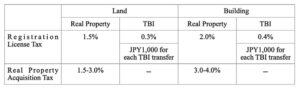
In Japan, commercial real property is often traded in the form of a trust beneficial interest (“TBI”) rather than an outright sale and purchase of the real property, to reduce taxes on the real property transfer. In general, when a person acquires outright ownership of real estate, (a) a registration license tax (for the registration of the ownership transfer) and (b) a real estate acquisition tax are imposed, based on the assessed value of the property listed in the fixed property tax register book. In the case of a sale and purchase of a TBI, these tax rates are significantly lower, as shown in the table below (as of September 2024):
When a property trust is used, the ownership of the real property is entrusted to a trustee, which holds the legal ownership of the real property for the benefit of the trust beneficiary (i.e., the TBI holder). The trustee manages the real property in accordance with the terms of the trust agreement and the instructions of the trust beneficiary.
When using a property trust, it should be noted that, in general, the trustee must be a licensed trust bank or trust company, so trust fees and other expenses will be incurred – hence, a property trust is usually used when the investment is above a certain size.
For tax consideration, the property trust usually falls under the category of “beneficiary taxable trust”, in which the beneficiary of the trust is deemed to have assets and liabilities attributable to the trust property, and the income and expenses attributable to the trust property are deemed to be the beneficiary’s income and expenses for corporate and income tax purposes (pass-through taxation).
In order to enhance the tax efficiency in respect of profits generated from a real property or TBI, tax-oriented investment schemes unique to Japan are often employed for real property investments.
There are two commonly used types of investment structures in Japan: (a) the TMK structure and (b) the GK-TK structure. By using TMK or GK-TK structure, double taxation at the level of an asset holding entity (TMK or GK) and its investor (a shareholder in the case of a TMK or a TK investor in the case of a GK-TK structure) can be avoided.
Overview of TMK
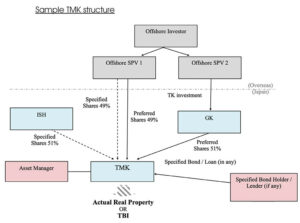
A TMK structure involves a specified purpose company known as tokutei mokuteki kaisha (TMK), which is a corporate entity specifically designed to acquire a specific asset (such as real estate assets) by issuing asset-backed securities under the Asset Liquidation Law.
A TMK may acquire real properties either in the form of actual real property or a TBI. Although a TMK can acquire an unlimited number of TBIs, it cannot acquire additional actual real property unless it is closely related to the actual real property already owned by the TMK. The business and operations of a TMK must be conducted in accordance with the asset liquidation plan (“ALP”), one of the constitutional documents of TMK, and a TMK is not permitted to engage in the operational business (e.g., hotel management business).
The TMK’s equity consists of “specified shares” and “preferred shares”, with no minimum capital requirement. Specified shares are similar to ordinary voting shares of a kabushiki kaisha, or a ordinary Japanese stock company. Investments in specified shares is typically nominal (such as JPY100,000) and are not supposed to be used for the acquisition of real properties. Preferred shares comprise most of the TMK’s equity.
In general, (i) a TMK finances the acquisition of real properties (in either form) by issuing preferred shares and obtaining third-party debt in the form of “specified bonds” and “specified loans”; (b) a TMK must always have at least one director and one statutory auditor, and should appoint one accounting auditor, who must be either a certified public accountant or an auditing firm; and (c)
certain fundamental matters with respect to a TMK require the approval of its shareholders (generally, only specified shareholders have voting rights at shareholders’ meetings).
Tax Consideration
The best feature of a TMK is that, by fulfilling certain requirements, it is eligible to deduct profit distributions to its preferred shareholders from its taxable income (pay-through treatment). In practice, the key requirements for a TMK to achieve pay-through treatment are, among other things, the following
(i) The TMK must issue specified bonds to a tax qualified institutional investor (“Tax QII”), as defined in the Act on Special Measures Concerning Taxation;
(ii) If the TMK takes out a specified loan, the lender should be a Tax QII;
(iii) More than 50% of the preferred shares must be offered in Japan;
(iv) More than 50% of the specified shares must be offered in Japan, unless it is stated in the ALP that the specified shareholders have waived their rights to profit distributions and distributions of residual assets; and
(v) The TMK distributes dividends in an amount exceeding 90% of its distributable profit per fiscal year, as calculated under the tax code.
The GK-TK structure is an investment scheme established by a godo kaisha (GK), which is a type of Japanese limited liability company, entering into a certain type of partnership agreement, known as tokumei kumiai (TK) agreement, with an investor. A TK is just a contractual arrangement formed under a TK agreement between the GK as operator and the TK investor, as a way of creating equity-like investments.
If there are several TK investors, each TK investor enters into its own TK agreement with the GK (TK operator), but usually the terms of the TK agreements are the same except for the investment amount.
In accordance with the TK agreement, a TK investor contributes funds to the GK (TK operator) and the GK (TK operator) conducts the TK business, which is defined in the TK agreement, using the funds so contributed. Thereafter, the GK (TK operator) distributes profits from the TK business to the TK investor.
In the GK-TK structure, a GK is incorporated as a special purpose vehicle without human resources, with one corporate entity being the sole managing member representing the GK, and such managing member appoints an individual (operating officer) to act as its representative and perform the duties of a managing member. As there is no specific minimum capital requirement, the paid-in capital of a GK is usually nominal (such as JPY100,000). Due to regulatory and tax reasons, the real property to be acquired under a GK-TK structure is usually in a form of TBI as opposed to actual real property, but a GK-TK can acquire multiple TBIs (including additional acquisitions).
Tax Considerations
In principle, the profits and losses related to the TK business belong to the GK, and corporate tax will be imposed on GK. However, if the TK agreement is legally valid and recognised as a TK for tax purposes, the amount of profit to be distributed to the TK investor or the amount of loss to be borne by the TK investor under the TK agreement may be included in the amount of loss or profit in the calculation of the taxable income of GK for the relevant fiscal year. Therefore, the GK-TK structure enables to avoid the double taxation.
One of the most important points to note is that, because the TK is not a joint venture in a sense that TK operator manages the TK business but the TK investor does not, any form of participation by the TK investor in the TK business (e.g., by way of a right to approve or disapprove material decisions regarding the TK business or otherwise) would invite a risk that jeopardises the characterisation of the nature of the TK from a tax perspective. If the TK agreement involves an non-Japanese TK investor, the tax re-characterisation risk would have a significant implication because the GK (TK operator) would be recognised as a permanent establishment of the TK investor and therefore the profit at the GK level would be subject to regular Japanese income tax. Because of this tax sensitivity, overseas investors tend to avoid the GK-TK structure.
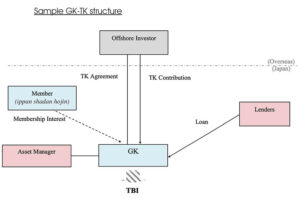
As a special purpose vehicle, a TMK or GK must retain an external advisor to ensure the proper management of its business, including the exercise of its rights (e.g., giving instructions to the trustee under the trust agreement for matters relating to the management of the real property) and performance of its obligations under the transaction documents (e.g., preparing and dispatching necessary notices or reports to the lenders under the finance documents) to which it is a party.
The asset manager of a TMK or GK must obtain a certain license, depending on the structure and underlying asset.
Asset Manager for a TMK structure
The type of license required to be obtained by the asset manager of the TMK depends on whether the TMK will acquire actual real property or a TBI.
Asset Manager for GK-TK structure
As mentioned, due to regulatory and tax reasons, the real property acquired under a GK-TK structure is usually in the form of a TBI as opposed to actual real property.
The type of license to be obtained by the asset manager to a GK that will acquire a TBI primarily depends on whether or not there is at least one “qualified institutional investor”, as defined in the FIEL (the “QII”).
When debt financing is provided to a special purpose vehicle (TMK or GK) purely based on the credibility of the underlying asset, without recourse to the other parties involved in the investment structure (e.g., by way of parent guarantee or otherwise), financiers typically require certain measures so as to minimise the insolvency risk of the special purpose vehicle or to achieve what is often referred to as “bankruptcy remoteness” in Japan. Such measures usually include using an ippan shadan houjin (ISH), whose directors are independent from the sponsors (in many cases, two accountants dispatched from a tax accounting firm), as the parent company of the special purpose vehicle. The purpose of having an ISH is to use it as an independent entity holding equity interests in a TMK or GK to achieve bankruptcy remoteness; therefore, the ISH is not expected to have any significant participation in the distribution of profits from the TMK or GK.
In practice, for the purpose of acquiring working capital for the ISH, the asset manager, investor or other party with an interest in the transaction would contribute capital to the ISH in the form of an endowment (kikin), but the contributor has no voting rights or any other right to control the ISH.
Structuring an investment in Japanese real property can be complex, bespoke, and require careful consideration from both a legal and tax perspective. It is important for all parties involved to understand what is fundamental to Japanese practice and what is specific to the present case. From this perspective, the roles of the local legal advisor providing structuring advice from a regulatory perspective and the international tax advisor providing tax advice, including tax treaty analysis, are critical. Ultimately, successful structuring can help mitigate financial losses and increase the effectiveness of the investment.