No spam - just the latest insights!
Join over 30,000 industry professionals who subscribe for free

Subscribe for free!
We'll never share your information or send you spam

Ka Yan is a Tax Partner of Deloitte China currently based in Hong Kong office. Ka Yan advises a wide range of her clients on both Hong Kong domestic and international tax matters, covering topics such as IPO, tax structuring, international tax planning, tax incentives planning, supply chain model design, complex investment and financing transactions, cross-border acquisitions, due diligence work, tax compliance and tax controversy. Ka Yan is also a frequent speaker on Hong Kong and international tax topics with various institutions and business chambers.

Under the global immense development of the aircraft leasing industry over the years, Hong Kong, located at the heart of Asia and serving as the southern gateway of mainland China, is full of opportunities in the future aviation business of the Asia-Pacific region. A trade forecast in 2023 suggested that global air traffic will grow by 6.1% per year in the next 20 years, with China alone experiencing an impressive yearly growth rate of 11.4%. By 2042, it is projected that approximately 42,600 new commercial jets will be delivered worldwide, 17,000 of these new jets will be delivered to the Asia-Pacific markets, and 8,560 of them will be destined for China. The Hong Kong Special Administrative Region Government (“the HKSAR Government”) anticipates that around 3,100 aircraft will be leased through Hong Kong platforms in the next 20 years, creating over 1,000 direct employment positions and around 20,000 indirect jobs, contributing over HK$400 billion to the local gross domestic product.
Tax competitiveness is a key factor for developing the aircraft leasing industry as aircraft leasing is a global business without geographical limitations. With a view to strengthen Hong Kong’s competitiveness, effective from the year of assessment beginning on 1 April 2023, Hong Kong further enhanced its Aircraft Leasing preferential tax regime in February 2024 under the Inland Revenue (Amendment) (Aircraft Leasing Tax Concessions) Ordinance 2024 (“the 2024 Amendment”).
As a background, in 2017, Hong Kong introduced the aircraft leasing preferential tax regime. Under the regime, qualifying aircraft lessors and qualifying aircraft leasing managers can enjoy concessionary tax rate of 8.25% (i.e., half of the prevailing profits tax rate of 16.5%) on profits derived from qualifying aircraft leasing activities (only dry lease, exclude funding lease, wet lease, etc.) and qualifying aircraft leasing management activities,subject to certain conditions. On the other hand, qualifying aircraft lessors can enjoy a 20% tax base concession as compensation for the lack of depreciation allowance. Effectively, the qualifying profits are only taxed at 1.65%.
Since then, there are noticeable market changes in the aircraft leasing industry in terms of leasing arrangements, lessees, source of finance, etc. In addition, the upcoming implementation of the Base Erosion and Profit Shifting (“BEPS”) 2.0 global minimum tax regime introduced by Organisation for Economic Co-operation and Development (OECD) will also diminish the competitiveness of the then existing regime.
Against the above background, the 2024 Amendment introduced enhancements to the aircraft leasing preferential tax regime with a view to maintaining and improving Hong Kong’s competitiveness. Below are the key features of enhancement introduced under the 2024 Amendment:
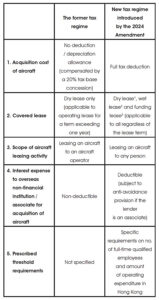
The 2024 Amendment’s enhancement measures are discussed in detail below:
Qualifying aircraft lessor would be allowed to deduct the capital expenditure incurred in relation to an aircraft that is used for an operating lease in that year of assessment to replace the current 20% tax base concession.
As a transitional arrangement, qualifying aircraft lessor who acquired an aircraft before the year of assessment 2023/24 may opt to continue enjoying the current 20% tax base concession or switch to the new tax deduction. If the aircraft lessor opted to claim depreciation allowances on the aircraft, a notional allowance for the years of assessment for which the 20% tax base concession was allowed would be excluded for deduction and its assessable profits would be computed on an actual basis. Once the election is made, it is irrevocable.
The purpose of introducing the new deduction to replace the 20% tax base is to tackle the potential issue arising from the upcoming BEPS 2.0 global minimum tax regime for large multinational enterprises.
Upon the disposal of aircraft, the deduction or concession (for the year of assessment 2023/24 and onwards) would be clawed back and the sale proceeds, not exceeding the amount of concession or deduction allowed, would be deemed as trading receipts chargeable to profits tax.
On the other hand, under the former tax regime, the 20% tax base concession would not apply if capital allowance has been granted to a qualifying aircraft lessor or its connected person in respect of the aircraft. The 2024 Amendment amends that the same anti-avoidance provisions would apply to the new tax deduction with some carve outs where no tax avoidance is involved. For example, deduction would still be allowed where the lessor or its connected person is subject to tax outside Hong Kong and where capital allowances on an aircraft granted to the lessor’s connected person outside Hong Kong have been fully clawed back.
Under the former tax regime, only the leasing of an aircraft under a dry lease that is an operating lease for a term exceeding one year is allowed.
In view of the market changes, e.g. shifting of leasing arrangements from dry leases to wet leases, increased use of funding leases to acquire aircraft and shortening of lease terms, the 2024 Amendment expands the scope of lease to include both operating leases (i.e., dry and wet leases) and funding leases and remove the one-year lease term restriction.
Under the former tax regime, the scope of “aircraft leasing activity” covers leasing of an aircraft only to an aircraft operator.
Given that aircraft lessors now also lease aircrafts to other types of entities, including private companies, public organizations or even individuals, the 2024 Amendment provides a more general meaning of “aircraft leasing activity”, which will cover leasing of an aircraft to any other person.
Under the former tax regime, interest expense incurred by an aircraft lessor is allowable for deduction if the money is borrowed from a lender whose interest income is chargeable to profits tax or a financial institution, or the money borrowed is wholly or exclusively used for financing the acquisition of machinery or plant which qualifies for depreciation allowance and the lender is not an associate of the borrower. In other words, the deduction is quite restrictive.
To accommodate different financing means for the acquisition of aircraft, the 2024 Amendment allows deduction of interest payable on money borrowed wholly and exclusively to finance the acquisition of an aircraft used by a qualifying aircraft lessor for producing qualifying profits.
If the lender is an overseas associate of the aircraft lessor, such interest deduction will be subject to certain anti-avoidance provisions1The interest income received by the associate must be subject to similar tax outside Hong Kong at a rate not lower than the reference rate (i.e., tax concession rate of 8.25%). The associate’s right to the interest would not pass to any other person, unless under an arm’s length transaction and the capital expenditure qualifies for a deduction under Section 14IC of the IRO., including subject-to-tax condition.
If a loan is partly used for financing the acquisition cost of an aircraft and partly used for other purposes, interest expenses would be allowed on an apportionment basis. Interest expenses attributable to that part of the loan used for financing the acquisition cost of the aircraft would be allowed for deduction, provided that the other relevant conditions are met.
Interest expenses on a subsequent loan obtained to wholly or exclusively refinance the outstanding balance of the previous loan obtained for financing the provision of aircraft would be allowed for deduction, provided that the other conditions are met.
Under the former tax regime, although there is substantial activity requirement for aircraft lessors and aircraft leasing managers, there is no specific threshold.
The 2024 Amendment prescribes the following threshold requirements for aircraft lessors and aircraft leasing managers:
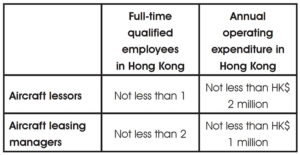
A director that possesses the required qualification and carries out the core income generating activities (“CIGAs”) in Hong Kong can be counted as a full-time employee.
In case an employee serves multiple aircraft lessors or other non-aircraft leasing group companies, the Hong Kong Inland Revenue Department (“IRD”) would allow the splitting of the employee by reference to the amount of time spent by the employee in carrying out the CIGAs for each aircraft lessor for the purpose of counting the number of full-time employees as long as there is no double counting.
Other enhancements
In addition to the above enhancement measures introduced under the 2024 Amendment, the following enhancement measures have also been implemented via administrative means in the first half of 2023:
To facilitate the financing of aircraft lessors through bonds or notes in asset backed securitisation structures listed in Ireland, the Irish Stock Exchange has been recognised by the IRD for the purpose of interest deduction under Section 16(2)(f) of the Hong Kong Inland Revenue Ordinance (“IRO”)2Under Section 16(2)(f)(i) of the IRO, interest can be allowed for deduction if it is payable on debentures listed on a stock exchange of Hong Kong or on any other stock exchange recognised by the Commissioner of Inland Revenue. starting from 1 April 2023.
In June 2023, the IRD updated its guidance on taxation of aircraft leasing activities3Departmental Interpretation and Practice Notes No. 54 to clarify that a beneficial owner of an aircraft under a bare trust arrangement4Under a bare trust arrangement, a bare trustee holds the bare legal ownership of an aircraft while the lessor acts as the beneficial owner of aircraft and carries on the qualifying aircraft leasing activities in Hong Kong. would be entitled to the tax concessions under the regime and provide further guidance in this regard.
Further in April 2024, the HKSAR government also marked new milestone for Hong Kong’s aircraft leasing market by signing a Memorandum of Understanding with the Tianjin Dongjiang Free Trade Port Zone to deepen cooperation in the development of the aircraft leasing and financing industries. The Tianjin Dongjiang Free Trade Port Zone is the largest aircraft leasing hub in China and the second-largest in the world after Ireland. Relying on the advantages of Hong Kong as an international financial centre and those of Dongjiang in the clustering of players of the aircraft leasing industry, the two sides will forge deeper co-operation in different areas, including financing, business, international competition, publicity, and the promotion of talent exchanges and training. Together, the two cities aim to build a regionally linked and complementary aircraft leasing and financing platform to promote co-operation between enterprises from both regions.
The HKSAR Government has also committed to continue its work in actively expanding Hong Kong’s Comprehensive Double Taxation Agreement network.
In recent years, the aircraft leasing business has evolved significantly. We are pleased to see the HKSAR Government has taken the above active steps in multiple aspects to strengthen Hong Kong’s aircraft leasing hub position. The enhancements brought by the 2024 Amendment are comprehensive and have catered for the market changes and international tax developments.
We believe the enhancement measures will strengthen Hong Kong’s competitiveness in the global aircraft leasing industry. We see Hong Kong’s current tax regime to be competitive amongst its major competitors in the global market, such as Ireland and Singapore. With its proximity and close relationship with mainland China and the favourable withholding tax rate on aircraft lease rental offered by mainland China, Hong Kong maintains a competitive advantage over its major competitors in this regard and we hope to see Hong Kong will be able to seize the business opportunities arising from the fast-growing civil aviation market in mainland China in the years to come.