Why This Matters
The most important financial story of the past 24 hours is Alphabet’s decision to raise up to $80 billion to fund its artificial intelligence expansion. The move represents the largest equity fundraising in corporate history and marks a significant turning point in the global AI investment race.
For investors, this is not simply another technology company raising capital.
It is evidence that AI is becoming one of the largest capital investment cycles modern markets have ever seen.
For years, technology businesses were celebrated for being asset-light. Software scaled efficiently, margins expanded, and growth required relatively modest capital investment compared with traditional industries.
Artificial intelligence is changing that model completely.
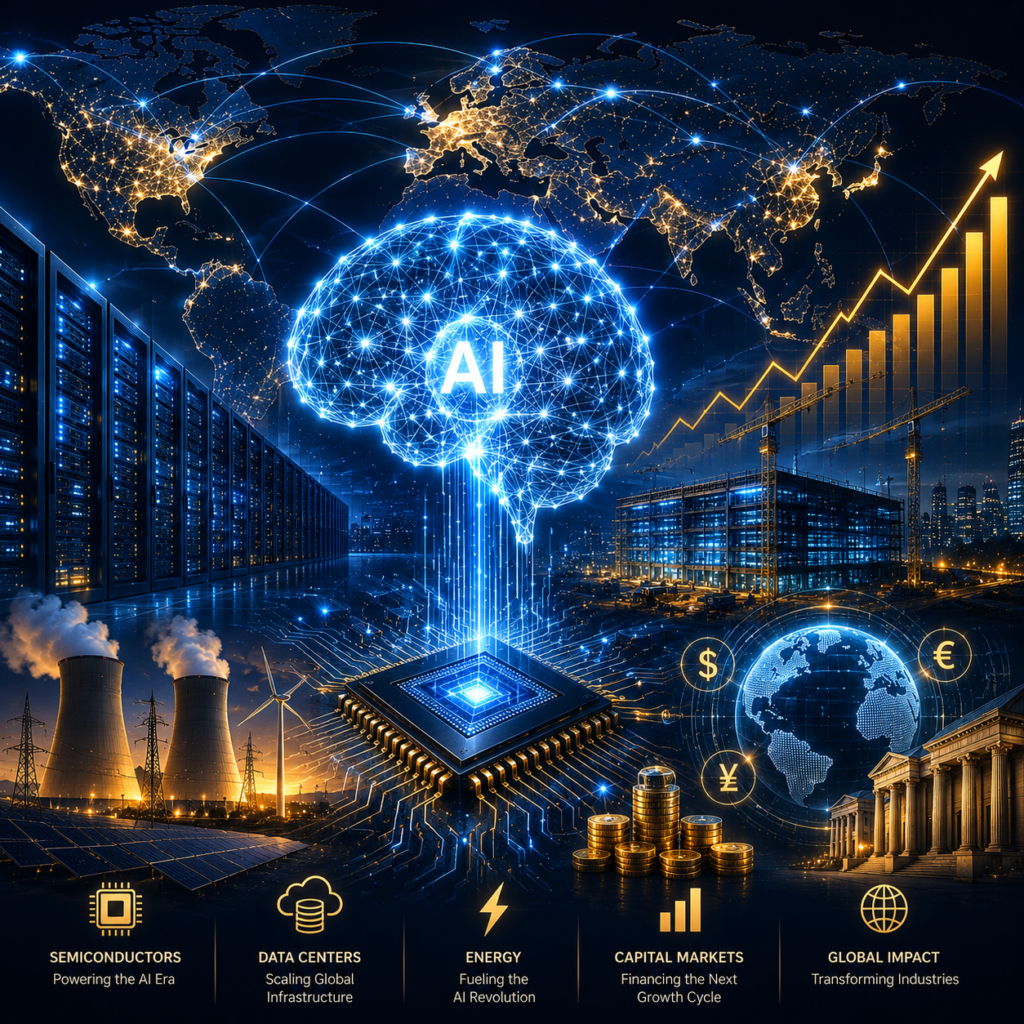
Today, the world’s largest technology companies are deploying unprecedented amounts of capital into:
• Data centres
• Semiconductors
• Cloud infrastructure
• Power generation
• Advanced computing capacity
Alphabet’s fundraising announcement confirms that AI has evolved beyond a technology story.
It is now a capital markets story.
And investors everywhere are being forced to pay attention.
The AI Arms Race Is Escalating
Alphabet’s fundraising comes as competition between major AI players intensifies.
The company plans to use the capital primarily to expand AI infrastructure and increase computing capacity after demand for its AI services exceeded available supply.
This highlights an increasingly important reality.
The AI race is no longer being won solely through better algorithms.
It is increasingly being won through infrastructure.
The winners will be the organisations capable of building:
• The largest data centres
• The most powerful computing clusters
• The strongest semiconductor supply chains
• The most resilient energy networks
This dramatically increases the importance of capital allocation.
AI leadership now requires massive financial resources.
Why Berkshire Hathaway’s Investment Matters
One of the most significant aspects of the deal is Berkshire Hathaway’s commitment to invest $10 billion in Alphabet through a private placement.
Institutional investors should not overlook the symbolism.
Berkshire Hathaway has historically been selective regarding technology investments.
Its willingness to commit such a large amount of capital sends a strong signal that sophisticated long-term investors increasingly view AI infrastructure as a durable investment opportunity rather than a speculative trend.
This matters because institutional capital often validates structural themes before they become fully appreciated by broader markets.
The investment also reflects growing confidence that AI demand will continue expanding for years rather than months.
AI Is Becoming an Infrastructure Story
One of the most misunderstood aspects of the current AI boom is that many investors still view it purely as a software revolution.
That perspective is becoming outdated.
Artificial intelligence requires enormous physical infrastructure.
Every AI query relies upon:
• Advanced processors
• Massive data centres
• Cooling systems
• Power generation
• High-capacity networking equipment
As a result, AI is creating investment opportunities across sectors that many investors do not immediately associate with technology.
Beneficiaries increasingly include:
• Utilities
• Industrial companies
• Engineering firms
• Data-centre operators
• Semiconductor manufacturers
• Infrastructure developers
This broadens the investment opportunity set considerably.
The AI boom is rapidly becoming one of the largest infrastructure buildouts in modern history.
Why Equity Markets Continue Rewarding AI Leaders
Despite concerns surrounding spending levels, investors continue rewarding companies perceived as AI leaders.
The reason is straightforward.
Markets increasingly believe AI can drive:
• Productivity growth
• Corporate efficiency
• New revenue streams
• Improved profitability
• Long-term economic expansion
This explains why many technology companies continue trading at premium valuations despite higher interest rates and tighter financial conditions.
Investors are effectively making a large macroeconomic bet.
They are betting that AI-generated productivity gains will eventually justify today’s enormous capital expenditures.
If that assumption proves correct, AI could become one of the most important growth drivers of the next decade.
However, that outcome is not guaranteed.
The Bond Market Is Becoming Part of the Story
Another major development is AI’s growing influence on debt markets.
Alphabet’s fundraising demonstrates that even the world’s largest companies are increasingly turning to capital markets to finance AI expansion.
Meanwhile, corporate debt issuance linked to AI infrastructure continues rising globally.
This creates several important implications:
• Higher corporate borrowing requirements
• Greater demand for infrastructure financing
• New opportunities within credit markets
• Increased institutional participation
AI is no longer influencing only stock valuations.
It is increasingly reshaping global capital markets.
That makes it relevant to every major institutional investor, regardless of asset class.
The Valuation Debate Is Intensifying
Not everyone is convinced current spending levels are sustainable.
Alphabet’s announcement triggered a decline in its share price as some investors expressed concerns about dilution and the scale of future investment requirements.
This raises an important question.
Can future profits justify today’s spending?
History shows that transformative technologies often experience periods of:
• Overinvestment
• Excessive optimism
• Capital misallocation
• Valuation corrections
The internet boom, railway expansion, and electrification all experienced similar phases.
The technology ultimately succeeded.
Many investors did not.
This is why distinguishing between genuine long-term beneficiaries and short-term speculation will become increasingly important.
AI’s Impact on Energy Markets
One of the least appreciated consequences of AI growth is its effect on global energy demand.
Advanced AI systems require enormous amounts of electricity.
As AI infrastructure expands globally, demand is increasing for:
• Power generation
• Grid infrastructure
• Energy storage
• Cooling technology
Many institutional investors are beginning to view energy infrastructure as an indirect AI investment.
This represents another reason why the investment opportunity extends well beyond traditional technology stocks.
The AI boom is becoming a technology story, an infrastructure story, and an energy story simultaneously.
What Investors Should Watch Next
The most important question is no longer whether AI matters.
That debate is over.
Instead, investors should focus on:
• Which companies possess the strongest infrastructure advantages?
• Which sectors benefit indirectly from AI expansion?
• Which businesses can generate sustainable returns on investment?
• Which valuations already price in unrealistic expectations?
The answers to those questions will likely determine investment winners and losers over the coming decade.
Conclusion
Alphabet’s $80 billion fundraising plan may ultimately be remembered as a defining moment in the AI investment cycle.
The announcement demonstrates that AI is evolving from a software revolution into a capital-intensive infrastructure race.
For investors, the implications are profound.
The beneficiaries are unlikely to be limited to technology companies alone.
Infrastructure providers, semiconductor manufacturers, energy suppliers, utilities, and capital-market participants may all benefit from the next phase of AI expansion.
Markets are no longer pricing artificial intelligence as a future possibility.
They are increasingly pricing it as an economic reality.