No spam - just the latest insights!
Join over 30,000 industry professionals who subscribe for free

Subscribe for free!
We'll never share your information or send you spam

Kumarakuru Jai has over 16 years of experience specialising in insolvency and restructuring. He has worked with clients from a vast array of industries including Transportation, Monorail, Oil and Gas, Property Development and Construction, Manufacturing, Resort and Hotel Management, Port Management, Revival of Abandoned Housing Developments, Plantation, Palm Oil Mill and several others.
His work includes various insolvency assignments comprising liquidation, receivership and advisory work for distressed companies. He has also managed many other assignments such as formulation of schemes of arrangement, debt restructuring, judicial management and has also been involved in monitoring accountant roles.
Kumarakuru Jai is a licensed Insolvency Practitioner from the Ministry of Finance Malaysia and Labuan Financial Services Authority. He is also a Chartered Global Management Accountant with the Association of International Certified Professional Accountants (CIMA) and a Chartered Accountant with the Malaysian Institute of Accountants (MIA). He has also acted as a special advisor for Bank Negara Malaysia in a matter related to Anti-Money Laundering, Anti-Terrorism Financing and Proceeds of Unlawful Activities Act 2001 (AMLA).

Patrick has more than 36 years of experience in Corporate Restructuring, Forensic Investigations, Transaction Advisory, Corporate Recovery, Litigation Support Services and Corporate Advisory. He is also a fellow of CPA Australia.
He rejoined Ferrier Hodgson since 2014 after completing three-year contract to open and build a new office for the KRyS Global Group in Hamilton, Bermuda as Managing Director. KRyS Global is a boutique firm dedicated to resolving complex cross border Insolvencies, Corporate Recovery Services and Fraud Investigations.
During Patrick’s initial contract with Ferrier Hodgson in Malaysia between 2005 to 2011, he held roles as lead partner for Investigation and Forensic assignments and Litigation Support Services. In addition, he has also acted as CFO and Company Secretary of several major publicly listed companies in Australia. He also has formal professional experience with two international accounting firms namely Deloitte and Ernst and Young.
He managed various insolvency assignments comprising liquidations, receiverships, Judicial Managements and Schemes of Arrangements and advisory work for financially distressed companies. Patrick is also experienced in conducting financial valuations on behalf of individual banks and syndicates.
In 2019 Patrick was appointed as Managing Partner of Baker Tilly Insolvency and Advisory formerly Ferrier Hodgson Malaysia. He continues in that role and leads what is now regarded as one of the largest insolvency and restructuring teams in Malaysia.
In 2022 Patrick was appointed as Chairman of the Baker Tilly Insolvency and Restructuring Committee for the Asia Pacific region (APAC) and continues in that role currently. The Asia Pacific Baker Tilly Network members comprise of 23 member firms across the region.

Recent trends and more effective measures for the management of insolvencies for corporate entities in Malaysia have developed in a positive direction over recent years in the form of restructuring and rehabilitation. The insolvency laws for companies in Malaysia have changed from that of a liquidation culture to that of a corporate rehabilitation framework culture under the governing legislative framework (i.e., Companies Act 2016 (“CA 2016”) and the Companies Winding Up Rules 1972). The earlier insolvency framework in Malaysia nurtured a liquidation culture with winding-up as the only viable option for insolvent companies and receivership culture reserved for secured creditors. The only available option to undertake a restructuring plan under the then Company’s Act 1965 were Schemes of Arrangement, however, it was limited to that of enabling companies to undergo a compromise of their debts with their creditors and in the event with their members; a compromise or arrangement regarding their shares.
The modern insolvency laws in Malaysia have recognised and acknowledged that not all insolvent companies should be liquidated unless they are no longer economically and commercially viable. As such, the adoption of the rehabilitation framework culture aims to protect the interests of all stakeholders, including that of the company’s creditors, company’s shareholders’ and the company itself, whilst providing a structured and transparent process administered by an independent Insolvency Practitioner for financially distressed companies to better facilitate their financial recovery. The rehabilitation framework available to corporate entities in Malaysia includes (i) Corporate Voluntary Arrangement (“CVA”); (ii) Judicial Management (“JM”); and (iii) Scheme of Arrangement (“SOA”).
The CVA framework allows for cash-strapped companies to work out an amicable arrangement with their unsecured creditors that includes the rescheduling of its debts with minimal court involvement and a requisite approval of seventy-five per centum (75%) of its creditors.
The company must aim to complete its restructuring arrangement within twenty-eight (28) to sixty (60) days during which a moratorium is granted.
An independent Insolvency Practitioner is required for the application to ensure the feasibility of the restructuring arrangement where there are reasonable prospects that the proposal put to the creditors in a formal meeting can be approved and implemented and there are sufficient funds available during the moratorium period.
However, the limitations provided under the CVA limbs pursuant to Section 395 of the CA 2016 attributes to the difficulty of implementation of a CVA by financially distressed companies. The foremost limitation of a CVA is that it is not applicable to public companies and companies that have created charges.
The number of reported CVA cases are depicted as
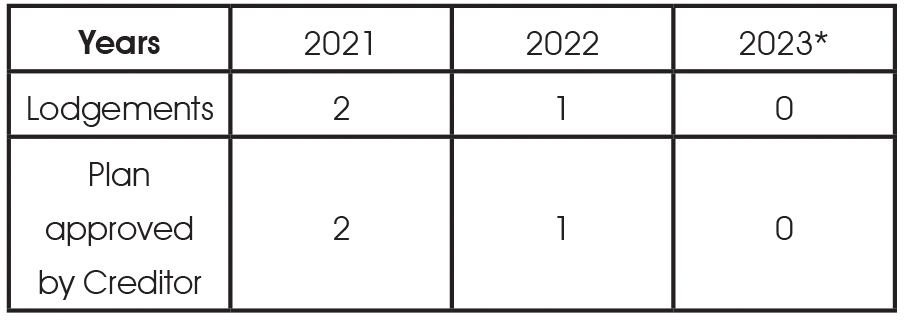
*Statistics reported as at 31 October 2023
Source: Companies Commission of Malaysia
JM is a framework available to financially distressed companies to carry out a holistic rehabilitation plan (including restructuring of business and debts) that will turnaround the business of the company and achieve any of the following pursuant to Section 405(b)(i) of the CA 2016:
(i) the survival of the company, or the whole or part of its undertaking as a going concern;
(ii) the approval under section 366 of a compromise or arrangement between the company and any such persons as are mentioned in that section; or
(iii) a more advantageous realisation of the company’s assets would be effected than on a winding up.
The JM framework provides for a wider scope of coverage for financially distressed companies in comparison to the CVA. A moratorium is in force from the time of application similar to a CVA until the end of the judicial management period however as opposed to a CVA, the tenure of appointment under the JM framework provides for an appointment for six (6) months and at the discretion of the Court, for a further six (6) months.
The number of reported JM cases are depicted as follows:
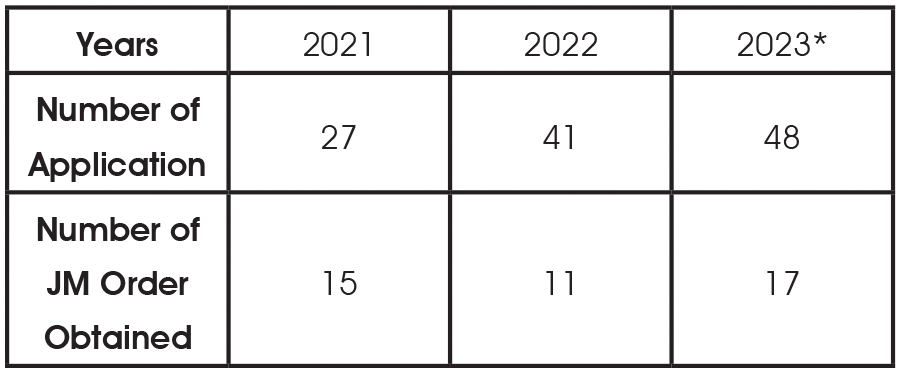
Source: Companies Commission of Malaysia
SOA under Section 366 of the CA 2016 is a debt compromise arrangement which can be undertaken by companies facing financial constraints and by solvent companies with the intention to restructure its business, reorganise its capital, debts, or corporate structure. The SOA framework here in Malaysia is often used to facilitate financial restructuring, mergers, acquisitions, or other significant changes within the company to facilitate the company as a going concern. It is a court-approved arrangement that requires class of members/creditors to obtain the requisite approval of seventy-five per centum (75%) at each class of members/creditors for the implementation of the proposed restructuring plan.
Unlike the other rehabilitation framework (i.e., CVA and JM) where an automatic moratorium is granted upon the filling of an application, companies whom opts to embark on a SOA framework is required to file an application at the Court to obtain a restraining order (similar to a moratorium) for a period of three (3) months and may be further extended up to nine (9) months upon meeting certain conditions subject to the Court’s discretion.
The number of reported SOA cases are depicted as follows:
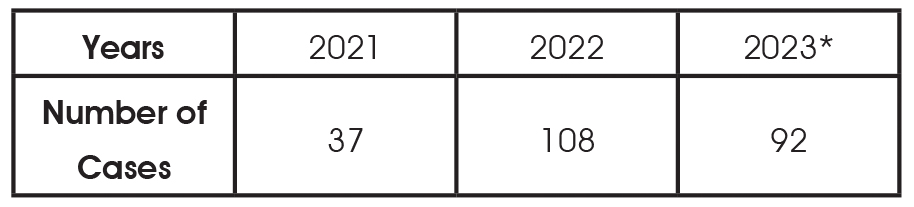
Source: Companies Commission of Malaysia
The three (3) key rehabilitation framework do provide a general corporate restructuring framework for financially distressed companies in Malaysia. However, it is noted that there are limitations that sets each mechanism apart.
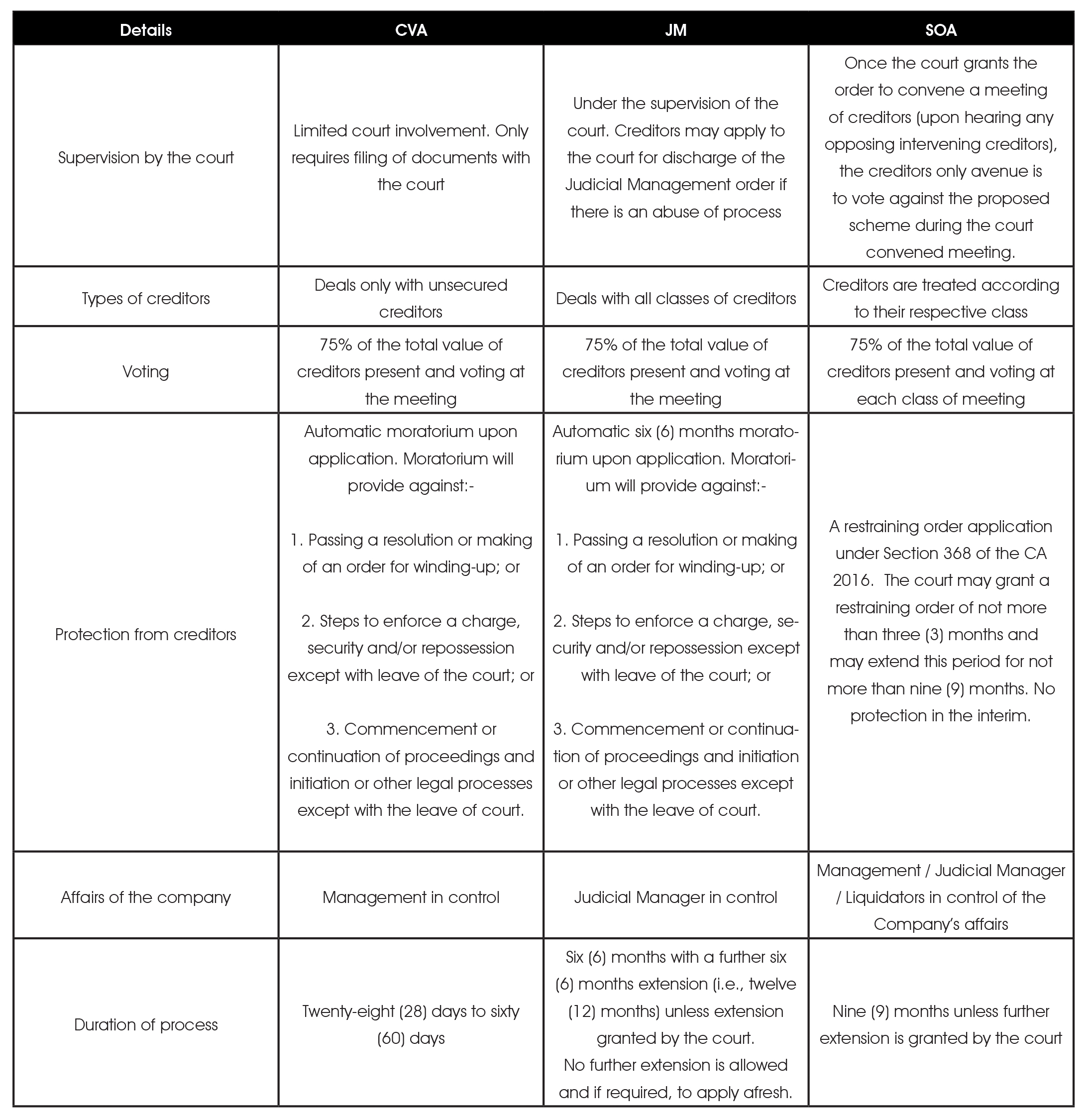
Notwithstanding the above, the usefulness of the CVA, JM and SOA framework as a rehabilitation framework for financially distressed companies are hampered by its limitations. As such, the Companies (Amendment) Bill 2023 (“Bill”) was passed by Dewan Rakyat and the Senate (Dewan Negara) on 28 November 2023 and 13 December 2023 and will be presented for Royal Assent and subsequently gazette into law. The proposed amendments aim to better align the rehabilitation framework with the current circumstances and surrounding insolvency outlook in Malaysia.
Two main amendments under the proposed Bill provides that CVA provisions shall include the following:
The proposed amendments aim to promote the utilisation of the CVA by all companies as opposed to the prior act which prohibited the use for companies with a secured charge and publicly listed companies. With these new amendments, we see a significant enhancement of the provisions in which financially distressed companies may be in a better position to promote out-of-court negotiations, which should be less costly and more time effective.
The amendment under the proposed Bill provides that the JM provisions shall include the following:
The proposed amendments aim to address several limitations faced by Insolvency Practitioners where there is a genuine proposal to restructure financially distressed companies where it can now be applied to more companies.
The amendments under the proposed Bill provides that the SOA provisions shall include the following:
The proposed amendments aim to enhance the overall Scheme of Arrangement by clarifying provisions on the moratorium, role of insolvency practitioners and introducing new provisions such as rescue financing and cram down provisions to facilitate financially distressed companies undertaking a restructuring via the SOA framework.
As seen from the proposed amendments to be introduced, the Bill aims to establish provisions to accord a more comprehensive framework at par with other foreign jurisdictions to ensure that the corporate rehabilitation framework can be used as a more effective rehabilitation tool for companies facing financial difficulties.
It is worth mentioning that reforms in foreign jurisdiction sets the reasonings for the proposed reforms over the restructuring and insolvency framework in Malaysia. This enables financially distressed companies to increasingly opt for CVA, JM and/or SOA to restructure their financial debts and obligations. The proposed reforms would be applicable across diverse industry segments including aviation, hospitality, retail, construction, oil and gas. The restructuring landscape in Malaysia is working towards aligning to the ever-changing domestic market dynamics and those of foreign jurisdictions. We at Baker Tilly Malaysia foresee a rise in insolvency related matters particularly in the hospitality, property and construction sectors. This new Bill will provide the necessary tools and flexibility to both companies in distress and Insolvency Practitioners to formulate arrangements and enter into compromises to restructure and eventually a return to profitability. In tandem, we are also likely to see these corporate rehabilitation frameworks being used in multiple manners and evolving further with landmark decisions under the Malaysian Courts.