



Filipinos: Key Partners that Fuel Economies
The Philippines and its citizens drive the global economy. A 3-month ban on deployment of nurses, caregivers and medical staff, engineers, accountants, hospitality personnel, sales and services associates, domestic staff, skilled workers, machine operators and seafarers, would have a global impact. It has never played this hand, as the Filipinos remain to be the most reliable, resilient, and loyal partners in the world stage.
The Philippine Statistics Authority (PSA) estimates the number of Overseas Filipino Workers (OFWs) in 2024 at 2.19 million, an increase of 1.5% from the previous year’s estimated number of 2.16 million.
The major occupation groups of OFWs, according to PSA, are managers, professionals, technicians and associate professionals, clerical support workers, services and sales workers, craft and related trade workers, plant and machine operators and assemblers, and elementary occupations.
OFWs could be further categorized into – Land-based workers and Sea-based workers. Land-based workers are overseas contract workers who are employed on land outside their home country and hired through direct employment, private recruitment agencies, or government assistance. Sea-based workers are individuals employed in any capacity on board a marine vessel, ship, or offshore installation navigating international waters.
It is important to highlight the different occupational groups and categories of OFWs, since to limit the discussions alone to the sea-based sector, will be a disservice to the other. Jointly, their remittances in 2024, amounted to $34.49 billion (P1.9 trillion), constituting some 7.4% of the Philippine GDP. It is universally agreed that OFW remittances is the oil that moves the machinery of the Philippine economy
Main Regulatory Body
The Department of Migrant Workers (DMW) is an agency of the government of the Philippines responsible for opening the benefits of the overseas employment program of the country. It is assigned to monitor and supervise overseas recruitment and manning agencies in the Philippines. All references to the Philippine Overseas Employment Administration (POEA) should now pertain to DMW. The DMW is the executive department of the Philippine government tasked to protect the rights and promote the welfare of OFWs. The department was created by virtue of the DMW Act or Republic Act 11641, which was signed into law on 30 December 2021 and took effect on 3 February 2022.
DMW now assumes and performs all the powers and functions of six merged agencies, namely: the POEA; the Office of the Undersecretary for Migrant Workers’ Affairs (OUMWA) of the Department of Foreign Affairs; the International Labor Affairs Bureau (ILAB) and all Philippine Overseas Labor Offices (POLO) under the Department of Labor and Employment (DOLE); the National Maritime Polytechnic (NMP); the National Reintegration Center for OFWs (NRC) under the OWWA, and the Office of the Social Welfare Attaché (OSWA) under the DSWD.11. See https://dmw.gov.ph/about-us/mandate.
Seafaring Tradition with Government Protection
The Philippines is one of the world’s largest suppliers of seafarers with around 578,600 deployed in 2024 according to DMW. Filipinos are involved in all segments of shipping, from passenger to cruise ships to tankers and cargo vessels.
There are 4 kinds of “seafarers” that the Philippines deploy to the world. Based on DMW data, majority of the 2024 deployment is categorized as “non-marine”, or individuals who work on ships but do not perform traditional seafaring jobs. They might be involved in specialized tasks such as medical services, entertainment, catering, or other non-maritime tasks. An example are hotel crew on cruise ships. This is followed by “ratings”, who are defined as non-officers performing various operational and support services on board a ship. These seafarers typically assist those in officer rankings in various areas, including the deck, engine, or catering. Finally, there are those who belong to the highly skilled “officers” category – seafarers bearing authority on a ship. These include the captain, chief engineer, and other senior officers who are responsible for the overall operation and management of the vessel. The latter are the elite mariners of the country and the most sought after.
The international importance of Filipino seafarers is a source of national pride. Their reputation for professionalism, adaptability, and unwavering commitment is legendary. As a valued stakeholder in international shipping, DMW and the government have flexed their muscles to ensure their welfare and protection through increased regulation, culminating in the passage of the Magna Carta of Filipino Seafarers (Republic Act 12021) in 2024 and its Implementing Rules and Regulations in 2025. These have been supported by numerous advisories by DMW urging stronger safety measures for Filipino seafarers in tagged warlike or high-risk areas (HRAs), a present-day threat, due to the ongoing conflicts in the world.
DMW has strictly enforced the right to refuse to sail and mandatory reporting of transits in HRAs for seafarers, coupled with heavy penalties of suspension for local manning agencies and de-accreditation for principals. They have gone as far as mandating support for next-of-kin of crews affected and/or attacked at these HRAs.
Establishing Local Manning Agencies (LMAs)
The recruitment and deployment of Filipino seafarers is a highly regulated industry. In addition to incorporating a Philippine corporation, an applicant must obtain a License to Operate (LTO) from the DMW before it may lawfully recruit or deploy Filipino seafarers.
Establishing a Philippine licensed manning agency involves more than incorporating a corporation or obtaining a government license. It requires careful planning, adequate capitalization, sound corporate governance, and a continuing commitment to regulatory compliance. By adopting an appropriate ownership structure, preparing the required documentation, and implementing effective internal controls from the outset, investors can significantly improve the efficiency of the licensing process and establish a strong foundation for long-term operations.
Philippine law limits foreign ownership in licensed manning agencies. At least 75% of the corporation’s outstanding capital stock must be owned by Filipino citizens, while foreign ownership is limited to 25%.
This ownership requirement must be maintained throughout the life of the corporation. Any subsequent transfer of shares that results in foreign ownership exceeding the allowable limit may affect the corporation’s eligibility to retain its DMW license.
Obtaining an LTO from the DMW is the most significant step in establishing a Philippine licensed manning agency. Unlike incorporation before the Securities and Exchange Commission, which creates the corporation as a legal entity, the DMW licensing process determines whether the corporation is qualified to recruit and deploy Filipino seafarers. Until the license is issued, the corporation may not engage in any recruitment, placement, advertisement, or deployment activities.
The DMW evaluates not only the corporation’s legal existence but also its financial capability, management team, office facilities, internal systems, and ability to comply with Philippine labor and maritime regulations.
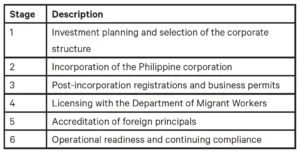
As a general overview, the process consists of the following stages:
The DMW requires supporting documents relating to the corporation, its shareholders, officers, finances and proposed operations. While the specific requirements may vary depending on the application, they generally fall into the following categories:
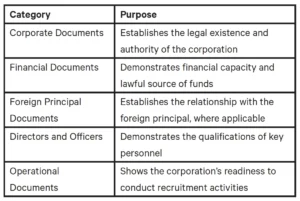
Applicants should allow sufficient time for authentication or apostille before filing because some documents originate outside the Philippines.
- Financial Capacity
One of the DMW’s primary considerations is whether the corporation has sufficient financial resources to operate responsibly and meet its obligations to seafarers and foreign principals.
Applicants should therefore be prepared to demonstrate that the corporation’s capitalization comes from legitimate sources and is intended to support actual business operations. Depending on the circumstances, the DMW may request additional documents to verify the source of investment funds.
Maintaining complete financial records from the outset will facilitate this review and reduce the likelihood of additional documentary requests.
- Evaluation Process
After the application is filed, the DMW conducts a comprehensive review of the corporation’s qualifications. This process generally includes:
- Documentary Evaluation – The DMW reviews the submitted documents for completeness, consistency, and compliance with applicable regulations.
- Panel Interview – The corporation’s key officers and shareholders may be interviewed to assess their understanding of the proposed business, management structure, financial capability, and compliance responsibilities.
- Office Inspection – The DMW verifies that the corporation maintains suitable office facilities, equipment, records management systems, and personnel necessary to operate a licensed manning agency.
The DMW may require clarifications or additional documents before acting on the application throughout the evaluation.
- Escrow Requirement
In addition to the required capitalization, every licensed manning agency must maintain the escrow deposit (P1,500,000) prescribed by the DMW.
The escrow serves as financial security for valid claims that may arise against the agency and is separate from the corporation’s working capital. It should therefore be treated as a continuing regulatory requirement rather than an ordinary operating expense.
Failure to maintain the required escrow may affect the corporation’s authority to continue operating.
- Provisional License
Once the DMW is satisfied that the corporation has complied with the applicable requirements, it may issue a Provisional License.
The Provisional License authorizes the corporation to begin recruitment operations subject to the conditions imposed by the DMW. During this period, the corporation is expected to demonstrate that it can operate responsibly, comply with regulatory requirements, and protect the welfare of Filipino seafarers.
The corporation should therefore maintain complete records, comply with reportorial requirements, and promptly address any issues identified by the DMW.
The most important requirement for a provisional license is the “virgin/virgin” rule. The LMA must have a new principal, which has been defined under the 2026 Seabased Rules of DMW as:
A “new” principal/employer is defined as one that has never been registered or accredited to any LMA; provided that, its new vessels: (1) have never been enrolled to any LMA; (2Justice Leonen, Sameer Overseas Placement Agency, Inc. vs. Joy Cabiles, Supreme Court G.R. No. 170139, 5 August 2014) if enrolled, should not be in the active list of enrolled vessels for the past twelve (12) months or more; or (3) if enrolled, there has been no prior Filipino seafarer deployment.
- Upgrading to a Regular License
Before the expiration of the Provisional License (3 months), the agency should apply for a Regular License in accordance with the applicable DMW procedures.
In evaluating the application, the DMW may consider the agency’s compliance history, financial standing, operational performance, and observance of regulatory requirements during the provisional period.
A well-organized compliance program and complete corporate records will help facilitate the upgrading process.
The main requirements for upgrading of Provisional License to Full License are:
- Deployment of seventy-five (75) seafarers;
- Quality Management System (QMS) manual, defining the scope of the agency’s quality management system that includes the quality policy and objectives, organizational structure and management responsibilities, and documented recruitment and deployment processes;
- Updated bank certificate stating an escrow deposit of P1,500,000;
- Certificate of no pending case or any substantiated adverse report during the validity of the provisional license from Adjudication Office;
- Certificate of attendance to the Continuing Agency Education Program (CAEP) of all its officers and operation staff involved in the recruitment and placement of workers/seafarers, and Heads of Administration or Accounting Department;
- Valid Certificate of Compliance with general labor standards and valid Certificate of Compliance with occupational safety and health standards; and
- Latest audited financial statement.
EPEEQ Law as Legal Correspondents for Protection and Indemnity Clubs and Related Manning Activities for Shipowners and Agencies
EPEEQ Law is one of the few firms that is at the center of deployment of seafarers from pre-employment, on-boarding, stint at sea, repatriation, and end-of-contract or on shore leave.
The legal solutions provided by the firm is seen in the entire ecosystem of seafarer employment as follows:
- Manning Agencies
- Setting up new manning agencies and assistance on provisional license applications
- Coordination, regulatory, and compliances with DMW affecting recruitment licenses of agencies for those who have full license
- Accreditation of Principals, Directors, Stockholders, Change of Management, and/or significant actions of the company
- Shipowners/Shipmanagement Companies/Principals
- Advisory and Opinion – Pre-claims
- Brewing claims but before actual arbitration – Negotiations, Settlements, etc.
- Actual Dispute – Arbitration, Litigation, and the like
- Ancillary services related to the above
- Assistance to Philippine Nationals (Seafarers) who are detained in a foreign jurisdiction
- Actual Mergers and Acquisition and investment in an agency
We agree that OFWs, specially Filipino seafarers, are “our true diplomats, they who show the world the resilience, patience, and creativity of our people. Indeed, we are a people who contribute much to the provision of material creations of this world.”2 But, this must also be harmonized with management prerogative or the equal right of principals and employers to manage their business affairs. This delicate dance between the two, is at the heart of the Philippines dual aim or problem – management of workers abroad, and tighter regulations.